
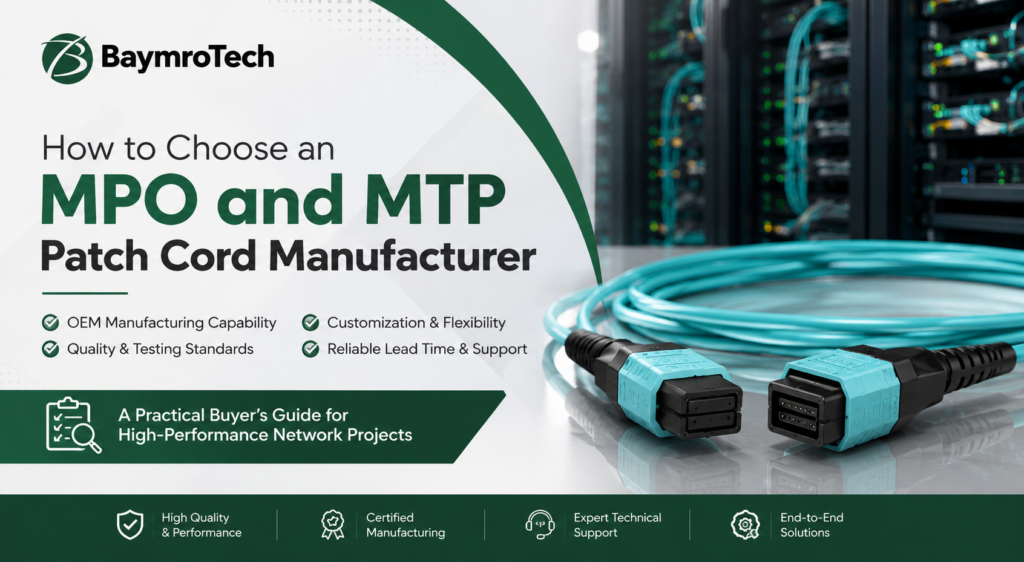
Introduction
Modern data centers, telecom networks, and enterprise communication systems demand faster data transmission, higher bandwidth, and reliable connectivity. As network density continues to increase, procurement teams face growing pressure to source high quality MPO and MTP patch cords that support long term performance while keeping projects on schedule and within budget.
Selecting the wrong manufacturer can create serious challenges. Poor manufacturing quality may lead to higher insertion loss, unstable network performance, inconsistent product specifications, and unexpected maintenance costs. Delayed deliveries can disrupt project timelines, while inadequate quality control increases the risk of failures after installation. Over time, these issues raise the total cost of ownership and affect customer satisfaction.
For procurement managers, system integrators, telecom operators, and engineering contractors, choosing an MPO and MTP patch cord manufacturer is not simply about comparing prices. It is a strategic sourcing decision that directly impacts project quality, operational efficiency, and future scalability.
This guide explains the key factors buyers should evaluate before selecting a manufacturer and highlights how a trusted engineering focused supplier like BaymroTech can help businesses reduce procurement risks while supporting complex network infrastructure projects.
What Is an MPO and MTP Patch Cord Manufacturer?
An MPO and MTP patch cord manufacturer designs and produces high density fiber optic patch cords used to connect network equipment in high speed communication environments.
MPO, or Multi Fiber Push On, is a standardized multi fiber connector capable of supporting multiple optical fibers within a single connector. MTP is an enhanced version of the MPO connector that offers improved mechanical performance, tighter tolerances, and better optical characteristics.
A professional manufacturer is responsible for far more than assembling connectors. Their role includes:
- Precision fiber termination
- Connector polishing
- Optical performance testing
- Quality inspection
- Compliance with international standards
- Product customization for different network architectures
For B2B buyers, selecting the right manufacturer ensures consistent performance across large deployments while simplifying procurement and installation.
Applications and Industry Use Cases
MPO and MTP patch cords are widely used in environments where high fiber density, fast deployment, and scalable infrastructure are essential.
Data Centers
Modern hyperscale and enterprise data centers rely on MPO and MTP connectivity to support high bandwidth switching, structured cabling, and efficient rack management.
Benefits include:
- High density cable management
- Faster installation
- Simplified upgrades
- Reduced cable congestion
Telecommunications Networks
Telecom operators deploy MPO and MTP patch cords in backbone infrastructure, central offices, and fiber distribution systems to support growing network traffic.
These products help improve:
- Network scalability
- Signal stability
- Maintenance efficiency
- Space utilization
Cloud Computing Infrastructure
Cloud service providers require reliable fiber connectivity between servers, storage devices, and switching equipment.
MPO and MTP patch cords allow rapid deployment while maintaining excellent optical performance across complex network architectures.
Enterprise Networks
Large corporate campuses, financial institutions, healthcare facilities, and educational organizations increasingly use MPO based structured cabling to support expanding digital infrastructure.
Industrial Communication Systems
Manufacturing plants and industrial automation environments require reliable optical communication that supports high speed data transmission with minimal downtime.
Properly manufactured MPO and MTP patch cords improve operational reliability in demanding environments.
High Performance Computing
Research laboratories, artificial intelligence infrastructure, and supercomputing facilities require extremely high bandwidth connections that support massive data processing.
MPO technology enables efficient communication between computing clusters while minimizing cable complexity.
Different projects require different connector types, fiber counts, cable jackets, environmental ratings, certification requirements, and installation methods. Some deployments prioritize ultra low insertion loss, while others require customized cable lengths, polarity configurations, or ruggedized designs for challenging environments. Because every application has unique technical and procurement requirements, evaluating a manufacturer’s engineering capability and customization expertise becomes a critical part of supplier selection.
Buyer Decision Factors When Selecting an MPO and MTP Patch Cord Manufacturer
For procurement professionals, evaluating a supplier requires much more than reviewing product specifications. A reliable manufacturing partner contributes to project success through engineering expertise, production consistency, quality assurance, and dependable delivery performance.
OEM Manufacturing Capability
OEM capability is one of the most important factors when selecting a manufacturer.
An experienced OEM manufacturer can:
- Produce products according to customer specifications
- Support private labeling
- Modify designs for unique applications
- Maintain consistent quality across production batches
OEM capability becomes particularly valuable for system integrators managing multiple large scale infrastructure projects.
BaymroTech supports OEM manufacturing services designed to meet the specific technical and branding requirements of global B2B customers.
Customization Options
Every network project has different installation requirements.
A capable manufacturer should provide customization for:
- Cable length
- Connector type
- Fiber count
- Fiber mode
- Cable color
- Polarity configuration
- Jacket material
- Packaging requirements
- Product labeling
Customization reduces installation complexity while improving deployment efficiency.
Minimum Order Quantity Requirements
MOQ directly influences purchasing flexibility.
Projects often begin with prototype orders before moving into volume production. Manufacturers with reasonable MOQ policies make it easier for buyers to validate product quality before committing to larger purchases.
Procurement teams should clearly understand:
- Sample order availability
- Prototype support
- Volume pricing
- Long term supply capability
Lead Time Stability
Consistent lead times help contractors maintain project schedules.
Late deliveries can delay installation, increase labor costs, and affect contractual commitments.
Ask manufacturers about:
- Standard production lead times
- Emergency production capability
- Inventory management
- Supply planning
- On time delivery performance
Reliable scheduling often reflects a mature manufacturing operation.
Product Certifications
International certifications demonstrate compliance with recognized quality and safety standards.
Depending on project requirements, buyers should request documentation related to applicable industry certifications and product compliance.
Certified products provide greater confidence during supplier evaluation and customer audits.
Testing Reports
Every shipment should be supported by comprehensive testing documentation.
Typical reports include:
- Insertion loss testing
- Return loss testing
- End face inspection
- Polarity verification
- Visual inspection
- Performance validation
Complete testing records improve procurement transparency while reducing project risks.
Quality Control Procedures
Consistent quality control separates professional manufacturers from trading companies.
An effective quality management process includes:
- Incoming material inspection
- Production monitoring
- Connector polishing verification
- Optical testing
- Final inspection
- Packaging inspection
These procedures help ensure every patch cord performs consistently after deployment.
Technical Support Capability
Engineering support becomes increasingly important during complex infrastructure projects.
Manufacturers should be able to assist with:
- Product selection
- Network design recommendations
- Connector compatibility
- Installation guidance
- Troubleshooting
- Custom project consultation
Strong technical support reduces procurement uncertainty and improves project outcomes.
Production Capacity
Large infrastructure deployments require manufacturers capable of handling consistent production volumes without sacrificing quality.
Buyers should evaluate:
- Factory size
- Production equipment
- Workforce capability
- Monthly output
- Scalability for future demand
Production capacity becomes especially important for multi phase telecom and data center projects.
Supply Chain Reliability
Reliable suppliers maintain stable relationships with raw material providers and logistics partners.
A resilient supply chain helps minimize disruptions caused by component shortages or transportation delays, ensuring projects remain on schedule.
Project References
Past project experience provides valuable insight into a manufacturer’s reliability.
Ask potential suppliers about:
- Telecom deployments
- Data center projects
- International customers
- Long term partnerships
- Industry experience
Strong project references demonstrate the ability to meet demanding technical and commercial requirements.
Procurement Risks and Common Supplier Selection Mistakes
Selecting an MPO and MTP patch cord manufacturer without a structured evaluation process can lead to unexpected costs and operational challenges. While pricing is an important consideration, overlooking key procurement factors often results in delays, quality issues, and reduced network performance.
Below are some of the most common supplier selection mistakes and how they impact projects.
Choosing a Supplier Without OEM Capability
Some suppliers act only as trading companies and have limited control over production. This can make it difficult to request custom cable assemblies, private labeling, or project specific modifications.
Without OEM capability, buyers may face:
- Limited customization options
- Inconsistent product specifications
- Longer communication chains
- Reduced flexibility for future projects
Working directly with an OEM manufacturer helps ensure better production control, consistent quality, and faster technical support.
Ignoring Testing Reports
Optical performance should never be assumed.
If a supplier cannot provide complete testing reports, buyers have no reliable way to verify insertion loss, return loss, connector quality, or overall product performance.
Missing test reports may lead to:
- Network instability
- Difficult troubleshooting
- Higher maintenance costs
- Increased risk of installation failures
Always request testing documentation before approving production shipments.
Overlooking Customization Support
Every network infrastructure project has unique requirements. Standard products may not always fit the installation environment.
A manufacturer without customization capability may be unable to provide:
- Custom cable lengths
- Specific connector configurations
- Polarity options
- Color coding
- Special packaging
- Customer branding
Lack of flexibility can increase installation time and create unnecessary project complexity.
Accepting Unstable Lead Times
Late deliveries often have a ripple effect throughout an entire project.
Unstable production schedules may result in:
- Delayed site installation
- Increased labor expenses
- Missed project milestones
- Customer dissatisfaction
Reliable manufacturers maintain organized production planning and communicate realistic lead times throughout the procurement process.
Choosing Suppliers with Limited Technical Support
Procurement does not end after the purchase order is issued.
During installation or network expansion, engineering teams may require assistance with product selection, compatibility, or troubleshooting.
Suppliers with weak technical support can slow project progress and increase operational risks.
Ignoring Quality Control Systems
Quality control is one of the strongest indicators of manufacturing reliability.
Suppliers with inconsistent inspection procedures may deliver products with varying optical performance between production batches.
This inconsistency can create:
- Higher failure rates
- More replacement costs
- Longer maintenance cycles
- Reduced customer confidence
Evaluating quality management procedures before placing an order helps minimize these risks.
Procurement Checklist for MPO and MTP Patch Cord Buyers
The following checklist can help procurement teams compare suppliers more effectively before making a purchasing decision.
| Evaluation Criteria | Why It Matters | Verified |
| OEM manufacturing capability | Supports customization and production consistency | ✓ |
| Minimum Order Quantity (MOQ) | Matches project purchasing requirements | ✓ |
| Stable lead time | Helps maintain project schedules | ✓ |
| Product certifications | Demonstrates compliance with industry standards | ✓ |
| Optical testing reports | Confirms product performance and quality | ✓ |
| Customization options | Supports project specific requirements | ✓ |
| Technical support | Assists with installation and troubleshooting | ✓ |
| Quality control process | Ensures consistent manufacturing quality | ✓ |
| Project references | Demonstrates proven industry experience | ✓ |
| Supply chain stability | Reduces procurement and delivery risks | ✓ |
Using a structured checklist allows procurement managers to evaluate suppliers objectively instead of relying solely on pricing.
Why Choose BaymroTech for MPO and MTP Patch Cord Solutions?
Choosing the right supplier is about more than purchasing a product. It is about building a long term partnership with a manufacturer that understands engineering requirements, procurement priorities, and project delivery expectations.
BaymroTech supports global telecom operators, system integrators, engineering contractors, and infrastructure developers with high quality MPO and MTP connectivity solutions designed for demanding network environments.
BaymroTech offers:
- OEM and private label manufacturing services
- Flexible product customization
- Multiple connector and fiber configuration options
- Strict quality control throughout production
- Comprehensive optical testing before shipment
- Professional engineering support
- Stable production capacity for large volume orders
- Reliable global supply chain management
- Responsive communication throughout the procurement process
Instead of offering a one size fits all solution, BaymroTech works closely with customers to understand project specifications, deployment environments, and long term procurement goals. This collaborative approach helps reduce sourcing risks while improving installation efficiency.
Whether your project involves telecom infrastructure, enterprise networking, hyperscale data centers, or cloud computing facilities, partnering with an experienced manufacturer can simplify procurement and improve overall project success.
Frequently Asked Questions
What is an MPO and MTP patch cord?
An MPO and MTP patch cord is a high density fiber optic cable assembly that connects multiple optical fibers through a single connector, enabling high speed data transmission and efficient cable management.
Why are MPO and MTP patch cords widely used in telecom projects?
They support high bandwidth, reduce cable congestion, simplify installation, and allow network infrastructure to scale more efficiently.
Can MPO and MTP patch cords be customized?
Yes. Many OEM manufacturers, including BaymroTech, can customize cable length, connector type, fiber count, polarity, jacket material, labeling, and packaging according to project requirements.
What certifications should buyers request?
Buyers should request applicable product certifications, compliance documents, and optical testing reports that demonstrate quality and performance according to project specifications.
What is the typical lead time for production?
Lead times vary depending on order quantity, customization requirements, and production schedules. Buyers should confirm lead times before placing an order and verify the supplier’s ability to maintain consistent delivery.
How can buyers verify a supplier’s quality?
Review quality control procedures, request insertion loss and return loss test reports, examine certifications, evaluate project references, and ask for production samples whenever possible.
Why is OEM capability important?
OEM capability allows manufacturers to produce customized products, maintain better production control, support branding requirements, and deliver solutions tailored to specific network projects.
What should procurement teams evaluate besides pricing?
Buyers should assess manufacturing capability, technical expertise, quality control, customization support, certifications, production capacity, lead time stability, and supply chain reliability to make informed sourcing decisions.
Request a Customized RFQ for Your Next Project
Every network deployment has unique technical and commercial requirements. Before selecting a supplier, discuss your project specifications with an experienced engineering team.
BaymroTech can help you evaluate:
- OEM manufacturing requirements
- Custom cable configurations
- Project specific customization
- MOQ planning
- Production lead times
- Optical performance requirements
- Packaging and labeling options
- Long term supply strategies
Whether you are sourcing for a telecom expansion, enterprise network upgrade, cloud infrastructure project, or large scale data center deployment, early supplier collaboration can improve procurement efficiency and reduce project risks.
Contact the BaymroTech team today to discuss your project requirements and request a customized quotation tailored to your business needs.
Final Thoughts
Choosing an MPO and MTP patch cord manufacturer is a strategic procurement decision that affects network reliability, installation efficiency, maintenance costs, and long term project success. By evaluating factors such as OEM capability, quality control, testing standards, customization options, lead time stability, and technical expertise, buyers can confidently select a manufacturing partner that delivers consistent value beyond the initial purchase.
With its engineering focused approach, OEM manufacturing capabilities, rigorous quality management, and commitment to customer success, BaymroTech is well positioned to support businesses seeking dependable fiber optic connectivity solutions for complex network infrastructure projects.
Ready to Simplify Your Supplier Evaluation?
Looking for a trusted OEM manufacturing partner for your next telecom or data center project? Contact BaymroTech today to discuss your customization requirements, compare supplier capabilities, and request a competitive RFQ that helps your project move forward with confidence.



1 Comment
[…] Polarity is one of the most important technical considerations when purchasing an MPO MTP patch cord. […]