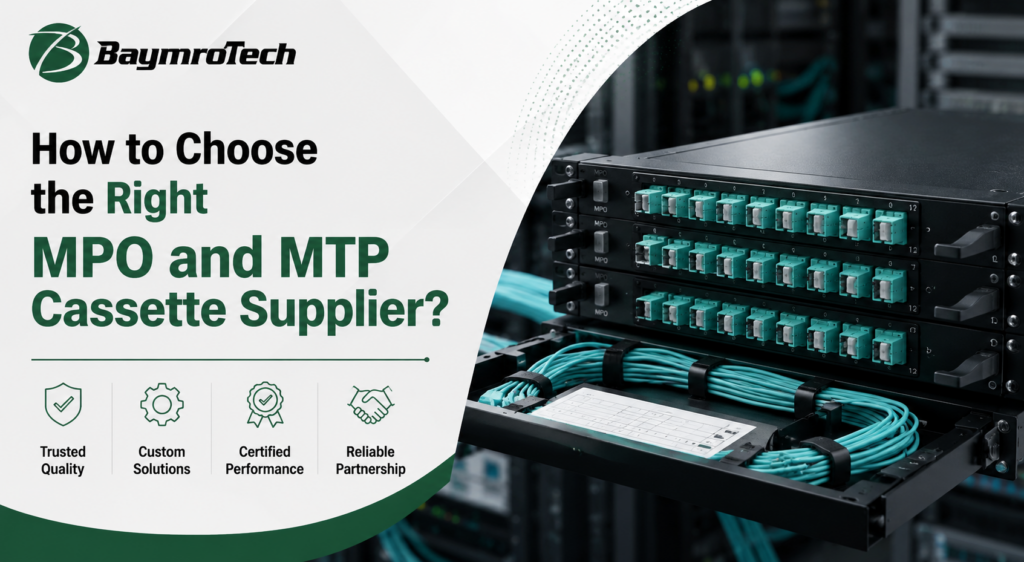
Modern telecom and data center projects demand more than just high performance networking equipment. Procurement teams are expected to deliver reliable infrastructure while controlling costs, meeting strict project timelines, and ensuring long term network stability. In this environment, choosing the right MPO and MTP cassette supplier is a strategic decision that can significantly influence project success.
Selecting the wrong supplier often results in inconsistent product quality, delayed deliveries, compatibility issues, limited customization, and higher maintenance costs over the lifecycle of the network. Even if the initial purchase price appears attractive, poor manufacturing standards and unreliable supply chains can increase the total cost of ownership and create unnecessary project risks.
For telecom operators, system integrators, engineering contractors, infrastructure developers, procurement managers, and technical sourcing teams, supplier evaluation should go beyond price comparison. Factors such as manufacturing capability, quality assurance, technical expertise, certifications, and supply chain reliability play a critical role in ensuring smooth deployment and long term network performance.
This guide explains what an MPO and MTP cassette supplier does, where these solutions are used, and how buyers can confidently evaluate suppliers before making procurement decisions.
What Is an MPO and MTP Cassette Supplier?
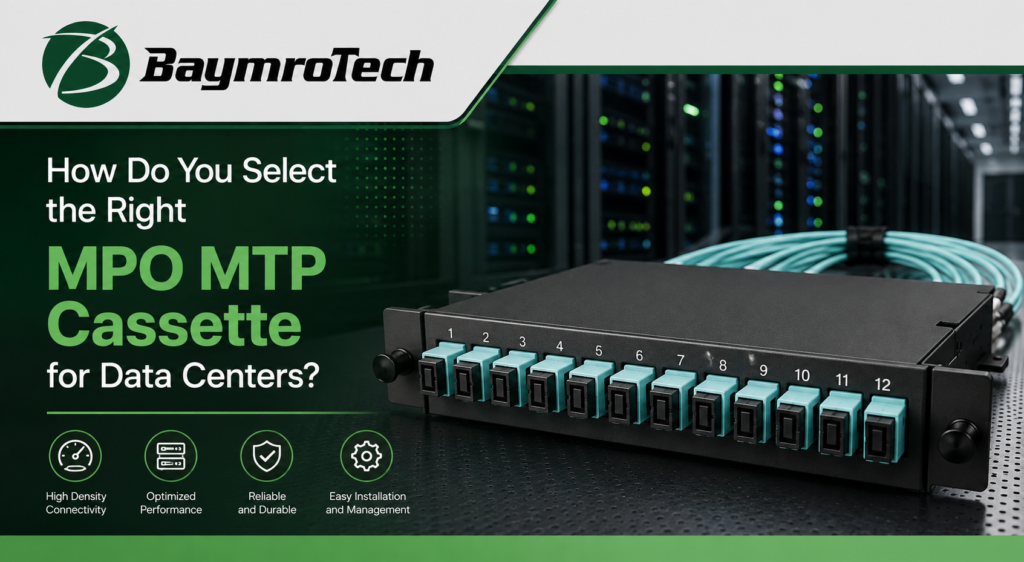
An MPO and MTP cassette supplier manufactures and supplies pre terminated fiber optic cassette modules that simplify high density fiber connectivity in structured cabling systems. These cassettes convert multi fiber MPO or MTP connectors into standard LC or SC interfaces, allowing efficient fiber distribution while reducing installation complexity.
These solutions are commonly deployed in:
- Data centers
- FTTH infrastructure
- Enterprise networks
- Cloud computing facilities
- Telecom backbone networks
- Campus networking
- Industrial communication systems
Rather than terminating dozens of fiber connections individually on site, installers can deploy pre tested cassettes that improve installation speed, reduce labor costs, and minimize the risk of human error.
For B2B buyers, the value of a supplier lies not only in product availability but also in the ability to deliver customized solutions, maintain consistent quality, and support complex infrastructure requirements.
BaymroTech offers a comprehensive range of MPO and MTP solutions designed for high density optical networks, helping engineering teams deploy scalable and reliable fiber connectivity across diverse applications.
Applications and Industry Use Cases
MPO and MTP cassettes are widely used in projects where space efficiency, rapid deployment, and network scalability are essential. Their modular design allows organizations to expand fiber infrastructure without extensive reconfiguration.
Data Centers
Modern data centers require thousands of fiber connections within limited rack space. MPO and MTP cassettes enable organized cable management while supporting high bandwidth communication between servers, storage devices, and switching equipment.
The pre terminated design reduces installation time and improves maintenance efficiency, making them a preferred solution for large scale data center deployments.
Telecommunications Networks
Telecom operators rely on MPO and MTP cassette solutions to support backbone transmission networks, metro fiber infrastructure, and access networks. High fiber density and low insertion loss help maintain stable signal performance while simplifying future network expansion.
Reliable cassette suppliers can also provide customized configurations for specific telecom standards and deployment requirements.
Enterprise Network Infrastructure
Large office buildings, university campuses, hospitals, and government facilities require structured cabling systems capable of supporting growing bandwidth demands.
MPO and MTP cassettes improve cable organization, simplify maintenance, and reduce installation complexity across enterprise environments.
Cloud Computing Facilities
Cloud service providers continue expanding their infrastructure to support increasing workloads and data traffic. High density fiber management solutions enable rapid equipment upgrades without significant network disruption.
Modular cassette systems also reduce downtime during maintenance or future expansion projects.
Industrial Communication Networks
Industrial automation environments often require dependable fiber connectivity capable of operating under challenging conditions. High quality cassette solutions help maintain stable communication between production equipment, monitoring systems, and control centers.
Depending on the project, suppliers may also provide specialized materials or enclosure designs suitable for industrial environments.
FTTH and Broadband Infrastructure
Fiber to the Home projects demand efficient fiber distribution that supports fast deployment across residential and commercial developments. MPO and MTP cassettes simplify fiber management inside distribution cabinets while improving installation consistency across large rollout projects.
Every infrastructure project has unique technical requirements. Some applications demand higher fiber counts, while others require specific environmental ratings, compliance certifications, connector configurations, or customized labeling. Large telecom projects may also require private labeling, specialized packaging, or project specific documentation.
Because these requirements vary significantly from one deployment to another, evaluating a supplier’s engineering capability, manufacturing flexibility, and customization support becomes just as important as comparing product prices.
Buyer Decision Factors When Choosing an MPO and MTP Cassette Supplier
Selecting a supplier should involve a structured procurement evaluation rather than focusing only on cost. A reliable supplier contributes to project efficiency, minimizes operational risks, and supports future network expansion.
1. OEM Manufacturing Capability
One of the first questions procurement teams should ask is whether the supplier is an actual OEM manufacturer or simply a trading company.
OEM manufacturers typically have greater control over:
- Product design
- Material selection
- Manufacturing processes
- Production scheduling
- Quality assurance
- Product customization
Working directly with an OEM often results in better communication, faster engineering support, and more consistent product quality throughout the project lifecycle.
BaymroTech operates as an engineering focused OEM manufacturer, enabling customers to source customized MPO and MTP cassette solutions that align with project specifications instead of relying solely on standard catalog products.
2. Customization Options
Every network deployment is different. Procurement teams frequently require products tailored to specific technical and operational requirements.
A capable supplier should be able to provide customization such as:
- Connector types
- Fiber counts
- Fiber polarity
- Housing materials
- Rack compatibility
- Port labeling
- Cable lengths
- Color coding
- Private labeling
- Custom packaging
Customization reduces installation errors, improves inventory management, and ensures compatibility with existing infrastructure.
Suppliers with strong engineering capabilities can also recommend optimized configurations that improve deployment efficiency and simplify future maintenance.
3. Minimum Order Quantity Requirements
Minimum Order Quantity, commonly known as MOQ, can significantly impact procurement planning.
Some suppliers only accept large production orders, making them less suitable for pilot projects or phased deployments. Others offer flexible MOQ options that allow buyers to validate products before committing to large scale procurement.
Understanding MOQ requirements helps procurement teams:
- Plan budgets more accurately
- Reduce inventory costs
- Minimize procurement risks
- Support gradual project expansion
- Improve cash flow management
Flexible MOQ policies can be particularly valuable for system integrators managing multiple customer projects with varying demand levels.
4. Lead Time Stability
Consistent lead times are often more valuable than simply having the shortest delivery schedule.
Delayed shipments can interrupt construction schedules, postpone network commissioning, increase labor costs, and create contractual challenges between contractors and project owners.
When evaluating suppliers, buyers should ask questions such as:
- How stable are production schedules?
- Are raw material inventories maintained?
- Can urgent orders be accommodated?
- Is production capacity sufficient for large projects?
- How are unexpected demand fluctuations managed?
Suppliers with well established manufacturing processes and reliable supply chain management are generally better positioned to deliver consistent lead times across long term projects.
5. Product Certifications
Product certifications provide buyers with greater confidence that components meet recognized industry standards for quality, safety, and performance.
Reputable suppliers should be able to provide relevant certifications and compliance documentation upon request. These documents not only support quality assurance but also simplify project approvals, customer audits, and regulatory compliance.
For international infrastructure projects, certification availability can become a key factor during supplier qualification and tender evaluation.
6. Testing Reports
Testing reports are essential for verifying that MPO and MTP cassettes meet the required optical and mechanical performance standards before deployment. Procurement teams should never assume that all products are tested to the same level. Requesting documented test results helps reduce uncertainty and supports informed purchasing decisions.
A reliable supplier should be able to provide reports such as:
- Insertion loss test reports
- Return loss test reports
- Polarity verification
- Fiber continuity testing
- End face inspection reports
- Factory acceptance test documentation
These reports help buyers confirm that the products have been inspected before shipment, reducing the likelihood of installation issues and costly rework.
7. Quality Control Procedures
Strong quality control is one of the biggest differentiators between dependable manufacturers and inconsistent suppliers.
A supplier with a structured quality management process typically performs inspections at multiple production stages, including incoming material checks, in process inspections, finished product testing, and final packaging verification.
Questions buyers should ask include:
- Are raw materials inspected before production?
- Are all cassettes individually tested?
- Are production records traceable?
- How are defective products handled?
- Is there a documented quality management system?
Consistent quality control helps ensure every shipment performs as expected, even across large volume orders.
8. Technical Support Capability
Procurement does not end once the products are delivered. During installation or future upgrades, technical questions often arise regarding compatibility, polarity, cable routing, or deployment best practices.
A supplier with experienced engineering support can assist with:
- Product selection
- Network design recommendations
- Installation guidance
- Technical documentation
- Troubleshooting support
- Project specific configuration advice
Responsive technical support minimizes downtime and helps contractors complete installations more efficiently.
9. Production Capacity
Large infrastructure projects often require thousands of components delivered within strict timelines.
Before placing an order, buyers should evaluate whether the supplier has sufficient production capacity to handle both current and future requirements.
Consider factors such as:
- Manufacturing scale
- Production equipment
- Skilled workforce
- Monthly production output
- Ability to support repeat orders
Suppliers with scalable production capabilities are better prepared to support long term partnerships and expanding infrastructure projects.
10. Supply Chain Reliability
A stable supply chain helps ensure that projects continue without unexpected delays caused by material shortages or logistics disruptions.
Reliable suppliers typically maintain strong relationships with raw material vendors, implement inventory planning, and monitor production schedules to reduce risks.
For procurement teams managing multi phase deployments, supply chain stability is just as important as product quality.
11. Project References
Past project experience demonstrates a supplier’s ability to deliver successfully across different industries and project sizes.
Request examples of previous deployments involving:
- Telecom operators
- Data centers
- Enterprise networks
- FTTH infrastructure
- Government projects
- Industrial facilities
Strong project references indicate that the supplier understands the technical and logistical challenges associated with complex network deployments.
Procurement Risks and Common Supplier Selection Mistakes
Many procurement challenges can be traced back to supplier selection decisions made early in a project. Avoiding common mistakes can save significant time, cost, and operational disruption.
Choosing a Supplier Without OEM Capability
Trading companies may have limited control over production, making it more difficult to guarantee consistent quality, customization, or delivery schedules.
Accepting Products Without Test Reports
Without documented testing, buyers cannot verify whether products meet the required performance standards, increasing the risk of failures after installation.
Ignoring Customization Requirements
Standard products may not fit every project. A supplier that cannot support customized solutions may create compatibility issues and increase installation complexity.
Overlooking Lead Time Stability
Selecting a supplier based only on the lowest price can result in shipment delays that affect construction schedules and contractual commitments.
Limited Technical Support
Projects often require engineering assistance before, during, and after installation. Suppliers with limited technical expertise may struggle to resolve project specific challenges.
Inconsistent Quality Control
Weak inspection processes can lead to variations in product performance, higher maintenance costs, and reduced network reliability.
Procurement Checklist for MPO and MTP Cassette Suppliers
Use the following checklist when evaluating potential suppliers.
| Evaluation Criteria | Verify Before Ordering |
| OEM manufacturing capability | ✔ |
| Flexible MOQ | ✔ |
| Stable lead times | ✔ |
| Product certifications | ✔ |
| Factory testing reports | ✔ |
| Customization options | ✔ |
| Engineering and technical support | ✔ |
| Quality control procedures | ✔ |
| Proven project references | ✔ |
| Reliable supply chain | ✔ |
A structured evaluation process helps procurement teams reduce risks and select suppliers that can support long term project success.
Why Choose BaymroTech?
For organizations seeking a dependable engineering partner, BaymroTech combines manufacturing expertise with a strong understanding of B2B procurement requirements.
As an OEM manufacturer and global B2B supplier, BaymroTech offers:
- High quality MPO and MTP cassette solutions
- Custom OEM and private label services
- Flexible product configurations
- Consistent manufacturing standards
- Comprehensive quality testing
- Engineering based technical support
- Stable production capacity
- Reliable global supply capabilities
Whether your project involves telecom infrastructure, enterprise networking, data centers, or FTTH deployments, BaymroTech works closely with procurement teams to provide solutions that align with technical specifications, delivery schedules, and long term operational goals.
Rather than offering a one size fits all product, BaymroTech focuses on understanding each customer’s application and recommending the most suitable configuration for reliable network performance.
Frequently Asked Questions
What is an MPO and MTP cassette?
An MPO and MTP cassette is a pre terminated fiber optic module that converts multi fiber connectors into standard LC or SC connections for high density fiber management.
Why are MPO and MTP cassettes used in telecom projects?
They simplify installation, improve cable management, reduce deployment time, and support high bandwidth communication.
Can MPO and MTP cassettes be customized?
Yes. Many OEM manufacturers offer customized connector types, fiber counts, polarity options, labeling, packaging, and other project specific configurations.
What certifications should buyers request?
Buyers should request applicable product certifications, quality documentation, and factory testing reports relevant to their project requirements.
What is the typical lead time?
Lead times vary depending on order quantity, customization requirements, and production schedules. Buyers should confirm delivery timelines before placing an order.
How can buyers verify supplier quality?
Review testing reports, certifications, quality control procedures, project references, and manufacturing capabilities before finalizing a supplier.
Why is OEM manufacturing important?
OEM manufacturers have greater control over production quality, customization, delivery schedules, and engineering support, resulting in more reliable products and services.
Request a Project Focused RFQ
Every fiber optic infrastructure project has unique technical and procurement requirements. Before placing an order, discuss your project with an experienced supplier to ensure the selected MPO and MTP cassette solution aligns with your application.
BaymroTech can assist with:
- OEM manufacturing requirements
- Product customization
- MOQ planning
- Lead time confirmation
- Technical documentation
- Project specific engineering solutions
- Large volume procurement support
Whether you are planning a new network deployment or expanding an existing infrastructure, early collaboration can help reduce procurement risks and improve project efficiency.
Ready to Source the Right MPO and MTP Cassette Supplier?
Talk with the BaymroTech engineering team today to evaluate your project requirements, compare OEM solutions, confirm lead times, and request a customized RFQ that supports reliable, cost effective, and future ready network infrastructure.