
Introduction
High-density fiber networks are putting greater pressure on network designers and procurement teams to select patch cords that fit the optical architecture correctly the first time. An MPO MTP patch cord may look like a relatively simple fiber assembly, but its fiber count, polarity, connector gender, fiber type, insertion loss, cable construction, and breakout configuration can directly affect compatibility and network performance.
This is why buying decisions should go beyond connector type or unit price. A patch cord with the wrong polarity or gender may not connect correctly with the rest of the system. An unsuitable fiber type can create compatibility issues, while a higher-loss assembly can consume too much of the available optical loss budget. Poor cable construction may also make installation more difficult in dense racks.
The wrong product selection can result in rework, installation delays, connectivity problems, and higher total project costs. For telecom operators, data center contractors, system integrators, and infrastructure developers, the better approach is to start with the network architecture and then select the MPO MTP patch cord configuration that matches it.
This guide explains the key technical factors buyers should check before placing an order.
What Is an MPO MTP Patch Cord?

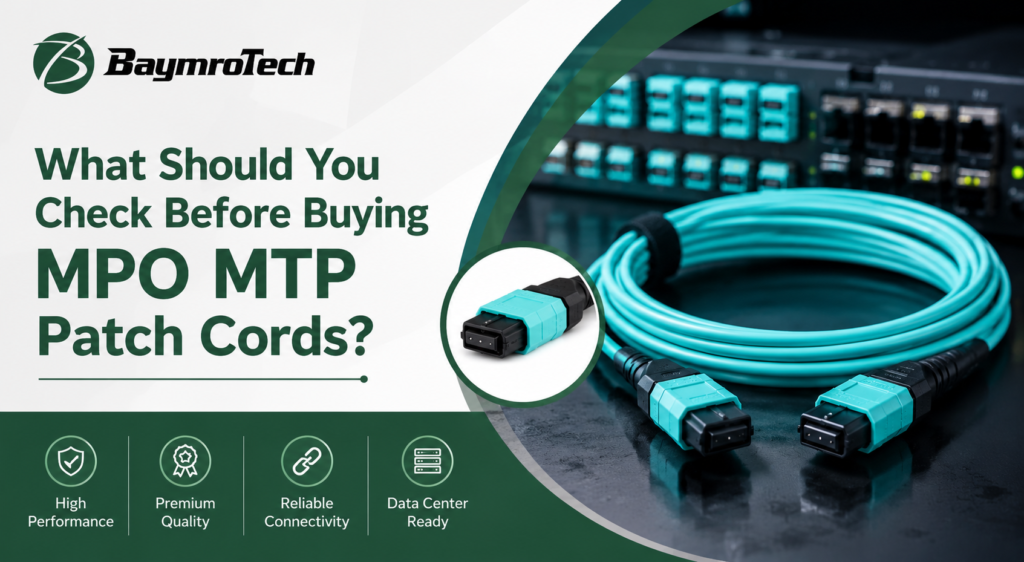
An MPO MTP patch cord is a multi-fiber optical assembly designed to connect multiple fiber channels through a single high-density connector interface.
MPO refers to a multi-fiber push-on connector format, while MTP is a higher-performance MPO connector brand developed with design features intended to improve mechanical and optical performance.
Depending on the application, MPO MTP patch cords can be configured with different fiber counts, fiber types, connector genders, polarity methods, cable lengths, cable constructions, and breakout arrangements.
For procurement teams, the important point is that these specifications are interconnected. Choosing the connector alone is not enough. The complete assembly needs to match the equipment, trunk cables, cassettes, transceivers, and overall fiber architecture.
Where Are MPO MTP Patch Cords Used?
MPO MTP patch cords are primarily used where multiple fiber connections need to be managed within a compact space.
Data Centers
High-density data centers use MPO MTP assemblies for connections involving fiber trunks, cassettes, patch panels, switches, and other optical infrastructure.
Their multi-fiber design can reduce the number of individual connector interfaces and help improve rack-level fiber management.
Telecom Networks
Telecom operators can use multi-fiber assemblies in high-capacity optical networks, equipment rooms, central offices, and structured fiber environments.
Enterprise Networks
Large enterprise networks may use MPO MTP connectivity where high fiber density and modular cabling are important considerations.
Structured Cabling Systems
MPO MTP assemblies can be integrated into pre-terminated structured cabling systems, allowing multiple fiber channels to be installed and connected as a coordinated assembly.
Data Center Interconnects
Where large numbers of optical channels need to be connected between network components, multi-fiber connectivity can simplify the physical cabling architecture.
The right configuration depends heavily on the equipment and cabling architecture. Fiber count, polarity, connector gender, fiber type, loss requirements, cable construction, and breakout design should therefore be established before selecting the patch cord.
How Should You Select the Right MPO MTP Patch Cord?
1. Start With the Required Fiber Count
Fiber count is one of the first specifications buyers should confirm.
Common MPO MTP configurations include 8-fiber, 12-fiber, 16-fiber, and 24-fiber assemblies, although availability depends on the manufacturer’s product range and application.
The required count should correspond to the network architecture rather than simply choosing the highest available option.
For example, an 8-fiber architecture may be suitable for certain parallel optical applications, while 12-fiber and 24-fiber configurations may be used in different trunking and connectivity architectures.
Before ordering, confirm:
- Required fiber count
- Number of active optical channels
- Equipment interface
- Trunk cable configuration
- Cassette configuration
- Future expansion requirements
Choosing the wrong fiber count can result in unused capacity or incompatibility with the rest of the system.
2. Check MPO MTP Polarity Carefully
Polarity is one of the most important technical considerations when purchasing an MPO MTP patch cord.
In a fiber network, polarity determines how the transmit and receive paths are aligned between connected components. If the polarity method does not match the rest of the system, the optical channels may not connect as intended.
MPO systems commonly use different polarity methods, including Method A, Method B, and Method C.
The correct choice depends on the architecture and the configuration of connected components.
Procurement teams should therefore provide the supplier with the complete connection arrangement rather than simply requesting an “MPO patch cord.”
Confirm:
- Polarity method
- Connector orientation
- Key orientation
- Fiber position mapping
- Equipment-side configuration
- Trunk and cassette compatibility
For large projects, polarity should be confirmed during the engineering stage because correcting an incorrect configuration after installation can be costly.
3. Confirm Male or Female MPO/MTP Connectors
MPO/MTP connectors are available in male and female configurations.
The difference relates primarily to the presence or absence of guide pins. The connector gender must match the equipment or mating connector arrangement.
Using the wrong gender can prevent proper mating or create an unsuitable connection.
Before ordering, confirm whether the required assembly needs:
- Male MPO/MTP
- Female MPO/MTP
- Male-to-female configuration
- Female-to-female configuration where applicable
This specification should never be assumed based only on the connector name.
4. Select Single-Mode or Multimode Fiber
The fiber type should match the optical equipment and transmission architecture.
Single-mode fiber, commonly associated with OS2-type infrastructure, is generally used for longer-distance and higher-performance optical transmission applications.
Multimode fiber, including OM3 and OM4 configurations, is commonly used in shorter-distance data center and enterprise applications.
The choice affects transmission distance, optical performance, transceiver compatibility, and overall network design.
When requesting an RFQ, specify the exact fiber type rather than simply stating “MPO fiber patch cord.”
For example, the requirement may need to identify:
- Single-mode or multimode
- OS2, OM3, or OM4 where applicable
- Fiber count
- Required cable length
- Connector configuration
5. Consider Standard-Loss or Low-Loss Performance
Insertion loss is particularly important in high-density optical networks because multiple connectors and components can contribute to the overall optical loss budget.
A standard-loss MPO MTP assembly may be appropriate for many applications. However, a low-loss version can be important when the network has a tighter loss budget.
Buyers should consider the total link rather than evaluating the patch cord in isolation.
The optical path may include:
- Transceivers
- MPO/MTP patch cords
- Trunk cables
- Cassettes
- Adapters
- Patch panels
- Other passive components
If too much loss accumulates across the link, network performance can be affected.
Therefore, specify the required insertion-loss performance when requesting an MPO MTP patch cord.
6. Evaluate Return Loss Requirements
Return loss describes the amount of optical power reflected back toward the source.
Higher return loss generally indicates lower reflected optical power and can be important for demanding optical applications.
The required return-loss performance depends on the fiber type, connector configuration, equipment, and application.
Procurement teams should therefore request the relevant optical performance specifications instead of evaluating the product solely by connector appearance.
7. Look at the Cable Structure
The connector is only one part of an MPO MTP patch cord. The cable structure also affects installation and long-term handling.
Depending on the application, buyers may need to consider:
- Cable diameter
- Fiber count
- Jacket material
- Bend performance
- Flexibility
- Pulling requirements
- Indoor or suitable environmental construction
- Breakout structure
High-density installations can benefit from compact cable designs because they help reduce congestion around patching equipment.
For environments where cables are routed through tight rack spaces, flexibility and bend performance can be particularly important.
8. Determine Whether a Breakout Configuration Is Required
Not every MPO MTP connection remains multi-fiber at both ends.
Some network architectures require an MPO/MTP connector on one side and individual LC connectors on the other side. These assemblies are commonly used when a multi-fiber trunk needs to interface with equipment using individual duplex fiber connections.
A buyer may therefore require:
- MPO/MTP to MPO/MTP
- MPO/MTP to LC
- Other project-specific breakout configurations
The breakout arrangement should match the equipment and patching architecture.
When requesting a customized assembly, provide the required connector type and fiber mapping so the manufacturer can confirm the correct configuration.
9. Match the Patch Cord to the Network Architecture
The correct MPO MTP patch cord is ultimately determined by how the network is designed.
A suitable configuration should align with:
- Optical transceiver type
- Fiber trunk architecture
- Cassette configuration
- Polarity method
- Fiber count
- Connector gender
- Fiber type
- Optical loss budget
- Rack and patching layout
This is more useful than selecting a product based only on a generic description such as “12-fiber MPO patch cord.”
What Product Specifications Should Buyers Put in an RFQ?
A technically clear RFQ can reduce unnecessary communication and prevent incorrect configurations.
A useful MPO MTP patch cord specification should include:
| Specification | Buyer Should Define |
| Fiber count | Required number of fibers |
| Fiber type | Single-mode or multimode, with applicable grade |
| Connector | MPO or MTP configuration |
| Gender | Male or female |
| Polarity | Method A, B, C, or project-specific arrangement |
| Length | Required finished cable length |
| Insertion loss | Standard or low-loss requirement |
| Return loss | Required optical performance |
| Cable structure | Diameter, jacket and construction |
| Breakout | MPO/MTP to MPO/MTP, LC or other arrangement |
| Application | Data center, telecom, enterprise or other |
| Labeling | Project-specific identification if required |
Providing these details helps the manufacturer quote a product that is technically aligned with the project instead of offering a generic assembly.
What Procurement Mistakes Should You Avoid?
Choosing Only by Price
A lower unit price does not necessarily mean a lower project cost. If the patch cord does not match the optical architecture, replacement and reinstallation can quickly outweigh the original savings.
Ignoring Polarity
Incorrect polarity can result in connectivity problems even when the physical connectors appear compatible.
Ordering Without Confirming Connector Gender
A male or female mismatch can make an otherwise suitable assembly unusable for the intended connection.
Mixing Fiber Types
Using the wrong fiber type can create compatibility and transmission issues, particularly when optical equipment and the passive cabling system are designed for a specific fiber category.
Overlooking the Loss Budget
High-density networks can contain multiple passive components. Buyers should ensure the selected patch cord’s insertion loss is compatible with the total link budget.
Treating Every MPO MTP Assembly as Identical
Two assemblies can have the same general connector format but different fiber counts, polarity, gender, fiber types, loss performance, and cable construction.
That is why the product specification should be reviewed as a complete configuration.
How Can BaymroTech Support MPO MTP Patch Cord Requirements?
BaymroTech provides MPO MTP solutions for B2B fiber infrastructure projects where technical configuration and deployment requirements need to be considered together.
As an OEM manufacturer and engineering-focused B2B supplier, BaymroTech can support requirements involving fiber count, fiber type, connector configuration, polarity, cable length, optical performance, and customized assembly arrangements.
This approach is particularly relevant for system integrators, telecom infrastructure contractors, data center projects, and procurement teams that need repeatable product configurations across multiple orders.
Instead of selecting a generic patch cord and adapting the network around it, buyers can define the required configuration based on their existing architecture and request an assembly that matches those requirements.
Supplier capabilities such as testing, production consistency, technical communication, and supply planning still matter, but they should support the primary objective: receiving the correct MPO MTP assembly for the intended optical system.
MPO MTP Patch Cord Buyer Checklist
Before confirming your purchase, verify:
✓ Fiber count matches the network architecture
✓ Single-mode or multimode fiber is correctly specified
✓ Required fiber grade is identified
✓ MPO/MTP connector type is confirmed
✓ Male or female configuration is correct
✓ Polarity method is documented
✓ Connector key orientation is confirmed
✓ Standard or low-loss performance is specified
✓ Insertion-loss requirement is defined
✓ Return-loss requirement is appropriate
✓ Cable length is correct
✓ Cable structure fits the installation environment
✓ Breakout configuration matches connected equipment
✓ Fiber mapping is confirmed where required
✓ Testing documentation is available
✓ Customized labeling or packaging is defined if needed
Frequently Asked Questions
What is an MPO MTP patch cord?
It is a multi-fiber optical assembly that provides high-density connectivity through an MPO or MTP-style connector.
How many fibers can an MPO MTP patch cord have?
Configurations can include 8, 12, 16, and 24 fibers, depending on the product and network architecture.
What is MPO MTP polarity?
Polarity defines how transmit and receive fiber positions are aligned between connected network components. Common methods include Method A, Method B, and Method C.
Should I choose male or female MPO/MTP?
The choice depends on the mating connector and network architecture. The required connector gender should be confirmed before ordering.
Can MPO MTP patch cords use single-mode fiber?
Yes. MPO MTP assemblies can be manufactured for single-mode applications as well as multimode applications, depending on the required configuration.
What is the difference between standard-loss and low-loss MPO MTP patch cords?
The primary difference is their specified optical insertion-loss performance. Low-loss assemblies can be useful where the overall network has a tighter optical loss budget.
Can MPO MTP patch cords connect to LC equipment?
Yes. MPO/MTP to LC breakout assemblies can be used where a multi-fiber connection needs to interface with individual LC connections.
Why is fiber count important?
Fiber count determines how many optical channels can be carried through the assembly and must match the requirements of the connected equipment and cabling architecture.
What information should I provide when requesting an MPO MTP RFQ?
Provide fiber count, fiber type, connector configuration, gender, polarity, length, optical loss requirements, cable construction, breakout requirements, quantity, and application details.
Request a Project-Specific MPO MTP Patch Cord RFQ
If you are sourcing MPO MTP patch cords for a telecom, data center, enterprise, or structured fiber project, start with the technical configuration rather than a generic product name.
Share your required fiber count, fiber type, polarity, connector gender, cable length, optical performance, breakout configuration, quantity, and application with BaymroTech. This allows the required assembly to be evaluated against the actual network architecture and procurement requirements.
For customized projects, buyers can also discuss OEM requirements, project-specific configurations, labeling, packaging, production quantities, and delivery expectations during the RFQ process.
Ready to Specify the Right MPO MTP Patch Cord for Your Project?
Contact BaymroTech to review your MPO MTP configuration, confirm the right technical specifications, and request an OEM-focused RFQ for your next fiber infrastructure deployment.
