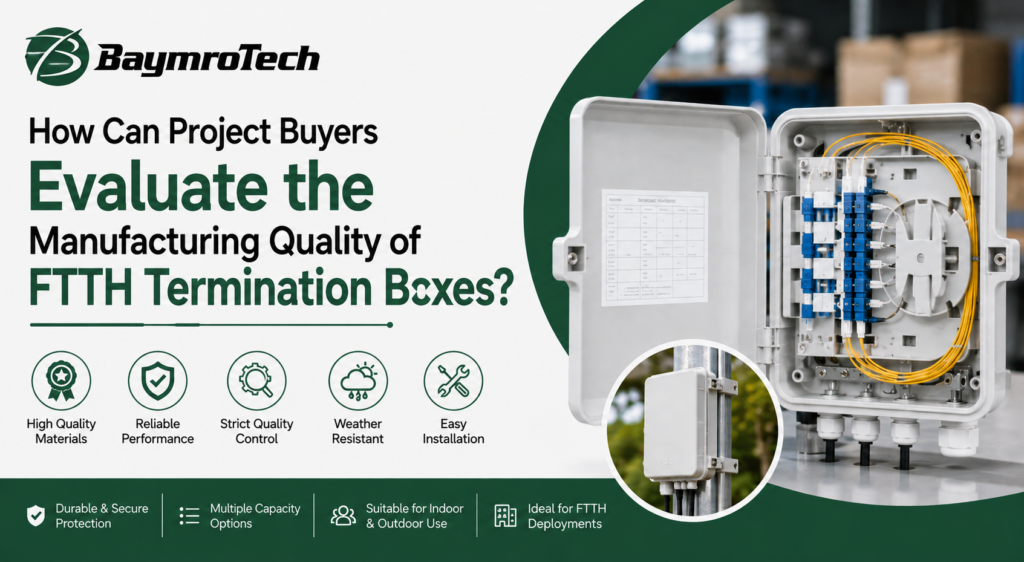
When a telecom project is under procurement pressure, the lowest quoted price can look attractive. But for FTTH infrastructure, a low unit price does not always mean a low project cost. Poor enclosure quality, inconsistent dimensions, weak materials, unreliable protection, or irregular supply can create installation problems that appear only after deployment.
For project buyers, the real question is not simply which FTTH termination box supplier offers the cheapest quotation. It is whether the manufacturer can consistently deliver the required product specification, quality, quantity, documentation, and lead time.
Choosing the wrong supplier can result in inconsistent product quality, project delays, higher maintenance requirements, unstable lead times, installation difficulties, and increased total cost of ownership. This is why supplier evaluation should be treated as a strategic procurement decision rather than a simple price comparison.
For telecom operators, system integrators, engineering contractors, infrastructure developers, and technical sourcing teams, evaluating manufacturing capability before issuing a purchase order can significantly reduce downstream risks.
What Is an FTTH Termination Box Manufacturer?
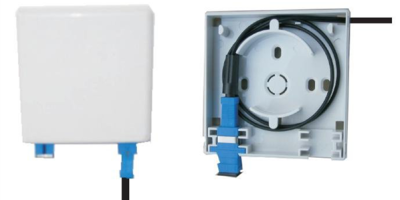
An FTTH termination box manufacturer designs and produces enclosure solutions used to terminate, organize, protect, and manage optical fiber connections in FTTx networks.
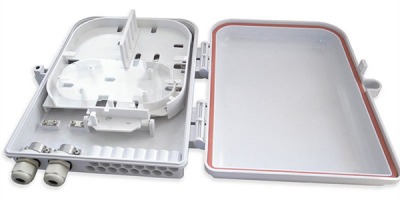
An FTTH termination box provides a protected point for fiber termination, splicing, adapter installation, and cable management. Depending on the model, it can support different port densities and splice capacities, allowing buyers to select a configuration according to the number of fibers and connections required at a particular network location.
For procurement teams, the physical structure of the box is just as important as its optical compatibility. Buyers should evaluate enclosure dimensions, available ports, splice space, cable entry points, internal cable routing, mounting method, and environmental protection before approving a product.
BaymroTech supplies fiber termination boxes covering configurations from 2 cores to 96 cores. Its product range includes face plate and enclosure types, with options designed for wall or pole mounting and applications involving air blown fiber and drop cables. The company also states that customization and customer branding are available.
Key Technical Selection Criteria
Before selecting an FTTH termination box, project buyers should compare:
- Port density and connector capacity
- Splice capacity
- Enclosure dimensions and physical structure
- IP protection requirements
- Wall-mounted or pole-mounted installation
- Internal cable management
- Cable entry and exit arrangements
- Indoor or outdoor environmental suitability
- Required certifications
- Customization requirements
These specifications help ensure that the selected box fits both the physical installation and network architecture.
Applications and Industry Use Cases
FTTH termination boxes support several types of optical network deployment, including:
- FTTH access networks
- FTTx infrastructure projects
- Telecommunications networks
- CATV networks
- Data communication networks
- Local area networks
- Residential broadband deployments
- Building and property connectivity projects
They can be installed in different locations depending on the enclosure design and network requirements.
Wall-Mounted Installation
Wall-mounted termination boxes are suitable for locations where the enclosure can be securely fixed to a vertical surface. They are commonly considered for indoor telecom rooms, buildings, residential developments, commercial properties, utility spaces, and protected outdoor locations.
For wall-mounted applications, buyers should confirm the mounting-hole arrangement, enclosure dimensions, cable entry direction, available working space, and accessibility for installation and maintenance.
Pole-Mounted Installation
Pole-mounted models are useful when fiber distribution points need to be positioned on utility or telecom poles rather than building walls.
For these installations, the enclosure should provide an appropriate mounting arrangement and sufficient mechanical stability. Buyers should also consider exposure to sunlight, rain, dust, temperature fluctuations, wind, and other outdoor conditions.
A box designed only for protected indoor environments should not automatically be selected for exposed pole deployment.
Port Density and Splice Capacity
Port density is another important selection factor. A smaller termination box may be appropriate for low-density access points, while larger projects may require higher port counts to support multiple subscribers or fiber connections.
Splice capacity should also be evaluated separately from port density. The number of external ports does not always indicate how many fibers can be safely accommodated inside the enclosure.
A buyer should therefore confirm:
- Number of fiber ports
- Adapter configuration
- Maximum splice capacity
- Fiber routing space
- Cable storage capacity
- Splitter accommodation, if required
- Available working space for technicians
For example, BaymroTech’s published FTTH termination box range covers 2 to 96 cores, giving buyers multiple capacity options for different network requirements.
Internal Cable Management
Internal cable management directly affects installation quality and future maintenance.
A well-designed termination box should provide sufficient space for organizing incoming and outgoing fibers while reducing unnecessary bending, crossing, and mechanical stress.
Buyers should examine whether the enclosure provides:
- Defined fiber routing paths
- Splice protection space
- Fiber storage area
- Cable fixation points
- Organized entry and exit routes
- Adequate bend management
- Accessible termination areas
Good internal organization can make installation more efficient and help technicians identify and maintain individual fiber connections more easily.
IP Protection and Environmental Suitability
For outdoor applications, IP protection should be evaluated according to the actual installation environment rather than treated as a general product feature.
The required protection level may depend on whether the box is installed inside a protected cabinet, on an exterior building wall, or directly on a pole exposed to weather.
Buyers should request the manufacturer’s declared IP rating and supporting documentation for the exact model being considered. They should also evaluate exposure to:
- Rain and moisture
- Dust
- UV radiation
- Temperature changes
- Mechanical impact
- Outdoor pollution
- Wind and weather conditions
The correct protection level helps reduce the risk of moisture or contamination reaching sensitive fiber connections.
Different projects therefore require different port densities, splice capacities, environmental ratings, certifications, mounting arrangements, and customization options. This makes supplier evaluation critical because two products with similar external appearances can have very different installation capabilities and field performance.
What Should Project Buyers Check When Evaluating FTTH Termination Box Manufacturing Quality?
Manufacturing quality should be evaluated through a combination of product engineering, factory capability, documentation, testing, supply reliability, and project support.
1. OEM Manufacturing Capability
OEM capability is one of the first questions procurement teams should ask.
A genuine OEM manufacturer has greater control over product design, materials, tooling, production processes, inspection, and customization. This can be particularly important when a project requires a private-label product, modified enclosure, custom mounting arrangement, special packaging, or a specific fiber configuration.
Buyers should ask:
- Is the supplier manufacturing the product directly?
- Can the supplier modify the design?
- Is tooling available for project-specific requirements?
- Can customer branding be applied?
- Can the manufacturer provide engineering assistance?
BaymroTech states that it provides OEM and ODM production services and has engineering capabilities for customized telecom products.
For procurement teams, this matters because direct manufacturing control can reduce communication gaps between the buyer, engineering team, and production floor.
2. Customization Options
Standard products are useful for straightforward deployments, but large infrastructure projects often have project-specific requirements.
Customization may involve:
- Fiber capacity
- Port density
- Splice capacity
- Enclosure dimensions
- Adapter configuration
- Cable entry design
- Mounting method
- Splitter accommodation
- Labeling
- Customer logo
- Packaging
- Material selection
- Color or appearance requirements
BaymroTech states that its FTTH termination box products can be customized and that customer logos can be printed on the product and outer packaging according to requirements.
For B2B buyers, customization becomes particularly useful when a project has specific mounting, fiber capacity, internal routing, or environmental requirements.
3. MOQ Requirements
Minimum order quantity can have a direct effect on procurement planning.
A supplier may offer a competitive unit price but require an MOQ that is much larger than the project’s initial deployment requirement. This can increase inventory costs and create unnecessary working-capital pressure.
Before comparing quotations, confirm:
- Standard-product MOQ
- Customized-product MOQ
- Sample availability
- Pilot-order quantity
- Repeat-order conditions
- Packaging MOQ
Do not assume that the MOQ for a standard product also applies to customized production.
4. Lead Time Stability
A quoted delivery date is useful, but procurement teams should also evaluate whether the supplier can maintain that lead time consistently.
Ask about:
- Normal production lead time
- Capacity during peak demand
- Raw material availability
- Tooling lead time for customized products
- Sample approval time
- Production scheduling
- Inspection time
- Shipping preparation
For a network rollout, predictable delivery can be more valuable than a slightly lower purchase price because missing installation windows can affect contractors, site teams, logistics, and project milestones.
5. Product Certifications and IP Protection
Certifications and compliance documentation help buyers verify whether a product is appropriate for the intended market and project requirements.
Depending on the project, buyers may need to review documentation relating to:
- RoHS compliance
- Applicable IEC requirements
- Environmental performance
- Material compliance
- IP protection rating
- Customer-specific telecom standards
- Regional regulatory requirements
BaymroTech states that its fiber termination boxes meet the RoHS standard.
For outdoor termination boxes, procurement teams should also verify the IP rating of the specific model rather than assuming that every enclosure in a product range has the same protection level.
This is particularly important when comparing indoor wall-mounted models with outdoor wall-mounted or pole-mounted configurations.
6. Testing Reports
Testing documentation can provide a clearer picture of manufacturing consistency than product photographs or marketing descriptions.
Depending on the design, buyers may want to review evidence relating to:
- Material performance
- Dimensional inspection
- Mechanical strength
- Environmental resistance
- UV resistance
- Rain or water resistance
- Connector or adapter compatibility
- Fiber management performance
- Assembly inspection
- Enclosure protection
The exact testing requirements should be based on the project specification and applicable standards.
A supplier that can explain its testing process clearly gives procurement and engineering teams greater confidence before volume production.
7. Quality Control Procedures
A reliable FTTH termination box manufacturer should have defined quality control procedures rather than relying only on final visual inspection.
Buyers should ask how the supplier controls:
- Incoming raw materials
- Plastic or enclosure components
- Molded dimensions
- Port alignment
- Assembly accuracy
- Adapter installation
- Cable entry components
- Internal cable routing
- Labeling
- Packaging
- Final inspection
- Batch traceability
Consistency matters because a single defective unit may be manageable, while repeated quality variation across thousands of units can become a major field issue.
8. Technical Support Capability
Procurement does not end when the purchase order is issued.
During project execution, technical teams may need assistance with:
- Product selection
- Fiber capacity
- Port configuration
- Splice requirements
- Mounting arrangements
- Connector configurations
- Custom designs
- Installation questions
- Packaging requirements
- Replacement units
- Project-specific documentation
A supplier with technical support capability can help reduce the communication gap between procurement and engineering teams.
9. Production Capacity
Production capacity should match the scale and schedule of the project.
A supplier may successfully produce small orders but struggle when demand increases sharply. Before awarding a large contract, ask about production capacity, manufacturing locations, equipment, workforce, and the supplier’s ability to handle repeat orders.
Capacity should also be considered alongside product configuration. A manufacturer may have sufficient capacity for standard termination boxes but require additional time for customized high-density models.
For procurement teams, capacity assessment is especially important when the project involves phased deployment across multiple locations.
10. Supply Chain Reliability
Even a capable manufacturer depends on raw materials, components, packaging, transportation, and logistics.
Ask suppliers how they manage critical materials and whether they maintain sufficient stock or alternative sourcing arrangements for key components.
Supply chain reliability can influence:
- Production continuity
- Delivery schedules
- Cost stability
- Replacement availability
- Emergency orders
- Long-term project support
The best supplier is not necessarily the one with the lowest initial quotation. It is the one capable of maintaining acceptable quality and supply performance throughout the project lifecycle.
11. Project References
Project experience can help validate whether a supplier is capable of supporting real-world telecom deployments.
Where possible, buyers should ask for:
- Relevant application experience
- Similar fiber capacities
- Comparable environmental requirements
- Wall-mounted deployment experience
- Pole-mounted deployment experience
- Export experience
- Customer references where available
- Previous OEM projects
- Experience with large-volume orders
A supplier experienced in telecom infrastructure is more likely to understand the practical requirements surrounding packaging, installation, documentation, and repeat supply.
How Should Buyers Match the Termination Box to the Installation Environment?
The product should be selected according to where and how it will be installed.
| Installation Environment | Key Selection Considerations | Suitable Configuration |
| Indoor telecom room | Easy access, compact structure, cable organization | Wall-mounted, appropriate port density |
| Residential building | Space efficiency, subscriber capacity, easy maintenance | Compact wall-mounted model |
| Commercial building | Higher connection requirements, organized cable routing | Medium or high-density model |
| Outdoor building wall | Weather exposure, enclosure protection, secure mounting | Outdoor-rated wall-mounted model |
| Utility or telecom pole | Mechanical mounting, weather exposure, cable entry | Pole-mounted outdoor model |
| Large FTTH rollout | Fiber count, splice capacity, repeat supply | Higher-capacity configuration |
| Customized network project | Specific ports, mounting, branding, cable routing | OEM or customized model |
This approach helps procurement teams avoid selecting a product based only on fiber count or price.
Procurement Risks and Common Supplier Selection Mistakes
A structured evaluation can prevent several common procurement problems.
Choosing a Supplier Without OEM Capability
If the supplier depends entirely on third-party products, design changes may become difficult. Communication can also take longer when a project requires modifications.
Accepting Claims Without Test Reports
Statements such as “high quality” are not enough for technical procurement. Buyers should request appropriate documentation that supports the claimed specifications.
Selecting the Wrong Capacity
A box with insufficient port or splice capacity can create installation constraints, while unnecessarily large enclosures can increase cost and consume valuable installation space.
Ignoring IP Protection
Selecting an indoor enclosure for an exposed outdoor application can increase the risk of environmental damage. Buyers should match the protection rating to the actual deployment conditions.
Ignoring Mounting Requirements
Wall-mounted and pole-mounted applications can have different mechanical and installation requirements. The mounting method should therefore be confirmed before ordering.
Accepting Poor Internal Cable Management
Insufficient routing space can make installation and maintenance more difficult and may increase the risk of fiber handling problems.
Focusing Only on Unit Price
A cheaper product can become more expensive when it causes higher installation time, replacement requirements, quality disputes, or project delays.
Overlooking Technical Support
If engineering questions arise during deployment, limited supplier support can slow down project execution.
Failing to Check Quality Consistency
One approved sample does not automatically prove that every production batch will meet the same specification. Buyers should understand how production quality is controlled and verified.
FTTH Termination Box Supplier Evaluation Checklist
Use the following checklist before shortlisting or approving a supplier:
| Procurement Factor | What Buyers Should Verify | Why It Matters |
| OEM capability | Direct manufacturing and engineering support | Better design and quality control |
| Port density | Required adapter and connection capacity | Matches network architecture |
| Splice capacity | Number of fibers that can be accommodated | Prevents internal space limitations |
| IP protection | Declared rating and supporting documentation | Matches outdoor exposure |
| Mounting | Wall or pole installation compatibility | Ensures practical deployment |
| Internal cable management | Fiber routing and storage structure | Improves installation and maintenance |
| MOQ | Standard and customized order quantities | Controls inventory and cash flow |
| Lead time | Normal and peak production schedules | Protects project milestones |
| Certifications | Applicable compliance documentation | Supports project and market requirements |
| Testing reports | Relevant inspection and performance records | Verifies product claims |
| Customization | Design, capacity, mounting, branding options | Matches project specifications |
| Technical support | Engineering and installation assistance | Reduces deployment issues |
| Quality control | Incoming, in-process, and final inspection | Improves consistency |
| Project references | Similar telecom deployments | Validates supplier experience |
| Supply chain stability | Materials, capacity, logistics, repeat supply | Reduces delivery risk |
A procurement team can use this checklist during RFQ evaluation to compare suppliers on more than price.
Why BaymroTech?
BaymroTech approaches fiber termination box supply from an OEM and engineering perspective rather than treating the product as a simple catalog item.
Its FTTH termination box range covers 2 to 96 cores and includes face plate and enclosure configurations. The company states that the products use high-quality plastic materials, support wall and pole mounting, and can accommodate selected PLC splitter configurations.
For B2B buyers, the broader value is the ability to discuss product customization, OEM branding, engineering requirements, and project-specific configurations with a telecom equipment manufacturer.
BaymroTech also positions itself as a telecom equipment manufacturer and exporter with R&D, manufacturing, marketing, and engineering capabilities for ICT network infrastructure. Its products and solutions are supplied across international markets with OEM and ODM production services.
For projects with different installation environments, buyers can discuss requirements such as fiber capacity, port density, splice space, mounting configuration, cable management, environmental conditions, and customization before finalizing the product.
This engineering-focused approach can be useful when a project requires more than an off-the-shelf enclosure.
Frequently Asked Questions
What is an FTTH termination box?
An FTTH termination box is an enclosure used to terminate, organize, splice, and protect optical fiber connections in FTTx networks. It provides a structured point for managing fiber and drop cable connections.
What is port density in an FTTH termination box?
Port density refers to the number of available fiber connection ports or adapters supported by the enclosure. Buyers should select the port density according to the number of connections required at the installation point.
Why is splice capacity important?
Splice capacity indicates how many fiber splices the internal enclosure can accommodate. Adequate splice space helps prevent overcrowding and supports organized fiber management.
How do buyers select between wall-mounted and pole-mounted boxes?
Wall-mounted models are generally selected where a secure vertical surface is available. Pole-mounted models are intended for installations on utility or telecom poles and should be evaluated for mounting stability and outdoor environmental exposure.
What IP protection rating should an outdoor FTTH box have?
The required IP rating depends on the installation environment and project specification. Buyers should request the manufacturer’s declared rating and supporting documentation for the exact model instead of assuming all termination boxes have the same protection level.
Why is internal cable management important?
Internal cable management provides organized routing and storage for fibers and cables. It can make installation easier, improve accessibility, and support future maintenance.
Can FTTH termination boxes be customized?
Yes. Depending on the manufacturer, customization can include fiber capacity, port configuration, mounting, enclosure design, adapters, labeling, packaging, and branding.
What certifications should buyers request?
Buyers should request the certifications and compliance documentation applicable to their market and project specifications. RoHS documentation and relevant technical or environmental compliance records may be required depending on the application.
What is the typical lead time for FTTH termination boxes?
Lead time depends on product configuration, order quantity, customization, material availability, and production scheduling. Buyers should request a project-specific lead-time commitment rather than relying on a generic estimate.
How can buyers verify supplier quality?
Request product samples, technical specifications, applicable certifications, test reports, quality-control information, production details, and relevant project references. Comparing these items across suppliers gives procurement teams a stronger basis for approval.
Ready to Evaluate Your FTTH Termination Box Supplier?
A strong RFQ should provide enough information for the manufacturer to understand the project rather than asking only for a unit price.
When contacting BaymroTech, buyers can discuss:
- OEM requirements
- Required port density
- Fiber and splice capacity
- Wall-mounted or pole-mounted installation
- IP protection requirements
- Internal cable management requirements
- Environmental conditions
- Customization requirements
- Mounting configuration
- Connector or splitter requirements
- Branding and packaging
- MOQ expectations
- Target quantities
- Required lead times
- Certifications and testing documentation
- Project deployment conditions
This information allows the supplier to recommend a more suitable configuration and prepare a more meaningful commercial proposal.
For telecom operators, system integrators, contractors, and procurement teams, the goal should be simple: select a manufacturer that can deliver the right specification consistently, at the required volume, with reliable technical and supply support.
Explore BaymroTech’s FTTH Termination Box Solutions
Need the right FTTH termination box for your network environment? Contact BaymroTech to discuss port density, splice capacity, IP protection, mounting requirements, cable management, OEM customization, MOQ, lead time, and your project-specific RFQ.