Introduction
For telecom operators, system integrators, engineering contractors, and infrastructure developers, a network server cabinet is not simply a metal enclosure. It is part of the physical infrastructure that protects equipment, supports cable organization, manages airflow, and enables reliable installation and maintenance.
The procurement challenge is that two cabinets can look similar on a quotation while performing very differently in a real deployment. Differences in rack capacity, construction, load-bearing capability, cooling and ventilation, cable management, security, mounting compatibility, customization, and supplier reliability can affect the entire project.
Choosing the wrong network server cabinet supplier can result in inconsistent product quality, project delays, unstable lead times, difficult installation, higher maintenance costs, and increased total cost of ownership. A low unit price may become expensive when cabinets arrive late, require modifications, cannot accommodate the planned equipment load, or provide inadequate cooling and cable management.
That is why procurement teams should evaluate a supplier as a strategic manufacturing and engineering partner rather than comparing prices alone.
For modern infrastructure projects, the better question is not simply, “How much does the cabinet cost?” It is, “Can this supplier consistently deliver the right cabinet capacity, load rating, cooling design, security, cable management, quality, and customization for our project?”
What Is a Network Server Cabinet Supplier?
A network server cabinet supplier provides enclosed rack systems designed to house and organize networking, server, storage, and related IT or telecom equipment.
A capable supplier should be able to address practical requirements such as 19-inch equipment mounting, cabinet dimensions, rack unit capacity, load-bearing requirements, airflow, cable routing, physical security, access, installation configuration, and project-specific customization.
Rack unit capacity is particularly important during cabinet selection. Cabinets are available in different U sizes, with the required height depending on the equipment being installed and the amount of expansion space needed. Procurement teams should calculate the total rack units required by servers, switches, patch panels, PDUs, shelves, and other rack-mounted equipment instead of selecting a cabinet based only on its external dimensions.
Load-bearing capacity should also be evaluated against the actual equipment configuration. Servers, storage systems, UPS units, network switches, and other hardware can create substantial static loads. The cabinet frame, mounting rails, shelves, and floor or castor arrangement should therefore be suitable for the intended equipment weight.
BaymroTech’s network and server cabinets support standard and non-standard equipment configurations and are designed for applications involving routers, switches, patch panels, servers, storage equipment, and other networking accessories. Available configurations include floor-standing and wall-mounted options, with customization available for project requirements.
From a procurement perspective, the supplier’s manufacturing capability matters just as much as the cabinet itself.
Applications and Industry Use Cases
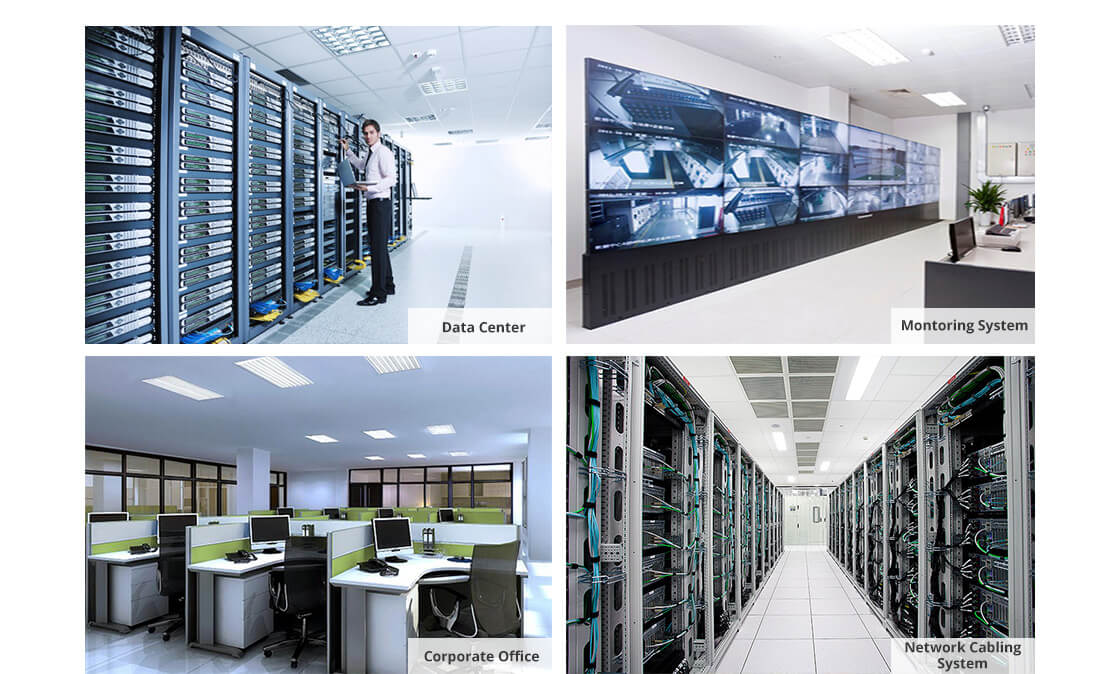
Network server cabinets are used across infrastructure environments where equipment needs secure, organized, accessible, and properly ventilated rack-based installation.
Telecom Networks
Telecom operators use cabinets for networking equipment, switches, patch panels, transmission equipment, and supporting infrastructure. Proper rack capacity and cable routing are important when multiple connections enter and leave the cabinet.
Cooling is another consideration because continuously operating network equipment generates heat. A cabinet with appropriate ventilation, perforated doors or panels, and compatible cooling accessories can support better heat dissipation.
Security can also matter in telecom rooms and remote facilities. Lockable doors and panels can help restrict unauthorized physical access to sensitive equipment.
Data Centers
Data centers require cabinets that can accommodate servers, storage equipment, networking hardware, power distribution, and structured cabling.
Cabinet selection should consider rack height, equipment depth, load capacity, airflow direction, cable entry, and future expansion. High-density environments may require greater attention to ventilation and cooling because concentrated equipment loads can generate substantial heat.
A cabinet that has sufficient U space but inadequate airflow or load capacity may not be appropriate for a high-density server deployment.
Enterprise IT Infrastructure
Corporate server rooms and IT facilities use cabinets to organize network equipment while providing physical protection and controlled access.
Depending on the installation, buyers may require different cabinet heights, locking arrangements, cable management systems, ventilation configurations, shelves, PDUs, and other accessories.
Network Wiring and Distribution
Cabinets can support network cabling between floors, distribution points, monitoring systems, and other structured infrastructure applications.
Cable management should not be treated as an accessory afterthought. Horizontal and vertical cable management, cable entry points, routing space, and appropriate bend-radius control can make installation and future maintenance significantly easier.
This is especially important when fiber optic and copper connections are installed together.
Infrastructure and Engineering Projects
Engineering contractors and system integrators may require cabinets with specific dimensions, mounting arrangements, access configurations, finishes, locking systems, ventilation designs, or accessories to integrate with an overall deployment design.
Different data center and telecom environments often require different specifications, environmental considerations, certifications, testing documentation, security arrangements, cooling requirements, and customization options. This is why supplier evaluation should happen before the purchase order is finalized, especially when cabinets are being deployed across multiple sites.
What Should Procurement Teams Evaluate in a Network Server Cabinet Supplier?
This is the most important part of the sourcing process. A strong supplier evaluation should cover technical capability, manufacturing consistency, commercial flexibility, and project support.
1. OEM Manufacturing Capability
Ask whether the supplier actually has OEM manufacturing capability or primarily operates as a trading company.
An OEM manufacturer can generally provide greater control over dimensions, materials, production processes, customization, quality inspection, and production scheduling.
For large telecom or infrastructure projects, this can reduce communication gaps between design and manufacturing teams. It also makes it easier to request engineering changes when the standard cabinet does not fully match the project.
BaymroTech positions itself as a telecom equipment manufacturer and exporter with manufacturing, R&D, and engineering capabilities. Its product portfolio includes cabinets and racks alongside fiber optic and copper connectivity products.
2. Rack Unit Size and Cabinet Capacity
Rack unit size should be confirmed before selecting a cabinet model.
The “U” measurement indicates the vertical rack space available for equipment. Different deployments may require compact cabinets for smaller network installations or taller floor-standing cabinets for servers and higher equipment density.
Procurement teams should calculate:
- Total U space required by all equipment
- Additional U space for accessories
- Space required for cable management
- Cooling and ventilation requirements
- Future equipment expansion
- Equipment depth and mounting position
For example, if the current equipment requires most of the available rack space, selecting a cabinet with additional U capacity may provide greater flexibility for future expansion.
Buyers should also confirm whether the mounting rails are adjustable and whether the cabinet can accommodate the depth of the planned equipment.
3. Load-Bearing Capacity
Cabinet capacity is not determined by rack units alone. Procurement teams must also verify load-bearing capability.
A cabinet may provide sufficient U space but still be unsuitable for heavy servers, storage systems, UPS equipment, batteries, or other hardware if the structural load rating is inadequate.
Ask the supplier to clarify:
- Static load capacity
- Dynamic load capacity where relevant
- Frame construction
- Mounting rail strength
- Shelf capacity
- Castor and leveling foot capacity
- Floor loading considerations
The combined weight of installed equipment should remain within the cabinet’s specified capacity. For heavy configurations, buyers should also consider how the equipment will be installed and whether the cabinet needs reinforced components.
4. Cooling and Ventilation Design
Cooling is a critical specification when cabinets house equipment that operates continuously.
Procurement teams should evaluate how air enters and exits the cabinet and whether the design supports the thermal requirements of the installed equipment.
Important considerations include:
- Perforated front and rear doors
- Ventilation openings
- Airflow direction
- Fan trays or cooling accessories
- Heat accumulation
- Equipment density
- Room-level cooling
- Hot aisle and cold aisle arrangements where applicable
A cabinet should not simply provide ventilation openings. The airflow design should work with the equipment’s own cooling configuration and the wider data center environment.
For higher-density deployments, buyers should discuss cooling requirements with the supplier before finalizing the cabinet specification.
5. Cable Management Features
Cable management directly affects installation quality and long-term maintenance.
Procurement teams should confirm whether the cabinet supports:
- Vertical cable management
- Horizontal cable management
- Top and bottom cable entry
- Rear cable routing
- Patch cord organization
- Fiber and copper cable routing
- Adequate bend-radius space
- Separation between power and data cables where required
Good cable management reduces congestion and makes it easier for technicians to identify, replace, and maintain connections.
For telecom and data center applications, cabinet dimensions should therefore be evaluated together with cable routing requirements. A cabinet that fits the equipment but leaves insufficient cable management space may create installation problems later.
6. Security Locking Systems
Physical security is another important cabinet specification.
Depending on the deployment environment, procurement teams may require lockable front doors, rear doors, side panels, or other access-control features.
Security requirements can vary between:
- Telecom rooms
- Enterprise server rooms
- Data centers
- Remote network sites
- Shared infrastructure facilities
- Customer-facing technical facilities
A locking system should provide controlled physical access without making routine maintenance unnecessarily difficult.
Buyers should confirm the type of lock, door configuration, key management requirements, and whether front and rear access can be controlled according to the project’s security needs.
7. Customization Options for Different Data Center Environments
Standard cabinets are useful for common deployments, but not every infrastructure project has the same requirements.
A capable supplier should be able to discuss customization related to:
- Cabinet height, width, and depth
- Rack U capacity
- Mounting rail positions
- Door configuration
- Ventilation design
- Cooling accessories
- Cable entry points
- Cable management
- Locking systems
- Shelves and accessories
- Castors and leveling feet
- Surface finish
- Branding or labeling
- Packaging requirements
Customization may be especially useful for high-density data centers, telecom rooms with limited floor space, remote installations, or projects using equipment with unusual dimensions.
BaymroTech states that customization is available for its network/server cabinet products.
From a procurement perspective, customization should be discussed during the quotation stage rather than after production begins. This helps the supplier confirm feasibility, cost, tooling, production time, and technical requirements before the purchase order is finalized.
8. MOQ Requirements
Minimum order quantity can significantly affect procurement planning.
Before requesting a quotation, clarify:
- Standard MOQ
- Custom-product MOQ
- Sample availability
- Pilot-order quantities
- Volume pricing thresholds
- Whether repeat orders can use the same tooling or specification
A supplier with flexible MOQ arrangements may be more suitable for phased deployments, pilot projects, or multi-site rollouts.
9. Lead Time Stability
A quoted lead time is only useful if the supplier can consistently meet it.
Procurement teams should ask:
- What is the standard production lead time?
- Does customization change the lead time?
- What is the capacity during peak periods?
- How are production delays communicated?
- Can the supplier support phased delivery?
- Is there a documented production schedule after order confirmation?
Unstable lead times can affect installation crews, warehouse planning, project milestones, and customer commitments.
For large B2B projects, procurement should evaluate delivery consistency rather than accepting the shortest promised lead time.
10. Product Certifications and Standards
Certification and compliance requirements should be confirmed before purchase, not after production.
Buyers should ask for applicable standards and compliance documentation relevant to their destination market and project specification.
BaymroTech’s network/server cabinet information references standards including ANSI/EIA RS-310-D, DIN 41497 Part 1, IEC 297-2, DIN 41494 Part 7, and GB/T 3047.2-92.
Procurement teams should still confirm which specific standards apply to the exact model being quoted.
11. Testing Reports
Testing documentation provides evidence that the supplied product meets the agreed specification.
Depending on the project, buyers may request documentation covering structural performance, dimensions, material characteristics, finish, load performance, or other relevant tests.
For cabinets, testing and inspection should also relate to practical specifications such as dimensions, mounting compatibility, load-bearing performance, door operation, locking mechanisms, and finish quality.
Do not accept vague statements such as “quality tested.” Ask what was tested, according to which procedure, and whether a report can be provided.
12. Quality Control Procedures
Quality consistency becomes critical when purchasing dozens or hundreds of cabinets.
Ask the supplier about:
- Incoming material inspection
- Dimensional inspection
- Welding inspection
- Surface treatment inspection
- Assembly inspection
- Door and locking mechanism checks
- Mounting compatibility checks
- Load-related inspection where applicable
- Final inspection
- Packaging inspection
BaymroTech states that its products undergo checks during manufacturing before shipment.
13. Technical Support Capability
Procurement teams should not overlook technical support.
A supplier should be able to help clarify cabinet dimensions, rack U requirements, equipment depth, mounting requirements, load capacity, cooling and ventilation, cable management, accessories, security arrangements, customization, and installation considerations.
This is particularly important for system integrators working with complex bills of materials.
Technical support can also reduce errors between the procurement team, engineering department, installation contractor, and end customer.
14. Production Capacity
A supplier may successfully deliver a small sample but struggle with a large rollout.
Ask about:
- Production capacity
- Manufacturing locations
- Available production lines
- Workforce and equipment
- Monthly output capability
- Capacity during peak demand
- Ability to support repeat orders
BaymroTech states that it has its headquarters in Nanjing and branch factories in Jiangsu, Zhejiang, and Shenzhen, supporting its broader manufacturing operations.
15. Supply Chain Reliability
Cabinet production depends on materials, components, surface treatment, hardware, packaging, and logistics.
A reliable supplier should have processes for managing material availability and production continuity.
Supply chain reliability becomes even more important when cabinets are part of a larger telecom deployment where a delay in one component can hold up an entire installation.
16. Project References
Ask whether the supplier has experience supporting comparable projects.
Relevant references can help procurement teams assess whether the supplier understands:
- Telecom deployment requirements
- Data center environments
- Multi-site projects
- System integration
- High-volume orders
- Custom cabinet specifications
- International shipment requirements
References are particularly valuable when moving from a sample order to a strategic supplier relationship.
Installation and Cabinet Selection Considerations
Cabinet selection should not end with the product specification. Procurement teams should consider how the cabinet will actually be transported, installed, loaded, connected, and maintained.
Before final approval, buyers should confirm:
- Available floor space
- Required cabinet height and U capacity
- Equipment depth
- Equipment weight
- Floor load capacity
- Door opening and maintenance clearance
- Cable entry locations
- Power distribution requirements
- Cooling and airflow arrangement
- Access requirements
- Leveling feet and castors
- Future expansion requirements
For floor-standing cabinets, installation teams should confirm that the cabinet can be positioned safely and that the floor can support the combined cabinet and equipment weight.
For wall-mounted cabinets, wall construction and mounting strength become particularly important. The mounting system must be suitable for the fully loaded cabinet rather than the empty enclosure.
Installation access should also be considered. A cabinet may technically fit within a room but still be difficult to install if doors, corridors, elevators, or maintenance areas do not provide adequate clearance.
These considerations should be shared with the supplier during the RFQ stage so the proposed cabinet configuration can be evaluated against the actual installation environment.
Procurement Risks and Common Supplier Selection Mistakes
Several supplier selection mistakes repeatedly create problems for B2B buyers.
Selecting a Supplier Without OEM Capability
A trading-only supplier may have limited control over customization, production scheduling, and quality consistency. This can make engineering changes difficult.
Ignoring Rack Capacity and Load Requirements
Selecting a cabinet only by external dimensions can create problems when the available U space or structural load capacity does not match the equipment.
Treating Cooling as an Afterthought
Insufficient ventilation or poorly planned airflow can contribute to heat buildup and affect equipment reliability.
Accepting Poor Cable Management
Insufficient routing space can create congested installations, difficult maintenance, and cable organization problems.
Overlooking Physical Security
A cabinet without suitable locking arrangements may not meet the access-control requirements of a telecom room, server room, or shared facility.
Accepting Products Without Test Reports
Without supporting documentation, procurement teams have less evidence that the product meets the agreed technical requirements.
Ignoring Customization Support
A cabinet that looks suitable on paper may require costly modifications during installation if dimensions, cable routing, mounting rails, ventilation, or access arrangements do not match the project.
Choosing Based Only on Unit Price
The cheapest quotation may not represent the lowest total cost. Delays, rejected units, installation modifications, replacement shipments, and maintenance can quickly eliminate an initial price advantage.
Failing to Verify Lead Times
An unrealistic delivery commitment can disrupt installation schedules and project handovers.
Underestimating Technical Support
When engineering questions arise, slow supplier responses can delay procurement approvals and site deployment.
Accepting Inconsistent Quality
Variations between batches can create installation problems and make standardized deployment more difficult.
Procurement Checklist for Network Server Cabinets
Use this checklist before approving a supplier:
| Procurement Factor | What Buyers Should Confirm |
| OEM capability | Manufacturing ownership, engineering capability, production control |
| Rack U capacity | Required U size, equipment height, future expansion space |
| Load capacity | Static and dynamic requirements, equipment weight, mounting strength |
| Cooling | Ventilation, airflow, fan options, equipment heat load |
| Cable management | Vertical and horizontal routing, cable entry, bend-radius space |
| Security | Locking doors, side panels, access requirements |
| MOQ | Standard, customized, sample, and volume requirements |
| Lead time | Standard production time and customized-order timeline |
| Certifications | Applicable standards and compliance documentation |
| Testing reports | Available test procedures and supporting reports |
| Customization | Dimensions, doors, mounting, cable management, cooling, finish, accessories |
| Installation | Floor space, clearance, equipment depth, floor loading, access |
| Technical support | Engineering assistance and response capability |
| Quality control | Inspection process from materials to final shipment |
| Project references | Comparable telecom, data center, or infrastructure projects |
| Supply chain stability | Material availability, capacity, and delivery consistency |
A procurement team can also use this checklist during supplier comparison meetings to ensure that commercial and technical teams are evaluating the same criteria.
Why BaymroTech?
For buyers seeking an OEM-oriented B2B supplier, BaymroTech combines telecom equipment manufacturing with engineering and product development capabilities.
Its network/server cabinet range supports 19-inch standard and non-standard equipment, with options including floor-standing and wall-mounted configurations. The cabinets are designed for equipment such as routers, switches, patch panels, servers, storage systems, and other networking equipment.
BaymroTech also provides customization options that can help buyers address project-specific requirements involving cabinet configuration, dimensions, installation conditions, cable management, ventilation, and equipment integration.
Its broader telecom infrastructure portfolio includes fiber optic cable assemblies, passive components, fiber optic management products, cabinets and racks, and copper cable assemblies. This broader product capability can be useful for system integrators and infrastructure buyers seeking coordination across multiple connectivity components.
For procurement teams, the value is not simply having another cabinet supplier. The objective is to work with a manufacturing partner that can understand technical specifications, support customization, maintain quality, and coordinate supply for project requirements.
Frequently Asked Questions
What is a network server cabinet?
A network server cabinet is an enclosed rack system used to install and protect servers, switches, routers, patch panels, storage equipment, and related networking hardware.
What does the U size of a network cabinet mean?
U indicates the vertical rack space available for mounting equipment. Buyers should calculate the total U requirement of their equipment and include additional space for cable management, accessories, and future expansion.
How much load can a network server cabinet support?
Load capacity varies by cabinet design and configuration. Buyers should request the supplier’s specified static and, where relevant, dynamic load ratings and compare them with the combined weight of the installed equipment.
Why is cooling important in a network server cabinet?
Servers and network equipment generate heat during operation. Proper ventilation, airflow design, and compatible cooling accessories can help manage heat and support reliable equipment operation.
What cable management features should buyers look for?
Useful features include vertical and horizontal cable management, top and bottom cable entry, rear routing space, appropriate bend-radius clearance, and organized paths for fiber and copper cables.
Can network server cabinets be customized?
Yes. Customization can cover dimensions, U capacity, mounting arrangements, doors, cable management, ventilation, cooling accessories, locking systems, finishes, and other project-specific requirements. BaymroTech states that customization is available for its network/server cabinet products.
What security features should a server cabinet have?
Depending on the environment, buyers may require lockable front and rear doors, secure side panels, controlled key access, and other physical access features.
What certifications should buyers request?
Buyers should request applicable standards and compliance documentation for the exact cabinet model and target market. The relevant requirements depend on the project and destination.
What is the typical lead time?
Lead time varies according to cabinet specifications, order volume, customization, production capacity, and shipping requirements. Procurement teams should request a project-specific delivery schedule rather than relying on a generic estimate.
How can buyers verify supplier quality?
Ask for quality control procedures, inspection records, testing reports, production information, samples, and relevant project references. A factory audit or pre-shipment inspection can provide additional confidence for larger orders.
What should procurement teams confirm before requesting an RFQ?
Provide the required cabinet U size, dimensions, equipment type, equipment weight, equipment depth, cooling requirements, cable management needs, security requirements, quantity, customization requirements, destination, certifications, packaging needs, and expected delivery schedule.
Request a Project-Specific RFQ
A strong RFQ gives the supplier enough information to provide a realistic commercial and technical proposal.
When contacting BaymroTech, procurement teams can discuss:
- OEM manufacturing requirements
- Required rack U capacity
- Equipment dimensions and weight
- Load-bearing requirements
- Cooling and ventilation requirements
- Cable management configuration
- Security and locking requirements
- Standard or customized cabinet specifications
- Required MOQ
- Target lead times
- Project quantities
- Certifications and testing documentation
- Technical integration requirements
- Phased delivery requirements
- Project-specific engineering solutions
For telecom operators, system integrators, contractors, and infrastructure developers, this approach makes supplier evaluation more structured and reduces the risk of discovering specification or delivery problems after the purchase order is placed.
Final Takeaway
The right network server cabinet supplier should deliver more than a competitive quotation. Procurement teams should evaluate rack capacity, load-bearing capability, cooling and ventilation, cable management, security, customization, manufacturing capability, MOQ, lead time stability, certifications, testing, quality control, technical support, production capacity, supply chain reliability, and relevant project experience.
Ready to compare your cabinet requirements with an OEM manufacturing partner? Contact BaymroTech to discuss your rack U size, equipment capacity, load requirements, cooling, security, cable management, customization, MOQ, lead-time targets, and project requirements, and turn your next cabinet procurement into a more reliable RFQ decision.
Looking for the right network server cabinet for your next telecom or data center project? Contact BaymroTech today to evaluate your technical specifications and get a project-focused RFQ solution.