
Introduction
For telecom operators, system integrators, engineering contractors, and infrastructure developers, fiber optic cable assemblies are not simply low-cost connectivity components. They are critical parts of a network that must perform consistently during installation, commissioning, and long-term operation.
That makes supplier selection a procurement decision with consequences far beyond the purchase price.
A supplier that lacks consistent quality control, reliable testing, customization capability, or production capacity can create problems later in the project. Inconsistent assemblies may increase installation issues and maintenance requirements. Unstable lead times can affect deployment schedules. Poor documentation can make quality verification difficult. Over time, these issues can increase the total cost of ownership even when the original unit price looked attractive.
The better approach is to evaluate a fiber optic cable assemblies manufacturer based on technical capability, manufacturing controls, testing procedures, documentation, scalability, and supply reliability.
For buyers following current trends toward higher-density networks, faster deployment, and increasingly customized fiber infrastructure, these factors are becoming even more important.
What Is a Fiber Optic Cable Assemblies Manufacturer?
A fiber optic cable assemblies manufacturer produces pre-assembled optical connectivity products by combining fiber cable, connectors, protective components, and other elements according to defined technical specifications.
Typical products include:
- MPO/MTP solutions
- Fiber optic patch cords
- Pre-terminated patch cords
- Fiber optic pigtails
- Fiber optic adapters
- Fiber optic connectors
- Field assembly connectors
- Fiber optic cable assemblies
- Specialized and customized cable configurations
The manufacturer’s role goes beyond assembly. A capable supplier should control material selection, termination, polishing, inspection, testing, labeling, packaging, and traceability.
For B2B buyers, this integrated manufacturing capability can make it easier to maintain consistent specifications across large projects and repeat orders.
Applications and Industry Use Cases
Fiber optic cable assemblies are used across many network environments where reliable optical connectivity is required.
Telecom Networks
Telecom operators use fiber assemblies for network interconnections, distribution systems, access networks, and equipment connections. Consistent insertion loss, return loss, connector quality, and mechanical performance are important because a small performance variation can become significant across a large deployment.
Data Centers
Data centers increasingly depend on high-density fiber connectivity to support large amounts of traffic within limited rack space. Pre-terminated and multi-fiber assemblies can help simplify installation and reduce field termination work.
FTTx and Broadband Deployment
Fiber assemblies are widely used in FTTH and other FTTx infrastructure. Different deployment environments may require specific connector types, fiber counts, cable constructions, and termination configurations.
CATV and Metro Networks
Cable television, metro networks, and broadband infrastructure require dependable optical links between network equipment and distribution points. Standardized assemblies can help improve installation consistency across multiple sites.
Wireless Infrastructure
Fiber assemblies also support wireless network infrastructure, including connections between equipment and remote access points. Depending on the deployment, cable construction, length, environmental protection, and connector configuration may need to be customized.
BaymroTech’s fiber optic cable assemblies portfolio includes MPO/MTP solutions, patch cords, pre-terminated patch cords, pigtails, adapters, connectors, field assembly connectors, fiber optic cables, and related solutions. Its product range is positioned for applications including data centers, FTTx, CATV, wireless networks, IPTV, and metro networks.
Different projects often require different specifications, environmental ratings, certifications, connector configurations, and customization options. That is why supplier evaluation should happen before the purchase order is finalized, not after technical problems appear in the field.
What Buyer Decision Factors Matter Most When Selecting a Manufacturer?
Price matters, but it should not be the first or only comparison point. Procurement teams should evaluate the manufacturer’s ability to deliver the required product repeatedly and at the required scale.
1. OEM Manufacturing Capability
OEM capability is important when buyers require private labeling, specific packaging, custom specifications, or repeatable product configurations.
A true OEM manufacturer should be able to work from buyer specifications rather than simply reselling standard products.
BaymroTech provides OEM and ODM production services and states that it supports custom branding, labeling, packaging, engineering, and tooling for specific projects.
For procurement teams, this can simplify supplier consolidation and help maintain product consistency across projects.
2. Customization Options
Not every network can use an off-the-shelf assembly.
Buyers may require:
- Specific fiber types
- Custom cable lengths
- Different connector combinations
- PC or APC configurations
- Different fiber counts
- Special jacket materials
- Custom labeling
- Customized packaging
- Project-specific assemblies
Customization capability becomes particularly valuable when standard products do not match equipment layouts or installation requirements.
3. MOQ Requirements
Minimum order quantity can directly affect project economics.
A supplier with flexible MOQ policies can be easier to work with during:
- Pilot projects
- Sample validation
- Initial deployment
- Replacement requirements
- Smaller regional rollouts
- Product qualification
BaymroTech states that standard fiber optic patch cables, pigtails, adapters, and several other products do not have an MOQ, while certain customized cable orders may have specific requirements. Buyers should confirm the applicable MOQ for their exact configuration before placing an order.
4. Lead Time Stability
A supplier’s quoted lead time is only useful if it is consistently achievable.
Procurement teams should ask:
- What is the standard production lead time?
- How does customization affect delivery?
- What happens during demand peaks?
- Is production capacity reserved for large projects?
- Can repeat orders follow the same specifications?
- How are delays communicated?
Predictable lead times help engineering contractors coordinate installation crews, logistics, equipment deliveries, and commissioning schedules.
5. Product Certifications
Certifications and compliance documentation help buyers verify whether a product is suitable for the intended market and application.
Depending on the product and project, buyers may need documentation relating to standards such as IEC, RoHS, REACH, Telcordia, UL, or other applicable requirements.
The important point is not to assume that a supplier’s general certification automatically applies to every product. Ask for product-specific documentation where required.
6. Testing Reports
Testing capability is one of the strongest indicators of manufacturing discipline.
Buyers should ask whether the manufacturer can provide relevant test data covering characteristics such as:
- Insertion loss
- Return loss
- Optical continuity
- Connector geometry
- End-face condition
- Mechanical performance
- Environmental performance where applicable
BaymroTech states that its fiber optic products undergo performance and inspection testing before shipment. Its pigtail manufacturing information also describes interferometer geometry testing and video inspection of connector end faces.
For procurement teams, documented testing provides evidence that the supplier’s quality claims are supported by measurable controls.
7. Quality Control Procedures
A supplier should have quality controls throughout the manufacturing process, not only at final inspection.
Look for controls covering:
- Incoming materials
- Fiber and connector preparation
- Assembly
- Polishing and termination
- Visual inspection
- Optical testing
- Final inspection
- Labeling and packaging
- Batch traceability
A structured process reduces the possibility of inconsistent products reaching the project site.
8. Technical Support Capability
A good supplier should be able to discuss technical requirements with engineering and procurement teams.
Support may include specification review, connector selection, product customization, sample evaluation, documentation, and troubleshooting.
This is particularly important when the buyer is integrating several fiber components into a larger network architecture.
9. Production Capacity
A supplier may deliver samples successfully but struggle with a large production order.
Ask about:
- Manufacturing facilities
- Equipment
- Production capacity
- Workforce
- Quality personnel
- Material availability
- Capacity planning
BaymroTech reports a headquarters in Nanjing and three branch factories in Jiangsu, Zhejiang, and Shenzhen, alongside OEM/ODM production capabilities.
10. Supply Chain Reliability
Reliable production depends partly on reliable access to fiber, connectors, ferrules, cable materials, packaging, and other components.
A sourcing team should consider whether the supplier has established procurement channels, adequate stockholding, and contingency planning for critical materials.
11. Project References
Relevant project experience can provide additional confidence.
Rather than asking only how long a supplier has been operating, ask whether it has supplied comparable products for similar applications, quantities, environmental conditions, or deployment regions.
The best reference is not necessarily the largest project. It is the one most closely aligned with your technical and procurement requirements.
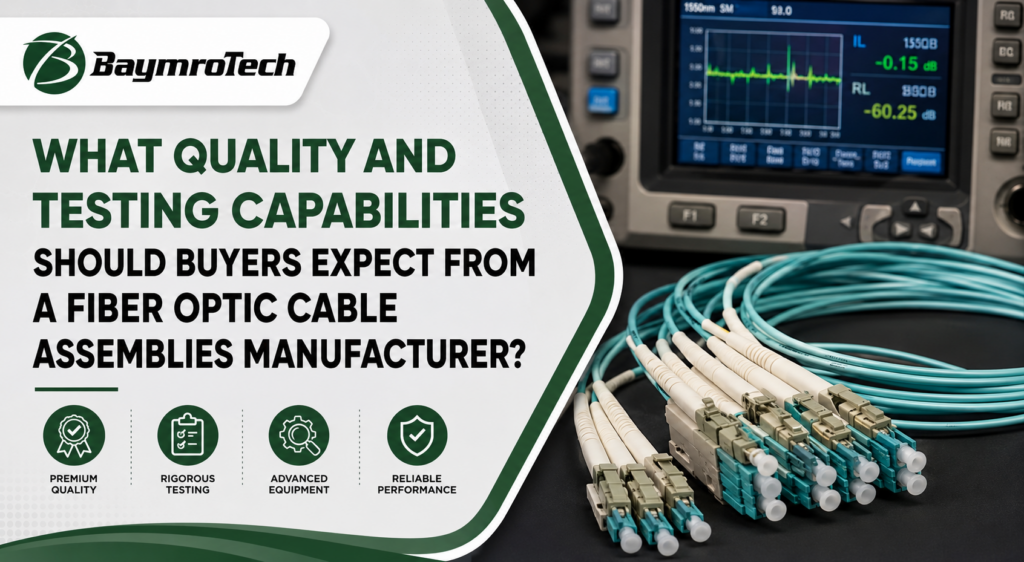
What Quality and Testing Capabilities Should Buyers Expect?
A serious fiber optic cable assemblies manufacturer should treat testing as part of production rather than an optional service.
At minimum, buyers should investigate whether the supplier has processes for optical performance testing, connector inspection, dimensional checks, and final quality verification.
For higher-risk applications, procurement teams may also need environmental or mechanical testing based on the installation conditions.
Important questions include:
- Are test instruments calibrated?
- Are test procedures standardized?
- Are results recorded?
- Can reports be supplied with the order?
- Is batch or lot traceability available?
- Are acceptance criteria agreed before production?
- Can samples be tested before mass production?
BaymroTech describes factory testing and inspection procedures for its fiber optic products, while its pre-terminated patch cord information states that products are assembled, tested, and inspected before shipment.
Procurement Risks and Common Supplier Selection Mistakes
Choosing a supplier based primarily on unit price can create hidden costs.
No OEM Capability
If a supplier is primarily a reseller, customization, branding, engineering changes, and specification control may be limited.
No Test Reports
Without test documentation, buyers have less evidence that assemblies consistently meet the required optical and mechanical specifications.
No Customization Support
Standard products may not fit every project. Limited customization can force engineering teams to redesign installation plans or source additional components.
Unstable Lead Times
Late deliveries can leave installation teams waiting for material, increase storage and labor costs, and delay project milestones.
Limited Technical Support
When technical questions arise, a supplier without engineering support may create unnecessary communication delays between procurement, engineering, and the factory.
Inconsistent Quality Control
A supplier that does not maintain standardized inspection and testing procedures may deliver variable quality between batches.
These risks demonstrate why supplier evaluation should consider total procurement risk rather than purchase price alone.
Procurement Checklist for Fiber Optic Cable Assemblies
Use the following checklist before approving a manufacturer:
| Procurement Factor | What Buyers Should Verify | Why It Matters |
| OEM capability | Private label, engineering and production support | Better specification control |
| MOQ | Standard and customized order requirements | Helps control inventory |
| Lead time | Standard and project-specific delivery | Supports deployment planning |
| Certifications | Applicable product and compliance documents | Supports market and project requirements |
| Testing reports | Optical and inspection test data | Provides quality evidence |
| Customization | Lengths, connectors, fiber counts and packaging | Supports project-specific requirements |
| Technical support | Engineering and pre-sales assistance | Reduces specification errors |
| Quality control | Incoming, process and final inspection | Improves consistency |
| Project references | Comparable telecom or infrastructure projects | Supports supplier validation |
| Supply chain stability | Materials, capacity and production planning | Reduces supply disruption |
This checklist can also be incorporated into an internal supplier scorecard so that technical, procurement, and project teams evaluate manufacturers using the same criteria.
Why BaymroTech?
For B2B buyers, BaymroTech positions itself as an OEM manufacturer and engineering-focused telecom equipment supplier rather than simply a trading company.
Its portfolio covers fiber optic cable assemblies and related connectivity products, while its broader manufacturing capabilities include fiber optic management, passive components, cabinets and racks, and copper cable assemblies. BaymroTech also states that its products and solutions have been deployed across more than 50 countries and regions.
From a procurement perspective, the value lies in having access to product manufacturing, customization, testing, and technical support through one supplier.
BaymroTech’s cable assembly portfolio includes standard and customized solutions, and its published product information highlights factory testing, inspection, connector options, and project-specific customization.
For larger projects, this type of supplier relationship can help procurement teams reduce unnecessary vendor fragmentation while maintaining closer control over specifications and repeat orders.
Frequently Asked Questions
What is a fiber optic cable assembly?
A fiber optic cable assembly is a prepared optical cable with connectors or termination components installed and tested for network connectivity.
Why are fiber optic cable assemblies important in telecom projects?
They provide reliable, standardized optical connections between network equipment, distribution systems, and other infrastructure components.
Can fiber optic cable assemblies be customized?
Yes. Depending on the manufacturer, buyers can request customized lengths, connector types, fiber counts, cable constructions, labeling, packaging, and other specifications.
What certifications should buyers request?
The required documentation depends on the product and deployment market. Buyers should request applicable IEC, RoHS, REACH, UL, Telcordia, or other project-specific compliance documentation where relevant.
What testing reports should a buyer request?
Depending on the product, buyers may request insertion loss, return loss, connector inspection, geometry, continuity, mechanical, or environmental test results.
How can buyers verify supplier quality?
Review quality procedures, testing capabilities, calibration practices, sample results, certifications, traceability systems, production facilities, and relevant project references.
What is the typical lead time?
Lead time depends on product configuration, quantity, customization, material availability, and production scheduling. Buyers should request a project-specific lead-time commitment rather than relying on a generic estimate.
Does MOQ apply to fiber optic cable assemblies?
MOQ policies vary by product and customization level. Standard products may have flexible ordering requirements, while specialized custom cable orders may have minimum quantity or length requirements.
Why is OEM capability important for telecom procurement?
OEM capability allows buyers to maintain control over product specifications, branding, packaging, customization, and repeat-order consistency.
Should buyers request samples before a bulk order?
For new suppliers or customized assemblies, sample evaluation is a practical way to verify dimensions, connector compatibility, optical performance, labeling, packaging, and overall workmanship before committing to larger volumes.
Request a Project-Specific RFQ From BaymroTech
The right fiber optic cable assemblies manufacturer should be evaluated against the actual requirements of your project.
Before requesting a quotation, prepare details such as:
- Required assembly type
- Fiber mode and count
- Connector types
- Connector polish
- Cable length
- Indoor or outdoor application
- Quantity
- Customization requirements
- Packaging and labeling requirements
- Required certifications
- Testing documentation
- Target delivery schedule
- MOQ expectations
BaymroTech can discuss OEM requirements, customized configurations, MOQ considerations, lead times, and project-specific fiber connectivity solutions with B2B buyers.
Discuss your fiber optic cable assembly requirements with BaymroTech
Final Takeaway
Selecting a fiber optic cable assemblies manufacturer should never be reduced to comparing two quotations. Quality systems, testing capabilities, OEM flexibility, customization, production capacity, technical support, documentation, and supply reliability all influence the real cost and success of a telecom infrastructure project.
Ready to evaluate a reliable fiber optic cable assemblies supplier for your next project? Contact BaymroTech today to discuss your specifications, request an RFQ, and build a connectivity solution around your technical and procurement requirements.
