

Did you know that a single fiber optic cable can transmit enough data to stream every Netflix show ever made—in less than a second? Yeah, it’s mind-blowing. But if you’re scrambling to pick the right fiber optic cable assembly for your project and ending up with a tangled mess of incompatibility headaches, you’re not alone. I’ve been there, staring at a pile of connectors wondering why nothing fits. In this post, we’ll cut through the confusion, explore types and real-world uses, and arm you with a simple guide to choose the perfect one—so you save time, money, and sanity.
What Exactly Are Fiber Optic Cable Assemblies?
Picture this: a fiber optic cable is like a superhighway for light signals, zipping data at speeds copper wires can only dream of. A cable assembly takes that cable and outfits it with connectors on both ends, turning raw fiber into a plug-and-play powerhouse ready for your network.
These assemblies aren’t one-size-fits-all. They’re custom-built (or pre-made) with specific fibers, jackets, and connectors to handle everything from harsh outdoor environments to delicate lab setups. According to the Fiber Broadband Association, global fiber optic deployments grew 20% in 2024 alone, fueling demand for reliable assemblies. We at Baymro Tech specialize in these—check out our custom fiber optic solutions if you’re ready to upgrade.
Why care? Poor choices lead to signal loss, downtime, or even fire hazards in extreme cases. Let’s dive into the types so you pick a winner.
Types of Fiber Optic Cable Assemblies: Your Options Breakdown
Fiber optic cable assemblies come in flavors for every need. I’ll break them down with real examples—no jargon overload.
Single-Mode vs. Multimode Assemblies
- Single-mode assemblies: Thin core (about 9 microns) for long-distance hauls. Light travels in one path, minimizing loss. Perfect for telecom backbones spanning miles. Fun fact: These power undersea cables connecting continents—over 1.4 million km worldwide, per TeleGeography.
- Multimode assemblies: Bigger core (50-62.5 microns) for shorter runs, like data centers. Light bounces multiple paths, but it’s cheaper and easier to install. Pro tip: OM3/OM4 versions hit 10G speeds up to 400 meters—ideal for most enterprise setups.
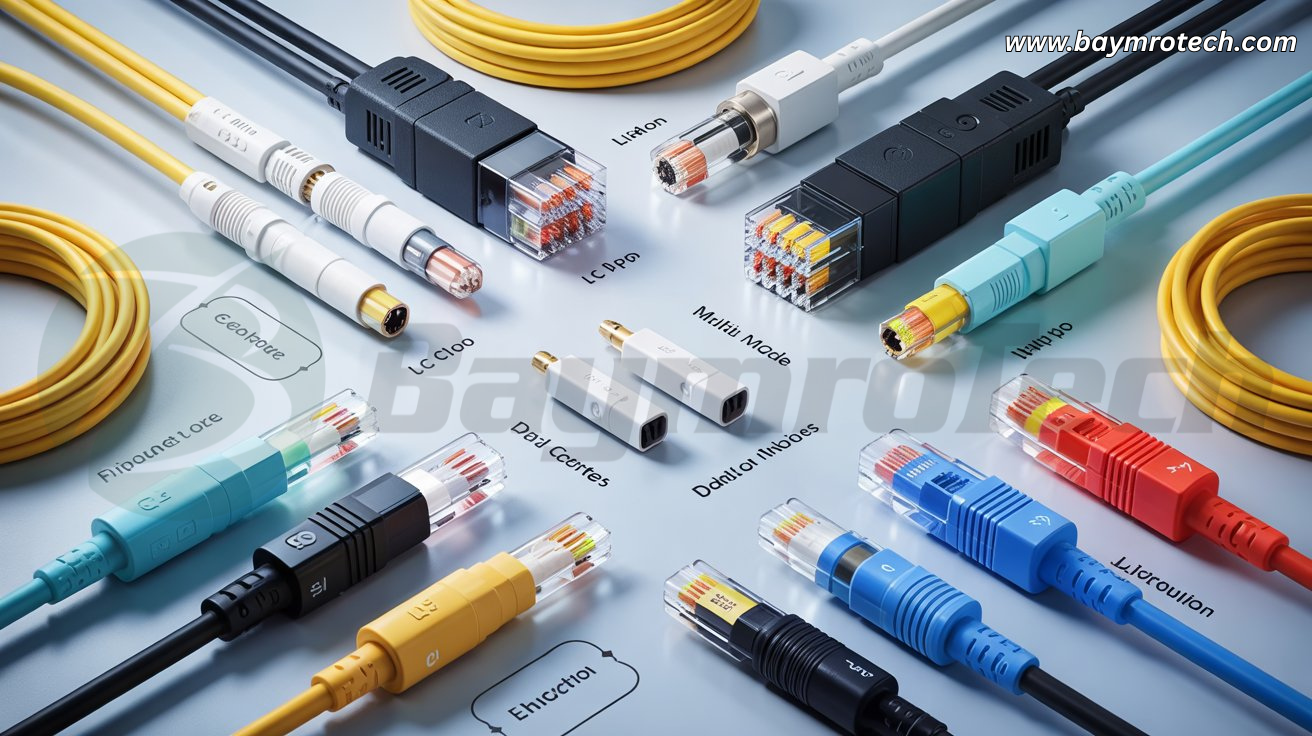
Connector Types That Make or Break Your Setup
Connectors are the “handshake” of fiber optics. Here’s the hit list:
- LC Connectors: Small, high-density champs for tight spaces. You’ll find them in Baymro Tech’s high-speed networking kits.
- SC Connectors: Push-pull design, reliable for telecom. Less fiddly than older ST types.
- MPO/MTP: Multi-fiber beasts for 40/100G networks. One connector handles 12+ fibers—game-changer for data centers.
- ST Connectors: Bayonet-style for legacy systems, but phasing out.
Jacket types matter too: PVC for indoors, LSZH (low-smoke zero-halogen) for safety in buildings, or armored for rodents and rocks outdoors. I once helped a client swap a cheap PVC assembly for armored in a construction site—saved them from a $10K rewiring nightmare.
Real-World Applications: Where These Assemblies Shine
Fiber optic cable assemblies aren’t lab toys; they’re everywhere powering our connected world. Here’s how they flex:
- Telecommunications: Backbone for 5G towers and FTTH (fiber-to-the-home). Single-mode assemblies dominate, carrying 100Tbps+ per fiber pair, as noted in a Lightwave Online report.
- Data Centers: Multimode MPO assemblies handle massive server farms. Hyperscalers like Google rely on them for AI workloads—fiber’s low latency is why your cloud apps feel instant.
- Industrial & Military: Rugged, armored assemblies endure oil rigs, factories, or submarines. EMI-proof, they laugh at electrical noise.
- Medical & Broadcasting: Precision LC assemblies in endoscopes or HD cameras ensure crystal-clear signals without interference.
Ever wonder why your home internet lags during peak hours? It’s often copper bottlenecks—switch to fiber assemblies, and poof, problem solved. A buddy of mine in broadcasting upgraded to SC assemblies and cut signal dropouts by 90%. Emotional win? His live streams finally stopped crashing mid-highlight reel.
How to Choose the Right Fiber Optic Cable Assembly: Your Step-by-Step Guide
Overwhelmed by options? Don’t sweat it. Follow this no-BS checklist—I use it daily at Baymro Tech.
- Match Your Distance & Speed Needs: Short run (<500m)? Go multimode. Long-haul? Single-mode. Calculate bandwidth with tools like Fiber Optic Association’s calculator.
- Pick the Connector: LC for density, MPO for high-speed. Test compatibility—mismatched polars can kill your link.
- Consider Environment: Outdoors? Armored + waterproof. Plenum spaces? OFNP-rated jackets.
- Check Insertion Loss & Testing: Aim for <0.3dB per connector. IL and RL matter—get pre-tested assemblies.
- Budget Smart: Pre-terminated saves install time (up to 70% faster, per industry stats), but custom beats generic for precision.
Humor break: Skipping step 3 once bit me—indoor assembly in a damp basement? Instant corrosion. Lesson learned: Always over-spec for Murphy’s Law.
Pro advice: Consult experts early. Our team at Baymro Tech runs free audits—reach out here to avoid pitfalls.
Common Mistakes to Dodge (And How We Fix Them)
- Ignoring Polish Types: APC (angled) beats UPC for reflections—vital for video apps.
- Overlooking Hybrids: Mix single/multimode? Use hybrid assemblies to bridge worlds.
- Cheap Imports: They fail 2x faster. Stick to certified ones like ours.
Stats back it: A 2023 FS.com study showed proper selection cuts downtime 40%.
Wrapping It Up: Light Up Your Network Right
Fiber optic cable assemblies are the unsung heroes of modern connectivity—types like single-mode LC or multimode MPO power telecom, data centers, and beyond. Nail your choice by matching distance, environment, and specs, and you’ll dodge costly errors.
Ready to future-proof your setup? Explore Baymro Tech’s fiber optic cable assemblies or contact our experts today for a custom quote. What’s your biggest fiber challenge? Drop a comment below—I’d love to hear and help!







1 Comment
[…] BaymroTech’s fiber optic cable assemblies portfolio includes MPO/MTP solutions, patch cords, pre-terminated patch cords, pigtails, adapters, connectors, field assembly connectors, fiber optic cables, and related solutions. Its product range is positioned for applications including data centers, FTTx, CATV, wireless networks, IPTV, and metro networks. […]