
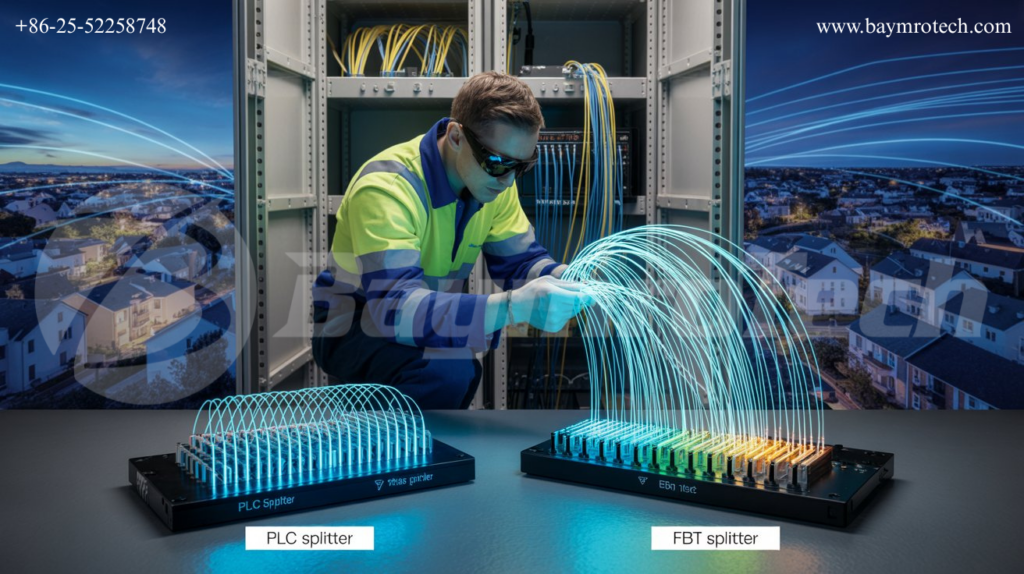
Imagine this: you’re wiring up a new FTTH rollout and suddenly realize you’ve ordered the wrong type of splitter. The project slows down, CAPEX creeps up, and your team starts asking “Why did we pick this in the first place?” You’re not alone—many engineers and procurement managers get tripped up on the PLC vs FBT splitter decision because it’s not just about price; it’s about performance, scale, and future‑proofing.
In this post, we’ll walk through the key differences between PLC splitters and FBT splitters, when to use each, and how to align them with products like Mini Splitters, ASB Box Splitters, LGX Splitters, and Rackmount Splitters you’ll find on baymrotech.com.
What are PLC and FBT Splitters?
An optical splitter shares one incoming fiber signal across multiple outgoing fibers so multiple users or devices can share the same backbone. In PON networks, splitters sit in the ODN (Optical Distribution Network) between the OLT (central office) and the ONUs/ONTs at the customer premises.
There are two main technologies:
- PLC Splitter (Planar Lightwave Circuit): Light passes through a waveguide circuit etched on a silicon chip, splitting the signal evenly across many ports.
- FBT Splitter (Fused Biconical Taper): Two or more fibers are fused and tapered together so the signal “leaks” between them and splits.
Both get the job done, but they behave very differently at scale, in temperature, and under tight budgets.
How PLC Splitters Work
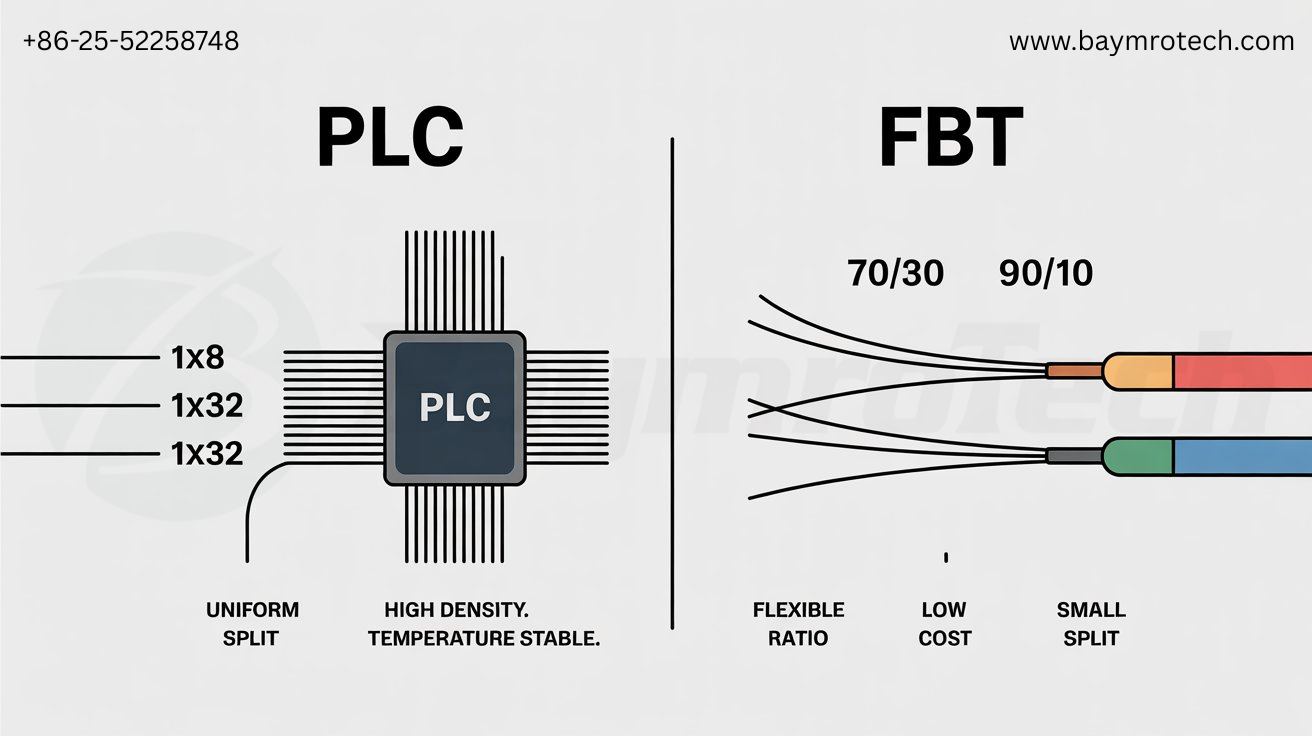
PLC splitters are built using planar waveguide technology on a small chip, similar to a tiny optical circuit board. Incoming light travels along this chip and is split into multiple equal‑power outputs, typically in standard ratios like 1×4, 1×8, 1×16, 1×32, or 1×64.
Key traits of PLC splitters:
- Uniform splitting: Output power is very consistent across all ports.
- High split counts: Can economically support 1×32 and 1×64 in dense FTTH/PON deployments.
- Temperature stability: Lower Temperature Dependent Loss (TDL), around 0.2 dB/°C, so performance stays steady in harsh outdoor environments.
Because of these strengths, PLC splitters power most modern FTTH, xPON, and large‑scale enterprise networks. If you’ve ever seen a rackmount splitter or LGX splitter in a central office or head‑end, it’s likely a PLC‑based design under the hood.
How FBT Splitters Work
FBT splitters are the older, more “mechanical” cousin. They start with two or more fibers fused together, then heated and stretched so the light couples between them at a controlled point. This lets manufacturers create custom, asymmetric ratios like 10/90, 20/80, or 30/70.
Typical use‑case characteristics:
- Low‑cost small splits: Often more economical for 1×2, 1×3, 1×4 taps.
- Flexible ratios: Great when you need to split power unevenly (for example, monitoring taps, test equipment, or legacy video‑distribution).
- Higher TDL: Insertion loss can drift more with temperature (up to ~0.5 dB/°C), so they’re less ideal in uncontrolled outdoor enclosures.
FBT splitters still show up in test benches, CATV systems, and some brown‑field upgrades where you only need a few branches and want to keep costs low.
Side‑by‑side: PLC vs FBT
Here’s a quick snapshot of the two technologies:
When to use PLC Splitters
PLC splitters sit at the heart of modern access networks. If any of the following sound familiar, PLC is usually the way to go:
- FTTH / GPON / XGS‑PON deployments with 32–64 subscribers per splitter.
- High‑density fiber panels using Rackmount Splitter or LGX Splitter chassis.
- Outdoor enclosures or wall‑mounted ASB Box Splitter type cabinets where temperature swings are wide.
For example, in a residential housing project with 64 ONTs, you’ll typically deploy 1×64 PLC splitters in centralized or cascaded stages rather than a bunch of FBT couplers. That keeps insertion loss stable, simplifies spares, and reduces cable congestion.
If you’re exploring mini PLC splitters for space‑constrained cabinets or compact FTTH boxes, check our Mini Splitter product page on baymrotech.com to see compact form‑factors that still pack full‑scale PLC performance.
When FBT Splitters still make sense
FBT isn’t obsolete—it’s just more specialized. You might choose FBT when:
- You need very low split counts (1×2, 1×3, 1×4) and tighter upfront budgets.
- You require non‑equal power splits, such as a 95/5 tap for monitoring or testing.
- You’re working in legacy CATV or analog video systems rather than pure PON.
One real‑world example: an engineer once used FBT couplers inside a head‑end to sample a small percentage of the main feed for a monitoring system, while the bulk of the traffic went to end users. That 95/5 split was easy and cheap with FBT, whereas a PLC splitter would have forced equal‑power branches and wasted signal.
How to match splitter type to your cabinet style
One of the most overlooked questions in fiber projects is: “Which splitter type fits my cabinet and deployment style?” Here’s a practical guide:
- Rackmount Splitter / LGX Splitter: Think data‑center‑style chassis. These almost always use PLC modules because you need high port density, uniform losses, and easy scalability.
- ASB Box Splitter (compact outdoor/local headend boxes): Often host PLC splitters for FTTH tap‑off points, but can sometimes include FBT for test or legacy taps.
- Mini Splitter (wall‑mount or compact enclosure): Frequently based on PLC technology to keep size small while supporting 1×8 or 1×16 splits.
If you’re still unsure, our fiber splitter selection guide on baymrotech.com walks you through enclosure types, loss budgets, and how different splitter technologies fit real‑world scenarios.
Making the final call: PLC or FBT?
Here’s a simple decision checklist you can use on the job:
- Choose PLC Splitter if:
- You’re building new FTTH/xPON.
- You need 1×8 or more splits.
- Temperature stability and uniform loss matter more than saving a few dollars per splitter.
- Choose FBT Splitter if:
- You only need 1×2 or 1×4 taps.
- You want custom ratios for monitoring or CATV.
- You’re on a tight shoe‑string budget and won’t go beyond small splits.
Remember: in most modern designs, PLC splitters are the default choice, while FBT splitters are the niche fixer.
Wrapping up and what to do next
To recap:
- PLC splitters excel in high‑density, temperature‑varying, PON/FTTH environments and work beautifully with LGX, Rackmount, ASB Box, and Mini Splitter styles.
- FBT splitters are cheaper for small taps and flexible ratios but struggle with high splits and temperature swings.
If you’re planning a new FTTH rollout, a campus fiber upgrade, or simply want to audit your existing splitter strategy, consider downloading our Fiber Splitter Application Guide (linked on baymrotech.com) and checking out our PLC Splitter product page for compact, rack, and enclosure‑ready options.
Got a tricky splitter scenario on your desk? Drop us a line through the contact form on baymrotech.com—we’ll help you pick the right PLC Splitter, Mini Splitter, ASB Box Splitter, LGX Splitter, or Rackmount Splitter combination for your project.