Introduction
Telecom contractors are under constant pressure to complete fiber network deployments faster while maintaining installation quality and controlling project costs. As fiber-to-the-home (FTTH) expansion continues to accelerate, operators, infrastructure developers, and engineering contractors are expected to deliver reliable connectivity within increasingly demanding project schedules.
One factor that is often overlooked during procurement planning is the selection of the FTTH termination box. While it may appear to be a small component within a larger network infrastructure project, the right termination box can significantly influence installation speed, cable management efficiency, maintenance accessibility, and long-term network reliability.
Choosing the wrong supplier or product specification can result in inconsistent quality, difficult installation procedures, unstable lead times, higher maintenance costs, and unnecessary project delays. For procurement teams and contractors, selecting an FTTH termination box supplier should be viewed as a strategic sourcing decision rather than a simple price comparison.
This article explores how telecom contractors can reduce installation time by choosing the right FTTH termination box while also providing a practical supplier evaluation framework for procurement professionals.
What Is an FTTH Termination Box?
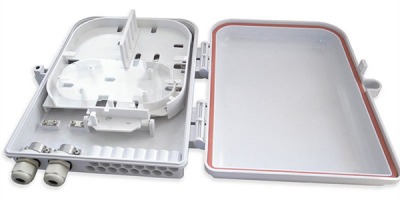
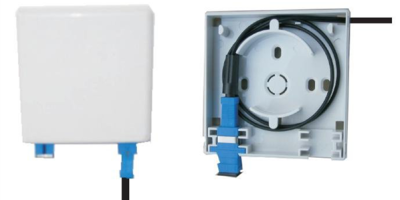
An FTTH termination box is a fiber management enclosure designed to terminate, organize, protect, and distribute optical fiber connections at the subscriber or distribution point level.
The box provides a secure location for fiber splicing, connector management, cable routing, and subscriber connection termination. It helps protect delicate fiber connections from environmental exposure, physical damage, and unauthorized access.
In modern FTTH networks, termination boxes play a critical role in ensuring efficient installation, simplified maintenance, and long-term network stability.
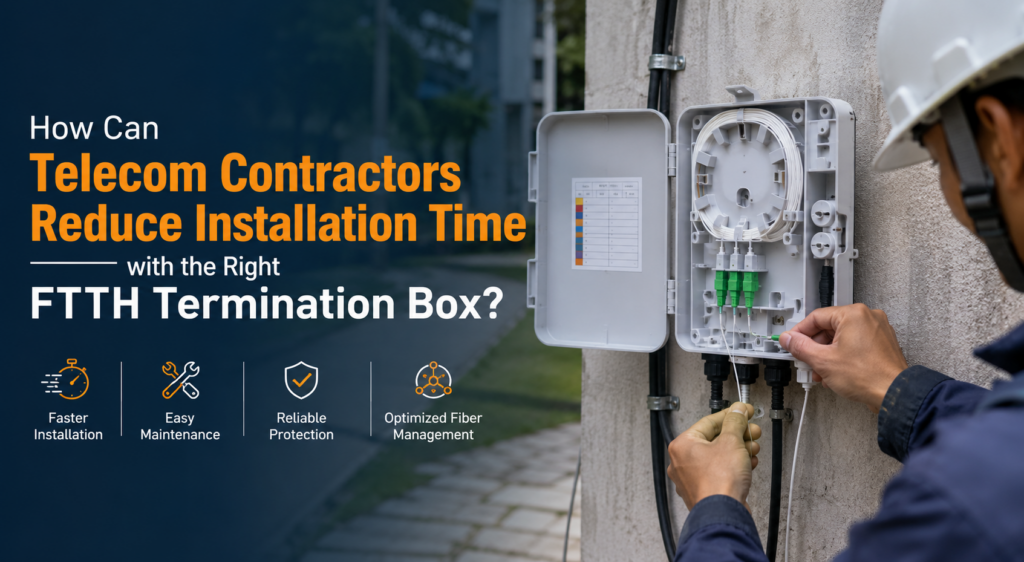
How the Right FTTH Termination Box Helps Reduce Installation Time
Installation efficiency is directly influenced by product design.
A well-designed FTTH termination box can help contractors:
- Reduce cable preparation time
- Simplify fiber routing
- Accelerate connector installation
- Minimize splicing errors
- Improve technician productivity
- Reduce rework requirements
- Enable faster network activation
Features that commonly contribute to faster installation include:
- Pre-designed cable management paths
- Easy-access splice trays
- Tool-free installation structures
- Clear labeling areas
- Flexible cable entry points
- Compact and organized internal layouts
- Support for pre-terminated fiber solutions
When multiplied across hundreds or thousands of deployment locations, even small installation time savings per unit can create substantial project-level efficiency gains.
Applications and Industry Use Cases
FTTH termination boxes are widely used across various telecommunications and infrastructure projects.
Residential FTTH Networks
Service providers use termination boxes to connect subscriber premises to fiber distribution networks. Efficient designs help technicians complete installations more quickly and consistently.
Multi-Dwelling Units (MDUs)
Apartment buildings often require organized fiber management to serve multiple subscribers. Proper termination boxes simplify deployment and future maintenance.
Smart City Infrastructure
Municipal fiber projects rely on reliable termination solutions for public connectivity systems, surveillance networks, and digital infrastructure.
Commercial Buildings
Office complexes, industrial facilities, and enterprise campuses use FTTH termination boxes to support high-speed communication networks.
Rural Broadband Expansion
Contractors working in remote locations benefit from installation-friendly designs that reduce field labor requirements and simplify deployment.
Telecom Network Upgrades
Existing networks undergoing modernization often require efficient fiber management solutions that minimize service disruption during installation.
Different projects often require different port capacities, environmental protection ratings, mounting options, certifications, and customization features. Because project requirements vary significantly, supplier evaluation becomes just as important as product selection.
What Should Buyers Evaluate When Selecting an FTTH Termination Box Supplier?
For procurement professionals, the supplier’s capabilities often determine project success more than the product itself.
1. OEM Manufacturing Capability
OEM capability allows suppliers to provide products tailored to specific project requirements.
Benefits include:
- Custom branding
- Specialized configurations
- Project-specific dimensions
- Unique port arrangements
- Customized packaging
Telecom contractors managing large deployments frequently require customized solutions that align with project specifications and operator standards.
BaymroTech supports OEM manufacturing services that help customers meet project-specific deployment requirements.
2. Customization Options
Every fiber deployment project is different.
Buyers should evaluate whether suppliers can provide:
- Customized port counts
- Material options
- Wall-mount designs
- Pole-mount configurations
- Indoor and outdoor versions
- Special cable entry structures
- Color customization
Customization flexibility can significantly reduce installation challenges in the field.
3. MOQ Requirements
Minimum order quantity requirements can directly affect procurement planning.
Buyers should determine:
- Standard MOQ
- Custom product MOQ
- Sample order availability
- Pilot project support
Flexible MOQ policies are particularly beneficial for network testing phases and regional rollout programs.
4. Lead Time Stability
Project delays often originate from unreliable supply schedules.
Procurement teams should evaluate:
- Production lead times
- Historical delivery performance
- Inventory management systems
- Capacity planning procedures
Reliable lead times help contractors maintain deployment schedules and avoid costly project disruptions.
5. Product Certifications
Certification compliance demonstrates product quality and regulatory alignment.
Common certifications may include:
- ISO quality management standards
- RoHS compliance
- CE compliance
- Environmental protection standards
Certification requirements often vary by region and customer specification.
6. Testing Reports
Testing documentation provides evidence of product performance.
Buyers should request reports covering:
- Mechanical durability
- Environmental resistance
- Fiber management performance
- Impact resistance
- Aging tests
Verified testing reports reduce procurement risk and improve confidence during supplier selection.
7. Quality Control Procedures
Consistent quality control is critical for large-scale deployments.
Evaluate whether suppliers conduct:
- Incoming material inspections
- In-process quality checks
- Assembly verification
- Final product inspections
- Packaging inspections
Strong quality management reduces field failures and installation issues.
8. Technical Support Capability
Technical support can directly impact deployment efficiency.
Buyers should assess:
- Engineering support availability
- Product documentation quality
- Installation guidance
- Troubleshooting assistance
- Response times
Experienced technical teams help contractors resolve issues quickly.
9. Production Capacity
Large telecom projects often require significant product volumes.
Procurement teams should understand:
- Monthly production capacity
- Factory scalability
- Equipment capabilities
- Workforce capacity
Insufficient production capacity may create supply bottlenecks during large rollouts.
10. Supply Chain Reliability
A stable supply chain helps ensure uninterrupted project execution.
Key evaluation factors include:
- Raw material sourcing
- Supplier diversification
- Inventory planning
- Logistics management
Supply chain resilience has become increasingly important for telecom infrastructure projects.
11. Project References
Past project experience can provide valuable insight into supplier capabilities.
Buyers should request:
- Industry references
- Deployment case studies
- Customer testimonials
- Export experience
Strong project references often indicate proven performance and reliability.
Procurement Risks and Common Supplier Selection Mistakes
Selecting a supplier solely based on pricing can create significant long-term challenges.
No OEM Capability
Suppliers without OEM support may be unable to meet project-specific requirements, leading to installation inefficiencies.
No Testing Reports
Without documented testing, buyers have limited visibility into product performance and reliability.
No Customization Support
Standard products may not fit unique deployment environments, increasing installation complexity.
Unstable Lead Times
Delivery delays can halt construction schedules and increase project costs.
Limited Technical Support
Insufficient support can slow issue resolution and negatively impact deployment timelines.
Inconsistent Quality Control
Variations in product quality often result in field failures, rework, and customer complaints.
For telecom contractors, these risks can ultimately affect project profitability, customer satisfaction, and future contract opportunities.
FTTH Termination Box Supplier Evaluation Checklist
| Evaluation Factor | Verify Before Purchase |
| OEM Manufacturing Capability | ✓ |
| Minimum Order Quantity (MOQ) | ✓ |
| Stable Lead Time | ✓ |
| Product Certifications | ✓ |
| Testing Reports Available | ✓ |
| Customization Options | ✓ |
| Technical Support Team | ✓ |
| Quality Control Procedures | ✓ |
| Telecom Project References | ✓ |
| Supply Chain Stability | ✓ |
This checklist can help procurement teams compare suppliers more effectively and reduce sourcing risks.
Why BaymroTech Is a Trusted Partner for FTTH Termination Box Projects
For telecom operators, contractors, system integrators, and infrastructure developers, supplier selection extends beyond product pricing.
BaymroTech operates as an OEM manufacturer and B2B supplier focused on fiber optic connectivity solutions. The company supports customers through engineering-driven manufacturing processes designed to meet diverse project requirements.
Key strengths include:
- OEM manufacturing support
- Custom product development
- Flexible configuration options
- Professional technical assistance
- Quality-focused production processes
- Reliable supply capabilities
- Support for global telecom infrastructure projects
By combining manufacturing expertise with project-focused support, BaymroTech helps customers improve deployment efficiency while reducing procurement risks.
Frequently Asked Questions
What is an FTTH termination box?
An FTTH termination box is a fiber management enclosure used to terminate, organize, and protect optical fiber connections.
Why is it used in telecom projects?
It helps manage fiber connections efficiently while improving installation quality, maintenance accessibility, and network reliability.
Can FTTH termination boxes be customized?
Yes. Many OEM manufacturers offer customization options including port configuration, mounting methods, branding, and enclosure design.
What certifications should buyers request?
Common certifications include ISO quality certifications, RoHS compliance documentation, CE compliance, and relevant testing reports.
What is the typical lead time?
Lead times vary based on product specifications, order volume, customization requirements, and supplier production capacity.
How can buyers verify supplier quality?
Buyers should review testing reports, certifications, quality control procedures, factory capabilities, and project references.
Why is OEM capability important?
OEM capability allows suppliers to provide solutions tailored to specific project requirements, improving installation efficiency and deployment outcomes.
What procurement risks should buyers avoid?
Common risks include unstable lead times, poor quality control, lack of testing reports, limited customization options, and insufficient technical support.
Discuss Your FTTH Termination Box Requirements with BaymroTech
Whether you are planning a residential FTTH rollout, smart city infrastructure deployment, commercial fiber project, or broadband expansion initiative, selecting the right FTTH termination box supplier is essential for reducing installation time and ensuring long-term network performance.
BaymroTech can assist with:
- OEM manufacturing requirements
- Product customization needs
- MOQ planning
- Lead time evaluation
- Technical specifications
- Project-specific deployment solutions
Contact the BaymroTech team today to discuss your procurement goals and identify the most suitable FTTH termination box solution for your project.
Ready to reduce installation time and procurement risk? Contact BaymroTech today to evaluate supplier capabilities, compare customization options, and secure the right FTTH termination box solution for your next telecom deployment project.