
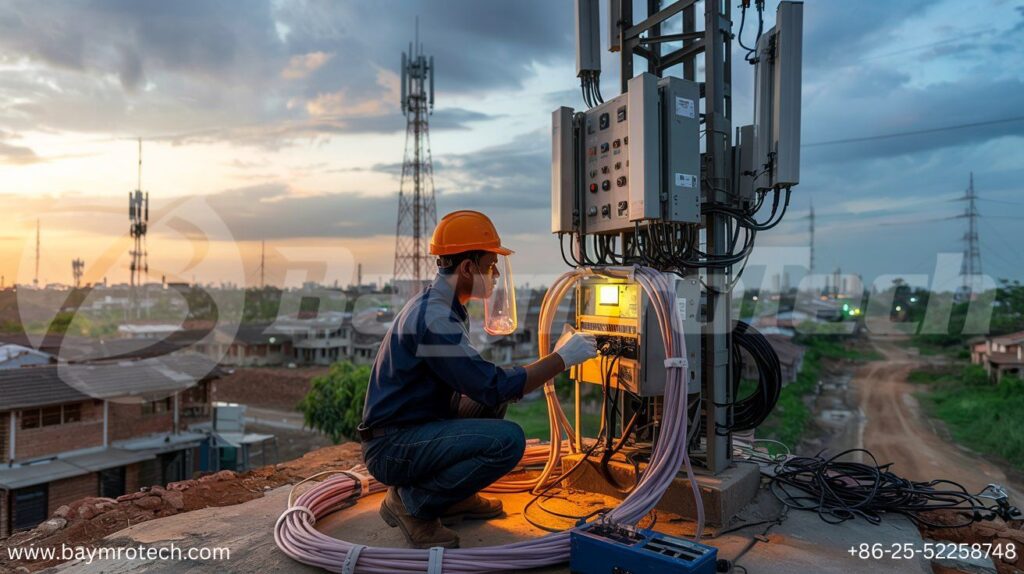
Imagine trying to stream a simple product demo over a shaky connection while your conference call drops every five minutes. Frustrating, right? For businesses and consumers in many emerging markets, that’s an everyday reality. The pain point is clear: unreliable networks slow growth, frustrate users, and repel investment. In this post, we’ll unpack the root telecom infrastructure challenges in emerging markets and offer practical, tech-forward solutions you can act on—whether you’re a network operator, policy maker, or business relying on connectivity.
Why this matters now
Mobile and fixed broadband demand is skyrocketing across regions like South Asia, Africa, and parts of Latin America. According to the ITU, global internet users surpassed 5 billion in recent years, but connectivity quality and access remain uneven. Poor infrastructure doesn’t just inconvenience consumers—it limits e-commerce, digital education, telehealth, and smart-grid deployments. Fixing these gaps unlocks economic opportunity.
Major telecom infrastructure challenges
- Limited fiber backbone and last-mile connectivity
- The challenge: Many emerging markets have underdeveloped fiber backbones and inconsistent last-mile links. Urban centers might have decent fiber, but smaller towns and rural areas often depend on old copper, microwave links, or weak mobile coverage.
- Why it hurts: Copper and microwave struggle to support high-speed broadband, and wireless-only approaches can’t always handle heavy enterprise loads or low-latency applications.
- Power reliability and operational costs
- The challenge: Frequent power outages and the high cost of diesel backup for base stations inflate operating expenses and reduce uptime.
- Why it hurts: Cellular towers and data centers need continuous power. Unreliable grids increase maintenance costs and harm service quality.
- Spectrum allocation and regulatory hurdles
- The challenge: Slow or complex regulatory frameworks, unpredictable spectrum auctions, and overlapping jurisdictional rules slow network rollouts.
- Why it hurts: Delays in obtaining spectrum or permits increase project timelines and costs, discouraging investment.
- High CAPEX for dense coverage
- The challenge: Building dense fiber or small-cell networks requires large upfront capital. Return on investment in low-income areas is uncertain.
- Why it hurts: Operators may defer investment in less profitable regions, keeping digital divides intact.
- Skilled workforce shortages and maintenance challenges
- The challenge: Skilled fiber technicians, RF engineers, and data center operators can be scarce. Maintenance regimes are sometimes reactive rather than proactive.
- Why it hurts: Poor installation or upkeep reduces network lifespan and increases downtime.
- Geography and last-mile complexity
- The challenge: Mountains, islands, and sparsely populated regions complicate physical network deployment.
- Why it hurts: Costs per subscriber spike, and traditional deployment models become economically unviable.
Practical solutions—actionable ways to bridge the gap
- Prioritize fiber where it matters (and use alternatives smartly)
Deploy fiber to anchor points and high-traffic corridors (metro areas, industrial parks, and educational hubs). For last-mile coverage, combine technologies:
- Fiber for backbone and business-critical links.
- Fixed wireless access (FWA) and 5G for rapid suburban/urban coverage.
- Satellite broadband (LEO and hybrid models) for remote, low-density areas.
When installing fiber, don’t forget quality components—things like a reliable Fiber Optic Patch Cord help reduce insertion loss and maintenance headaches at splice points and patch panels. Using quality patch cords in data centers and exchanges reduces troubleshooting time and improves performance.
- Invest in renewable power solutions
Reduce dependence on diesel with hybrid power systems:
- Solar-plus-battery for rural base stations.
- Microgrids for clusters of towers or rural communities.
This approach lowers operating costs, improves uptime, and reduces carbon footprints—something investors increasingly value.
- Simplify permits and introduce incentives
Governments can speed deployments by:
- Streamlining permitting processes for right-of-way and tower builds.
- Offering tax breaks or co-investment for network rollouts in underserved areas.
- Setting predictable spectrum auction rules.
Regulatory clarity attracts long-term investment and speeds expansion.
- Use shared infrastructure and neutral hosts
- Encourage tower sharing, neutral-host small cells, and open-access fiber models.
- Municipal or cooperative fiber can lower CAPEX for operators and encourage competition.
Shared infrastructure reduces duplication, speeds deployment, and improves economics for rural coverage.
- Build local capacity and remote operations
- Invest in training local fiber splicing and RF maintenance skills.
- Use remote monitoring, predictive maintenance software, and AI-driven fault detection to move from reactive to proactive upkeep.
This lowers downtime and creates local jobs—winning both operationally and socially.
- Flexible financing and public–private partnerships (PPPs)
- Blended finance models that combine concessional public funding with private capital can lower risk for operators.
- PPPs for fiber backbones and data centers help align public interest with commercial efficiency.
- Design networks for future upgrades
- Build fiber ducts and conduits during roadworks or other civil projects to avoid repeated digs (dig-once policy).
- Standardize on modular, scalable equipment that supports easy upgrades to higher capacities or different technologies.
Real-world examples and lessons
- Kenya’s success with mobile money was enabled by widespread mobile coverage and pragmatic regulation. Targeted investments and supportive policies catalyzed adoption.
- In India, initiatives to expand fiber to gram panchayats and school networks show how government-led backbone projects can reduce costs for last-mile operators.
- Companies in sub-Saharan Africa increasingly deploy solar-powered base stations with remote monitoring, lowering diesel dependency and extending uptime.

A brief anecdote
When I visited a small manufacturing park outside Kolkata, the company’s morning routine included a daily prayer—and a prayer that the router wouldn’t drop the ERP connection. They’d invested in a microwave backhaul as a quick fix, but the link struggled during monsoon season. A local operator solved it by trenching a short fiber spur from a nearby industrial corridor and installing quality patch cords and optical termination hardware. The uptime improved, the factory could implement cloud-based quality control, and productivity rose. Small infrastructure investments unlocked big operational gains.
Supporting data and sources
- The International Telecommunication Union provides global connectivity trends and user statistics (ITU data on internet usage).
- The GSMA reports on mobile infrastructure strategies and the economics of rural coverage, including insights on shared infrastructure and energy solutions.
- Recent analyses from the World Bank outline financing models and regulatory reforms that promote broadband expansion.
(Links: ITU statistics, GSMA rural coverage report, World Bank broadband financing overview)
How to get started in your region: a checklist
- Map existing assets: identify fiber backbones, towers, and power reliability.
- Prioritize corridors with high socio-economic impact: schools, hospitals, industrial parks.
- Assess hybrid tech mix: fiber, 5G/FWA, satellite.
- Engage regulators early: secure permits and incentives.
- Plan power solutions: grid + solar/battery options.
- Train or contract local technicians and set up remote monitoring.
- Explore PPP or blended finance for CAPEX support.
Internal resources at baymrotech
- See our guide on practical fiber deployment strategies for urban and peri-urban sites for step-by-step how-tos. (Internal link)
- For hardware options, check our product pages and specifications to choose robust patch panels and cabling components that match your rollout needs. (Internal link)
Conclusion and next steps
Telecom infrastructure in emerging markets faces clear challenges, but each has practical, cost-effective solutions. The winning strategies combine targeted fiber deployment, smart hybrid technologies, renewable power, regulatory clarity, shared infrastructure, and local capacity building. Start small—map your assets and pilot a hybrid solution in a high-impact area. Then scale with predictable regulation and blended financing.
Want help planning a rollout or choosing the right components for your network? Contact our team or browse our deployment guides on baymrotech.com/electric to get tailored recommendations. Have a specific challenge in your region? Tell us where you are and what’s blocking you—let’s troubleshoot it together.