Introduction
Data center fiber infrastructure is becoming denser as network operators deploy higher-speed connections while trying to make better use of limited rack and pathway space. This has increased the importance of structured, high-density fiber connectivity, particularly in environments where large numbers of parallel fibers must be managed efficiently.
MPO and MTP cassettes are designed to simplify this type of deployment. They provide a transition between high-density MPO/MTP trunk connections and individual fiber connections, often using LC interfaces for equipment-side connectivity.
However, choosing the right cassette is not simply a matter of selecting the required number of ports. Fiber count, Base-8, Base-12 or Base-24 architecture, polarity, connector gender, fiber type, insertion-loss performance, LC breakout configuration, and rack density can all affect whether the cassette is technically suitable for the network.
A mismatch can create problems such as excessive optical loss, incorrect polarity, incompatible connectors, difficult installation, or inefficient use of rack space. These issues can lead to additional labor, project delays, rework, and higher total cost of ownership.
For telecom operators, data center developers, system integrators, engineering contractors, and procurement teams, the better approach is to select the cassette according to the actual optical architecture first, then evaluate the manufacturer based on its ability to consistently deliver that specification.
What Is an MPO MTP Cassette?
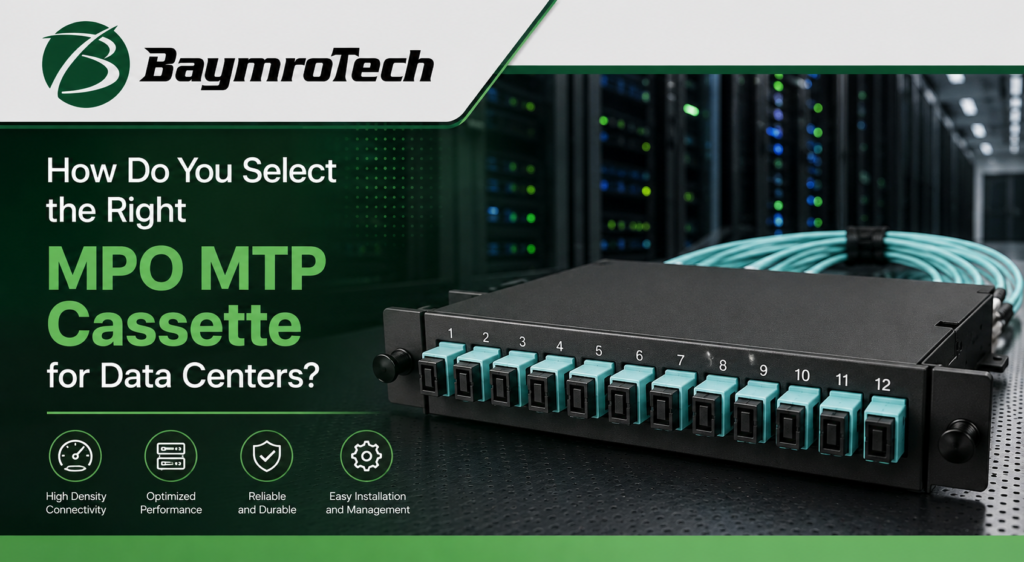
An MPO MTP cassette is a modular fiber connectivity unit that converts a high-density MPO or MTP connection into multiple lower-count fiber connections.
A typical configuration uses an MPO or MTP connector on the trunk side and multiple LC adapters on the breakout side. Depending on the design, a single cassette can organize multiple fiber channels within a compact enclosure.
This allows network designers to connect high-density backbone cabling to switches, servers, patch panels, or other equipment without managing every individual fiber directly from the trunk cable.
The cassette therefore acts as an important transition point within a structured cabling system.
For buyers, the critical question is not simply whether a supplier offers an MPO MTP cassette. It is whether the cassette matches the fiber architecture, polarity scheme, connector configuration, optical budget, and physical density of the planned network.
How Should You Match Fiber Count to the Network Architecture?
Fiber count is one of the first technical specifications buyers should establish.
MPO/MTP systems can be configured around different fiber-count architectures, with Base-8, Base-12, and Base-24 designs commonly considered for different connectivity requirements.
Base-8 Architecture
Base-8 systems organize connectivity in groups of eight fibers. This architecture is particularly relevant to high-speed parallel optical applications where transceiver configurations use eight-fiber connectivity.
For data center designers, Base-8 can provide an efficient pathway for applications that align with eight-fiber transmission architectures.
Base-12 Architecture
Base-12 has historically been widely used in structured fiber systems and provides 12 fibers within an MPO/MTP interface.
A Base-12 cassette can be suitable where existing backbone infrastructure, patching systems, or network equipment is designed around 12-fiber connectivity.
However, buyers should not select Base-12 simply because it is common. The cassette should correspond with the actual transceiver and trunk architecture.
Base-24 Architecture
Base-24 configurations can provide greater fiber density by grouping more fibers within the overall system architecture.
This can be useful in large data center environments where high fiber counts must be accommodated within limited rack space.
The important consideration is compatibility between the trunk cable, cassette, patching architecture, and equipment connections.
Why Does MPO/MTP Polarity Matter?
Polarity determines how transmit and receive fibers are correctly aligned between connected optical equipment.
If the polarity scheme is incorrect, the physical connection may appear correct while the optical paths do not communicate properly.
Common MPO/MTP polarity methods include Method A, Method B, and Method C. The correct method depends on the overall cabling architecture and the way the trunk cables, cassettes, patch cords, and equipment transceivers are connected.
Method A
Method A generally maintains a consistent fiber position from one end of the trunk to the other. The required polarity may then be achieved through appropriate components at the connection points.
Method B
Method B reverses the fiber positions across the connection. This can be useful in architectures where the transmit and receive paths need to be swapped through the trunk system.
Method C
Method C uses pair-wise fiber position reversal and may be appropriate for specific duplex connectivity architectures.
The key procurement lesson is simple: do not order an MPO MTP cassette without confirming the project’s complete polarity design.
The cassette must work with the selected trunk cables, patch cords, transceivers, and connection method. A supplier should be able to review the intended configuration and confirm compatibility before production.
Male or Female MPO/MTP: Which Should You Choose?
MPO/MTP connector gender is another specification that should be confirmed before purchasing.
MPO/MTP connectors may use guide pins or pinless configurations depending on the connection architecture. A pinned connector generally mates with a corresponding connector designed to accept the guide pins.
Selecting the wrong configuration can prevent proper mating or require additional components.
Buyers should therefore confirm:
- MPO or MTP connector type
- Male or female configuration
- Pinned or pinless design
- Connector polarity
- Key orientation
- Compatibility with the trunk cable and mating component
This is a relatively small specification, but an incorrect selection can create significant installation problems.
How Does the LC Breakout Configuration Affect Selection?
The equipment side of an MPO MTP cassette commonly uses LC adapters because LC connections are widely used for individual duplex fiber links.
The breakout arrangement determines how the fibers inside the MPO/MTP interface are distributed across the LC ports.
For example, a cassette may provide multiple LC duplex connections from a single high-density MPO/MTP input. The exact number depends on the fiber count and configuration.
Buyers should evaluate:
- Number of LC ports
- Duplex or simplex LC configuration
- LC adapter type
- Fiber mapping
- Polarity
- Port identification and labeling
- Front-panel density
- Compatibility with the connected equipment
A high-density cassette can reduce the amount of rack space required, but density should not come at the expense of accessibility or clear fiber management.
How Does Fiber Type Affect MPO MTP Cassette Selection?
The cassette should be matched to the fiber used throughout the network.
Single-Mode Fiber
Single-mode configurations are widely used for longer-distance optical transmission and telecom or data center interconnection requirements.
Buyers should verify the appropriate single-mode fiber specification and ensure the cassette is compatible with the selected trunk and patching components.
Multimode Fiber
Multimode configurations are commonly used for shorter-distance data center connections.
The specific multimode fiber category should be considered alongside the transceiver and network application because optical performance requirements can vary.
Mixing incompatible fiber types within the connectivity architecture can create performance and deployment problems. The cassette, trunk cable, patch cord, and transceiver should therefore be treated as one connected optical system.
Why Is Insertion Loss Important?
Insertion loss is one of the most important technical specifications when selecting an MPO MTP cassette.
Every connector and transition within a fiber link contributes some optical loss. The cassette therefore needs to fit within the total link loss budget.
A buyer should consider:
Total optical loss = connector loss + cassette loss + patch cord loss + trunk cable loss + other connection losses
If the combined loss exceeds the available optical budget, the link may not provide reliable transmission.
Standard-loss and low-loss cassette configurations may therefore be available for different applications.
For higher-performance networks, buyers should not select a cassette solely based on physical compatibility. They should confirm the expected insertion-loss performance and calculate whether it fits within the complete link budget.
Return loss should also be considered where relevant because it indicates the amount of optical power reflected toward the source.
How Does Cassette Density Affect Data Center Design?
One of the main reasons to use MPO MTP cassettes is to increase fiber density.
A compact cassette can organize many fiber connections within a relatively small rack footprint. This can be particularly useful in high-density distribution areas where traditional point-to-point patching would require more space and create more complex cable management.
However, maximum density is not automatically the best design.
Buyers should also consider:
- Port accessibility
- Fiber bend radius
- Cable routing
- Label visibility
- Maintenance access
- Airflow around rack equipment
- Future expansion
- Compatibility with existing fiber management systems
A well-designed cassette should balance density with practical installation and maintenance requirements.
Where Are MPO MTP Cassettes Used?
High-Density Data Centers
MPO MTP cassettes are commonly used to organize backbone and equipment-side fiber connections within high-density data center racks.
They can simplify connections between distribution panels and network equipment while reducing the number of individual fibers that must be routed through the rack.
Switch-to-Panel Connectivity
Cassettes can provide an organized transition between MPO/MTP trunk infrastructure and LC-based switch connections.
This makes them useful in structured cabling systems where high-density backbone connectivity needs to be converted into manageable duplex links.
Telecom Networks
Telecom operators and infrastructure providers can use MPO/MTP connectivity where compact, scalable fiber distribution is required.
Colocation Facilities
Colocation environments often need flexible fiber infrastructure because different customers may require different connectivity configurations. Modular cassette systems can support organized and scalable fiber deployment.
Enterprise Data Centers
Enterprise environments can also use MPO MTP cassettes where rack density, structured cabling, and future expansion are important considerations.
What Should Buyers Check Before Ordering an MPO MTP Cassette?
Once the technical architecture is established, procurement teams can evaluate the supplier against the actual project requirement.
Confirm the Exact Configuration
The RFQ should specify fiber count, connector type, polarity, gender, fiber type, LC configuration, and required optical performance.
Avoid descriptions such as simply “MPO cassette” because they leave too many technical variables open.
Check Customization Requirements
Projects may require specific port layouts, labeling, adapter configurations, fiber types, polarity arrangements, housing designs, or other modifications.
An OEM manufacturer can be particularly valuable when the required configuration differs from a standard catalogue product.
Request Test Documentation
Testing should correspond to the agreed technical specifications. Depending on the project, buyers may request insertion-loss, return-loss, polarity, and other relevant test information.
Review Lead Time
Custom configurations may require different production schedules from standard products. Confirm the expected production and delivery timeline before placing the purchase order.
Clarify MOQ
MOQ requirements can affect pilot projects, phased deployments, spare inventory, and large-scale rollouts. Buyers should establish the minimum order quantity early in the procurement process.
Evaluate Quality Consistency
For large data center deployments, consistency between batches is critical. A cassette installed during the first phase should perform and fit as expected when additional quantities are ordered later.
Consider Technical Support
A technically capable supplier should be able to help verify polarity, connector configuration, fiber architecture, optical specifications, and compatibility before manufacturing begins.
Common MPO MTP Cassette Selection Mistakes
Selecting by Fiber Count Alone
A 12-fiber or 24-fiber cassette may appear suitable based on capacity, but fiber count alone does not confirm compatibility with the network architecture.
Ignoring Polarity
An incorrect polarity arrangement can prevent the transmit and receive paths from aligning correctly.
Ordering the Wrong Connector Gender
Male and female MPO/MTP configurations need to match the mating components.
Choosing the Lowest Optical Specification
A cassette with higher insertion loss may not fit within the project’s optical budget.
Overlooking Fiber Type
Single-mode and multimode systems have different application requirements. The cassette must match the rest of the optical link.
Maximizing Density Without Considering Maintenance
A very dense installation can become difficult to access if cable routing, labeling, bend radius, and serviceability are not considered.
Treating Every Cassette as Interchangeable
Different architectures can require different polarity, fiber counts, connector arrangements, and performance specifications. A cassette should be selected as part of the complete cabling system.
MPO MTP Cassette Procurement Checklist
Before releasing an RFQ or purchase order, buyers can confirm the following:
| Technical / Procurement Factor | Buyer Confirmation |
| Fiber count | Base-8, Base-12, Base-24 or required configuration |
| Fiber type | Single-mode or multimode |
| MPO/MTP connector | Correct connector and interface type |
| Gender | Male/female or required pin configuration |
| Polarity | Method A, B, C or project-specific arrangement |
| LC breakout | Required LC simplex/duplex configuration |
| Insertion loss | Within the project’s optical budget |
| Return loss | Meets application requirements |
| Cassette density | Fits rack and fiber management architecture |
| Labeling | Port identification and project requirements |
| Customization | Required technical modifications confirmed |
| Testing | Required optical and quality reports available |
| MOQ | Suitable for project volume |
| Lead time | Compatible with deployment schedule |
This checklist allows engineering and procurement teams to establish the technical requirements before comparing supplier quotations.
Why BaymroTech for MPO MTP Cassette Requirements?
BaymroTech supports B2B fiber connectivity requirements with an OEM and engineering-focused approach.
For buyers, the value of working with an OEM manufacturer is particularly relevant when the project requires a specific MPO/MTP architecture rather than a generic catalogue cassette.
BaymroTech can support discussions around fiber count, connector configuration, polarity, LC breakout arrangements, optical performance, customization, MOQ, and project requirements.
This allows procurement teams to clarify the technical configuration before production instead of attempting to resolve compatibility issues after delivery.
For larger projects, BaymroTech can also support repeat supply requirements where consistent configuration and quality are important across different deployment phases.
The supplier evaluation process should therefore follow the technical requirements established by the engineering team. OEM capability, production capacity, testing procedures, lead time, and supply reliability matter, but they should support the central objective: receiving an MPO MTP cassette that works correctly within the intended optical architecture.
Frequently Asked Questions
What is an MPO MTP cassette?
It is a modular fiber component that converts a high-density MPO/MTP connection into multiple individual fiber connections, commonly LC interfaces.
What is the difference between Base-8 and Base-12 MPO systems?
Base-8 systems organize fibers in groups of eight, while Base-12 systems use groups of twelve. The appropriate architecture depends on the network and transceiver design.
What are MPO/MTP polarity Methods A, B, and C?
They are different methods for arranging fiber positions between connected MPO/MTP components. The correct method depends on the complete cabling architecture.
Should buyers choose male or female MPO/MTP cassettes?
The connector gender must match the mating component in the planned system. Buyers should confirm the complete connector configuration before ordering.
Can an MPO MTP cassette support LC connections?
Yes. Many MPO MTP cassettes use an MPO/MTP interface on the trunk side and LC simplex or duplex connections on the equipment side.
Why does insertion loss matter?
Insertion loss contributes to the total optical loss of a link. The cassette should have sufficient optical performance to remain within the network’s available loss budget.
Can MPO MTP cassettes be customized?
Depending on the manufacturer, configurations such as fiber count, connector type, polarity, LC breakout, labeling, fiber type, and housing can be customized.
What information should be included in an MPO MTP cassette RFQ?
Include fiber count, fiber type, MPO/MTP connector configuration, gender, polarity, LC breakout, insertion-loss requirements, quantity, customization requirements, testing documentation, MOQ, and required delivery schedule.
How can buyers verify cassette quality?
Buyers can review product specifications, optical test reports, quality procedures, samples, certifications where applicable, and the supplier’s experience with comparable deployments.
Request an MPO MTP Cassette Configuration From BaymroTech
The right MPO MTP cassette should be selected according to the optical architecture, not simply the number of available ports or the lowest quoted price.
Before issuing an RFQ, confirm the fiber count, Base-8/Base-12/Base-24 architecture, fiber type, polarity method, MPO/MTP gender, LC breakout configuration, insertion-loss requirements, and required cassette density.
Once these technical requirements are defined, procurement teams can evaluate OEM capability, customization, testing, MOQ, lead time, quality consistency, and supply capacity with much greater confidence.
BaymroTech can discuss your specific MPO MTP cassette requirements and help develop a configuration aligned with your data center, telecom, or structured fiber deployment.
Ready to specify the right MPO MTP cassette for your next high-density fiber project? Contact BaymroTech to discuss your fiber architecture, polarity, connector configuration, optical requirements, customization, MOQ, and project supply needs.