Did you know that without passive fiber optic components, your Netflix binge or video call could crawl at dial-up speeds? Imagine staring at a buffering screen during your favorite show—frustrating, right? You’re not alone; many folks in telecom, IT, or even home networking wrestle with murky explanations of these “passive” heroes that quietly power high-speed data. In this guide, we’ll demystify passive fiber optic components from scratch, tackling everything from basics to pro tips, so you can confidently upgrade your setup or troubleshoot like a boss.
What Are Passive Fiber Optic Components, Anyway?
Picture this: active components like lasers or amplifiers need power to do their thing—they’re the noisy engines of your fiber network. Passive ones? They’re the silent workhorses that don’t require electricity. They simply guide, split, or merge light signals through fiber optic cables with zero fuss.
These components form the backbone of modern networks, handling massive data loads without generating heat or failing from power surges. According to a 2024 report from Lightwave, passive optics now dominate 70% of fiber deployments worldwide, thanks to their reliability in data centers and 5G rollouts.
Why care? If you’re dipping into fiber for the first time or scaling a business network, understanding passives saves you from costly mistakes—like picking the wrong connector and watching your signal drop 50%.
The Core Players: Essential Passive Components
Let’s break down the must-knows. I’ll keep it simple, with real-world ties so you see why they matter.
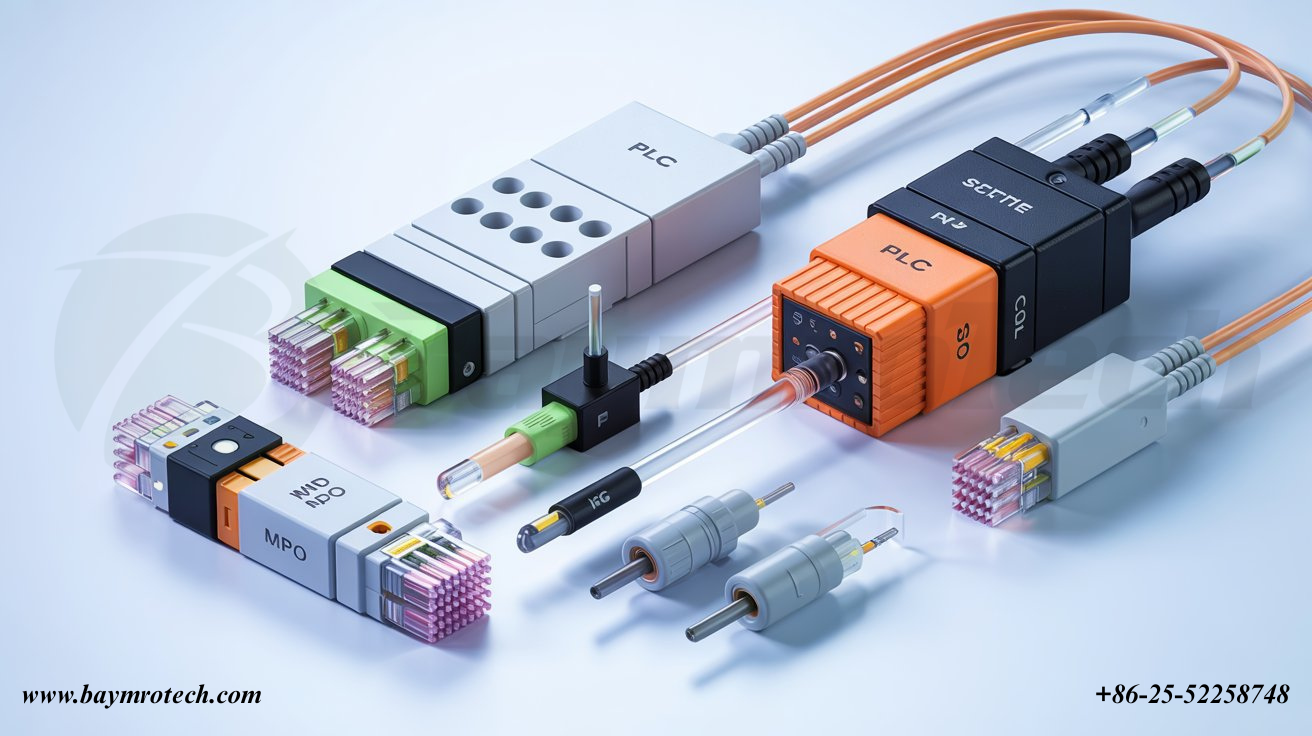
- Fiber Optic Connectors: These snap fibers together like Lego bricks. Think LC, SC, or MPO—wait, MPO? That’s short for Multi-fiber Push-On, and MPO solutions are game-changers for high-density setups. Ever yanked a cable and lost your Zoom call? Quality connectors prevent that nightmare.
- Adapters and Couplers: The matchmakers. They join dissimilar fibers or extend runs. Pro tip: Always match polish types (UPC vs. APC) or you’ll get reflections killing your signal.
- Splitters: PLC (Planar Lightwave Circuit) splitters divide one signal into many, perfect for FTTH (Fiber to the Home). Example: Your ISP uses a 1×8 splitter to share bandwidth across eight homes without active power.
- Attenuators: Dial down signal strength to avoid overloads. Like sunglasses for your fiber—too much light blinds the receiver.
- Patch Cords and Pigtails: The flexible links. Pigtails fuse to cables; patch cords plug and play.
I once helped a friend wire his small office—skipped attenuators, and his router screamed “signal too hot!” A $5 fix later, smooth sailing. Lesson: Test with an OTDR (Optical Time-Domain Reflectometer) before going live.
Diving Deeper: How Passive Components Work Their Magic
Light zips through fiber at 200,000 km/s, carrying data as pulses. Passives manipulate this without altering it actively.
Take fusion splicers—not truly passive, but they create permanent low-loss joints (under 0.02 dB). Then there’s multiplexers/demultiplexers for WDM (Wavelength Division Multiplexing), packing multiple signals onto one fiber. A single strand now hauls 100+ Terabits/sec, per Cisco’s 2025 forecast.
Humor break: Ever feel like your Wi-Fi is playing hide-and-seek? Passives ensure fiber doesn’t—losses stay below 0.2 dB/km in single-mode fiber.
For experts: Insertion loss matters big time. MPO solutions shine here, bundling 12-72 fibers with <0.35 dB loss, ideal for 400G Ethernet. Check our comprehensive guide to fiber patch cables for hands-on specs.
Real-World Applications: From Home to Hyperscale
Beginners, start small: Passive splitters power your smart home PON (Passive Optical Network). Plug in, and boom—gigabit speeds everywhere.
Scale up to enterprises. Data centers swear by MPO for backbone trunks. I chuckled during a site visit when an engineer called MPO arrays “fiber spaghetti tamers”—they parallelize fibers, slashing install time by 70%, as noted in a Fiber Broadband Association study.
Telecom pros: In metro networks, passives enable ROADMs (Reconfigurable Optical Add-Drop Multiplexers) for dynamic routing. 5G backhaul? All passive, cutting opex by 40%.
Challenges? Dust and bends kill signals. Empathy check: We’ve all bent a cable too far—use bend-insensitive fiber to forgive those oops moments.
Troubleshooting and Best Practices for Pros
Hit a snag? Here’s your toolkit:
- Measure Loss: Grab a power meter. Acceptable? <0.3 dB per connector.
- Clean Ruthlessly: 80% of failures trace to dirty ends, says FS Community benchmarks.
- Polarity Matters: MPO solutions demand A-B or U-D polarity—mismatch, and data ghosts you.
- Test Extensively: OLTS (Optical Loss Test Set) for end-to-end, OTDR for faults.
Advanced tip: For 800G upgrades, deploy low-loss MPO with MPOLX connectors. Simulate with free tools like OptiSystem.
Pro anecdote: During a rushed deploy, I overlooked polarity—hours of downtime. Now? Triple-check with a polarity tester. Saves sanity.
Why MPO Solutions Are the Future of Passive Optics
No guide’s complete without shouting out MPO solutions—they’re exploding for 40G/100G/400G transceivers. Why? Parallel optics mean more fibers, less space. Market stats: Expected 25% CAGR through 2030, per IDTechEx research.
At Baymro Tech, we stock polarity-managed MPO for seamless upgrades. Pair with our active optic transceivers for hybrid power.
Wrapping It Up: Your Fiber Journey Starts Now
From connectors splitting signals to MPO bundles conquering data centers, passive fiber optic components quietly enable our connected world. Key takeaways: Prioritize low loss, clean everything, and embrace MPO for density. You’ve got the blueprint—whether beginner or expert, these insights cut through the noise.
Ready to dive in? Contact our team at Baymro Tech for custom MPO solutions or a free consult. What’s your biggest fiber headache—share in the comments!