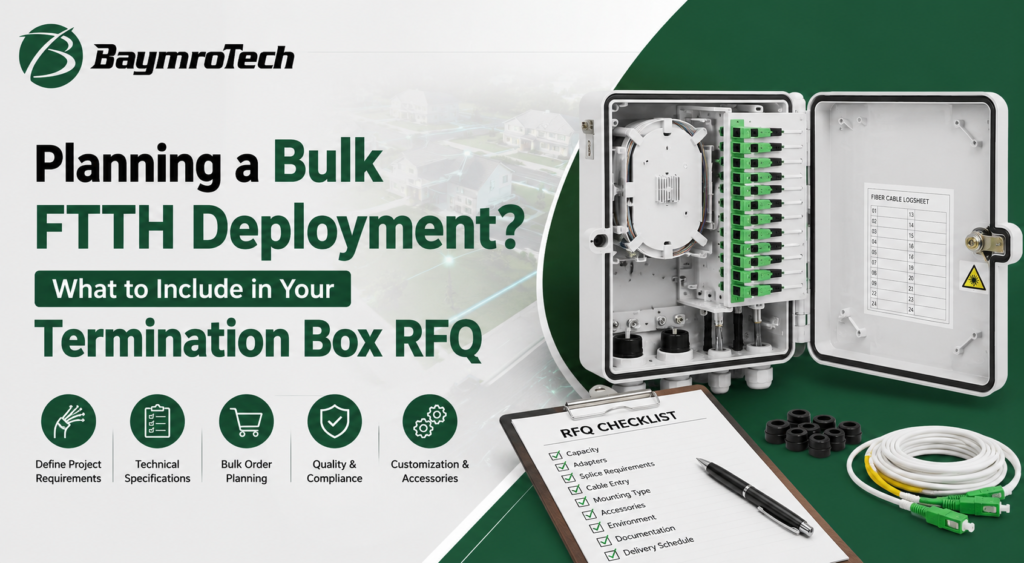
A successful bulk procurement process starts with a clear Request for Quotation (RFQ). For ISPs, telecom contractors, FTTH project managers and network procurement teams, specifying the right fiber termination box configuration helps prevent capacity mismatches, missing accessories, installation problems and unnecessary delays during deployment.
This article focuses on the technical and commercial information buyers should provide when requesting quotations for FTTH termination boxes. It includes a practical RFQ template, quality verification steps, sample approval considerations and guidance for coordinating bulk orders.
Introduction
Large-scale Fiber to the Home (FTTH) deployments depend on consistent network components that match the project’s installation requirements. When procurement teams request quotations for fiber termination boxes without defining the necessary specifications, suppliers may quote different product configurations even when the products appear similar.
One quotation might cover a box with a particular adapter arrangement, while another might assume a different port count, mounting method or accessory package. These differences make price comparisons unreliable and can create additional work when equipment arrives at the installation site.
Incomplete specifications can also lead to capacity mismatches, unsuitable indoor or outdoor enclosures, cable entry problems, inconsistent labeling and missing installation accessories. During a large rollout, even a small configuration difference across multiple sites can affect installation schedules and material planning.
A well-prepared RFQ gives suppliers a consistent basis for quoting. It identifies the required configuration, quantity, installation environment, technical documentation, sample approval process and delivery expectations before an order is finalized.
For procurement teams sourcing from BaymroTech, the starting point is its FTTH Termination Box product page. Buyers can use their project requirements to guide a quotation discussion and confirm which configuration is appropriate for the intended deployment.
What Is an FTTH Termination Box?
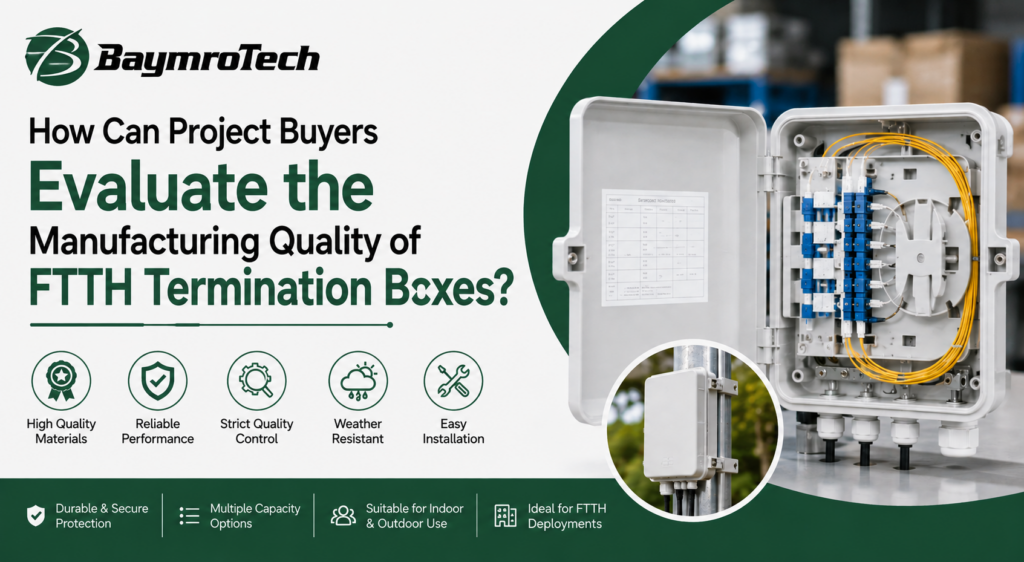
An FTTH termination box is a fiber management enclosure used to organize, terminate and protect fiber connections at an appropriate point in a fiber access network. Depending on its design and intended application, it may accommodate fiber adapters, connectorized cable ends, internal fiber routing and other components required to manage connections.
Termination boxes help keep fiber connections organized, reduce exposure to accidental disturbance and support maintenance when a connection needs to be inspected or changed.
Their exact function depends on the network architecture and product design. For example, a subscriber-facing termination point may have different requirements from a distribution point serving multiple fibers or a splice enclosure designed primarily to protect fusion splices.
These products should not be treated as interchangeable simply because they all manage fiber.
Before requesting a quotation, buyers should establish whether they need a termination box for a subscriber location, a building distribution point, a network cabinet or another specific installation. They should also confirm whether splicing is required, whether the fibers will be connectorized and how the box will connect to the surrounding network.
This distinction is important because not every FTTH termination box includes a splice tray, the same adapter count or an identical internal layout. Those features must be confirmed against the actual product configuration.
Define the Project Requirements First
Before listing technical specifications, procurement teams should document the conditions in which the boxes will be used. This makes the RFQ more precise and helps suppliers identify potential configuration issues early.
Deployment scale and subscriber capacity
Estimate the number of locations, network connection points and fibers that each box must accommodate. Distinguish between the number of fiber cables, the number of fibers and the number of connector ports, as these are not necessarily equivalent.
For example, a project might require several boxes at individual subscriber locations and a different configuration at shared distribution points. These should be specified as separate line items rather than combined under a broad description such as “FTTH box.”
Also identify whether the initial configuration must support planned expansion. Additional capacity should be requested only where it is relevant to the network design.
Indoor or outdoor installation
Describe the actual installation environment, including exposure to rain, dust, sunlight, temperature variation or other site-specific conditions.
An enclosure intended for an indoor building location may not be suitable for an exposed outdoor installation. Buyers should request the relevant environmental specifications and supporting documentation rather than assuming that all termination boxes offer the same level of protection.
Mounting and installation method
Specify whether the box will be wall-mounted, installed within a cabinet or used with another mounting arrangement supported by the product design.
Installation space, available cable routes and technician access can influence the required enclosure dimensions and cable entry locations. Where possible, include site drawings, photographs or a simple installation diagram.
Network architecture and future requirements
Explain where the box sits in the network and what connections it needs to support. Confirm whether the application requires connector termination, splicing or both.
For multi-site deployments, also identify which requirements must remain consistent across every site and which configurations may differ by location. This helps avoid receiving a single configuration that cannot accommodate the full project.
Technical Specifications to Include in the RFQ
The technical section is the most important part of a termination box RFQ. Each requirement should be specific enough to prevent suppliers from making different assumptions when preparing quotations.
The following table can serve as a specification checklist for bulk procurement.
| RFQ specification | Information to provide | Why it matters |
| Fiber capacity | Required fiber count or core capacity per box | Prevents insufficient or excessive capacity |
| Adapter and port configuration | Required port count, adapter type, connector interface and polish type, where applicable | Ensures compatibility with the network’s connectors and patching requirements |
| Splice capacity | Number of splices required, if splicing is part of the application | Prevents internal space limitations |
| Cable entry and exit | Cable type, outside diameter, entry direction and number of cable routes | Supports correct cable installation and retention |
| Internal fiber management | Routing, storage and bend management requirements | Helps protect fibers from excessive bending and congestion |
| Mounting method | Wall, pole or another supported mounting arrangement | Ensures compatibility with the installation site |
| Enclosure dimensions | Maximum permitted height, width and depth, or available installation space | Prevents physical fit problems |
| Housing material | Required material or performance criteria | Helps match the enclosure to the intended environment |
| Protection rating | Required IP rating or other environmental performance criteria, where applicable | Establishes the necessary level of protection against environmental exposure |
| Operating environment | Indoor or outdoor use, temperature range, UV exposure and expected weather conditions | Helps determine environmental suitability |
| Access and locking | Required lock, latch, opening method and maintenance access | Supports secure installation and practical servicing |
| Accessories | Mounting hardware, adapters, splice trays, seals, cable glands and other required items, as applicable | Avoids incomplete deliveries |
| Labeling | Port numbering, identification labels, customer branding or site codes | Improves traceability and installation consistency |
Not every requirement applies to every termination box. Buyers should identify which items are mandatory, optional or subject to supplier confirmation.
Fiber capacity and port count
State the required capacity for each box and the number of usable connection ports. If the project uses different configurations, list them separately.
BaymroTech’s published FTTH Termination Box range describes configurations from 2-core to 96-core, including face plate and enclosure types. These published range options are a starting point for a quotation discussion, not confirmation that every configuration includes a particular adapter layout or accessory set. Confirm the exact model and its available specifications before ordering.
Adapter and connector configuration
Specify the adapter interface required by the connected equipment and patch cords. Where relevant, include SC or LC interfaces, APC or UPC polish, and any required connector gender or arrangement.
Do not simply write “standard fiber adapters.” A supplier needs to understand the required interface and quantity to quote the correct configuration. If the design does not require adapters, state that clearly.
Splicing and cable management
If the application includes fiber splicing, specify the required splice count and whether splice trays or other protective components must be supplied. Ask for confirmation that the selected enclosure accommodates the required splice arrangement.
Also describe cable entry and exit requirements, cable diameter, fiber storage and routing needs. The supplier should confirm that the proposed design supports the intended cable type and installation method.
Housing, environmental protection and access
State whether the box will be installed indoors or outdoors and describe the actual exposure conditions. Specify the required protection rating only where the project demands it, and ask for supporting documentation for the quoted model.
For an outdoor installation, UV exposure, rainfall, dust, temperature variation and cable sealing may be relevant. Do not infer an IP rating from a product description that merely mentions weather resistance.
Include access and locking requirements if the equipment will be installed in shared areas or locations where unauthorized access is a concern.
Accessories, labeling and dimensions
Ask the supplier to list all included accessories separately from optional items. This is especially important when comparing quotations that may include different mounting kits, adapters or cable management components.
If the project requires standardized identification, provide the labeling format, language, numbering scheme and any site-specific codes. For custom branding, provide the approved artwork and identify whether it applies to the box, packaging or both.
Finally, include the maximum permitted enclosure dimensions and any clearance restrictions. A product may meet the capacity requirement but still be unsuitable for a constrained installation location.
Bulk Order RFQ Template
Procurement teams can use the following table as a starting point for issuing an RFQ to BaymroTech or another potential supplier. Replace the example prompts with the actual project requirements before sending it.
| RFQ field | Details to provide |
| Project name | Project or deployment reference |
| Product required | FTTH termination box, with intended application |
| Required configuration | Specific model or requested configuration for supplier confirmation |
| Capacity | Required fiber capacity and usable port count per unit |
| Adapter requirements | Interface, connector configuration and polish type, if applicable |
| Splice requirements | Required splice capacity and tray configuration, if applicable |
| Installation environment | Indoor, outdoor or other defined site conditions |
| Mounting arrangement | Wall, pole, cabinet or other applicable method |
| Cable compatibility | Cable type, diameter and entry or exit requirements |
| Quantity | Total units, with a breakdown by configuration |
| Accessories | Mandatory included items and separately quoted options |
| Customization | Labeling, branding, mounting changes or other requested modifications |
| Technical documents | Datasheet, drawings, material details and applicable test documentation |
| Sample approval | Sample requirement, evaluation criteria and approval process |
| Packaging | Individual packing, outer cartons, labels and project identification |
| Quality acceptance | Inspection requirements and agreed acceptance criteria |
| Delivery schedule | Required delivery date, shipment destination and phased delivery plan, if applicable |
| Commercial quotation | Unit price, tooling or customization charges, packaging costs and shipping terms, as applicable |
| Quotation validity | Requested period for which pricing and terms remain valid |
Example RFQ description
The following sample wording can be adapted for an actual project. The capacity and quantity are intentionally left open so that buyers can insert their confirmed requirements.
We are preparing a bulk procurement order for FTTH termination boxes for a fiber access network deployment. Please quote a configuration that meets the attached technical requirements, including the specified fiber capacity, adapter arrangement, cable compatibility, mounting method and installation environment.
Please provide the product datasheet, dimensional drawing, housing material details and applicable test documentation. Clearly identify included accessories and separately priced options. Confirm whether the requested configuration is available, whether a sample can be provided for evaluation, and what information is required to confirm the production and delivery schedule.
Please quote the requested quantities by configuration and identify any deviations from our specifications before submitting the final quotation.
Attach a specification sheet, installation diagram or site requirements document where available. If more than one configuration is required, use separate line items to prevent pricing and production confusion.
Quality, Compliance and Sample Approval
A competitive quotation is useful only when the proposed product meets the project’s agreed requirements. Before placing a bulk order, request documentation that allows your engineering and procurement teams to evaluate the actual configuration.
Request relevant technical documentation
Depending on the project, request:
- A product datasheet showing the quoted model and configuration.
- A dimensional drawing showing enclosure size, cable entries and mounting points.
- Housing material details and relevant environmental specifications.
- Test reports or inspection records applicable to the product.
- Evidence of claimed standards or regulatory compliance, where required.
- An accessory list and installation instructions, where available.
Documentation should correspond to the model being quoted. A general brochure may not confirm the capacity, mounting design or protection rating of a specific product.
Agree on acceptance criteria before production
Define what constitutes an acceptable unit before approving the order. Criteria may cover dimensions, housing appearance, adapter arrangement, cable entry configuration, accessory completeness, labeling and other project-specific characteristics.
For large orders, agree on the inspection process, sampling method and handling of nonconforming units. If the project requires inspection before shipment, specify the scope, timing and required records in the purchase agreement.
Evaluate samples where necessary
A sample can help the engineering team verify that the proposed design fits the installation and network requirements. Check mounting compatibility, cable access, available working space, fiber routing and the placement of required components.
Record the approved model, revision, configuration and any agreed modifications. Use this information as the reference for bulk production.
Protection ratings and compliance claims should be checked against appropriate evidence for the actual product. Do not treat a supplier statement or a visual inspection as a substitute for required testing or documentation.
Customization and Project Coordination
Large FTTH deployments sometimes require different labeling, packaging, mounting arrangements or product configurations across regions and installation sites. Such requirements should be discussed during the quotation stage rather than after the order has entered production.
BaymroTech’s published termination box page states that customization and customer logo printing on the box and outer packaging are available on request. Buyers should confirm the exact scope, feasibility, cost and schedule for their required changes directly with the company.
For a project involving multiple configurations, provide a clear schedule showing the quantity, specifications and destination associated with each line item. If the boxes will be installed by different contractor teams, consistent labels and packaging can also help identify the correct equipment at each site.
Before bulk production, document the final approved specifications. This should include any accepted sample, drawings, branding files, accessory requirements and packaging instructions.
Any subsequent changes should be reviewed and approved through a defined process. This reduces the risk of receiving a bulk shipment that differs from the product evaluated by the project team.
Delivery coordination deserves the same attention. Share the required delivery window, destination, shipment preferences and any phased delivery requirements. Ask the supplier to confirm the schedule based on the actual configuration, quantity and customization scope rather than assuming a standard lead time.
Common RFQ Mistakes That Affect Bulk Procurement
Even experienced procurement teams can overlook details when preparing a large purchase request. The following mistakes can reduce quotation accuracy and create avoidable deployment problems.
| Common mistake | Potential consequence | How to prevent it |
| Stating only a general capacity requirement | Different suppliers quote different designs | Specify fiber count, usable ports and configuration |
| Leaving adapter details open | Quoted products may not match the network interface | State adapter type, connector configuration and polish requirements |
| Omitting installation conditions | The proposed enclosure may not suit the actual site | Describe indoor or outdoor use, mounting and exposure conditions |
| Assuming splice trays are included | Additional components may be required later | State whether splicing is needed and list required accessories |
| Ignoring cable entry requirements | Installation or cable retention issues may arise | Provide cable type, diameter and entry arrangement |
| Requesting an unsupported protection rating | The quoted product may not meet environmental requirements | Specify the required rating and request evidence |
| Leaving labeling and packaging undefined | Products may arrive without the identification needed for deployment | Provide labeling artwork, site codes and packaging instructions |
| Giving an unrealistic delivery deadline | Production, approval or shipment schedules may not align | Request a confirmed schedule based on quantity and configuration |
Another common mistake is comparing quotations by unit price alone. A lower-priced box may have a different adapter arrangement, fewer included accessories or a different enclosure design. Buyers should compare quotations against the same technical specification and calculate the complete cost of the required configuration.
The objective is not to make the RFQ unnecessarily complicated. It is to remove uncertainty from the specifications that directly affect compatibility, installation readiness, quality and project cost.
How BaymroTech Fits Into FTTH Termination Box Procurement
BaymroTech supplies fiber optic management products for telecommunications and fiber access networks. Its published product range includes FTTH termination boxes, fiber distribution boxes and other fiber management components.
For buyers preparing a bulk termination box RFQ, the most useful starting point is to share the required configuration and ask for confirmation against the intended application.
BaymroTech’s FTTH Termination Box product describes face plate options for 2 to 4 cores and enclosure options for 8 to 96 cores. The page also describes wall and pole mounting, high-impact plastic construction and options related to splitter accommodation. These details should be checked against the specific model and final quotation before being treated as confirmed order specifications.
Related products may also be relevant to the wider network design:
- Fiber Distribution Box: for projects requiring a separate distribution and termination enclosure.
- Fiber Optic Joint Enclosure: for applications focused on protecting fiber cable joints and splices.
- FTTx Solution: for broader fiber access network requirements.
These products serve different functions and should not be substituted for one another without reviewing the network design.
For a quotation discussion, procurement teams should provide the capacity, installation environment, connector arrangement, cable requirements, order quantity, required accessories and delivery expectations. BaymroTech can then be asked to confirm the suitable configuration, available documentation and applicable commercial terms.
Frequently Asked Questions
1. What capacity should I specify for an FTTH termination box?
Specify the number of fibers and usable connection ports required at each installation point. Consider the network architecture, number of connections, installation space and planned expansion. Confirm the selected model’s actual capacity and configuration before ordering.
2. Which adapter types should be included in an FTTH termination box RFQ?
Identify the required adapter interface and connector configuration, such as SC or LC, with APC or UPC polish where applicable. Confirm the number of adapters required and whether they must be supplied with the enclosure or quoted separately.
3. Can the same FTTH termination box be used indoors and outdoors?
That depends on the particular model and installation conditions. Buyers should specify the actual environment, including weather exposure, UV radiation, dust and temperature requirements, and verify the enclosure’s suitability through product documentation.
4. Can BaymroTech termination boxes be customized for bulk orders?
BaymroTech’s published product page states that customization and customer logo printing on the box and outer packaging are available on request. Confirm the exact customization options, feasibility, pricing and delivery implications for the proposed configuration.
5. Should procurement teams request a sample before placing a bulk order?
A sample is useful when the project requires physical fit checks, installation trials or verification of a customized configuration. Buyers should agree on the sample specification and acceptance criteria, then use the approved configuration as the reference for bulk production.
6. What information is essential for a bulk FTTH termination box quotation?
At minimum, provide the required capacity, adapter arrangement, installation environment, mounting method, cable specifications, quantity, accessory list and delivery schedule. Include customization requirements and documentation needs if they apply.
7. What quality documents should be requested before ordering?
Request the relevant datasheet, dimensional drawing, material information, applicable test reports and evidence supporting any required compliance or protection claims. The documentation should match the exact model and configuration being quoted.
8. How can procurement teams reduce the risk of receiving incorrect products?
Issue a complete specification, request a line-by-line quotation, resolve deviations before ordering and document sample approval where applicable. Agree on labeling, packaging, inspection requirements and change control before production begins.
9. Should accessories be included in the termination box quotation?
Yes, when they are required for installation or operation. List each mandatory accessory and ask the supplier to identify what is included in the quoted price and what is optional. This helps avoid unexpected costs and incomplete deliveries.
10. How should buyers communicate their required delivery schedule?
Provide the target delivery date, destination and any phased shipment requirements. Ask the supplier to confirm the schedule against the order quantity, selected configuration, customization requirements and applicable shipping arrangements.
Conclusion: Prepare a Complete FTTH Termination Box RFQ Before Ordering in Bulk
Bulk FTTH procurement requires more than specifying a product name and requesting a unit price. A complete RFQ defines the required capacity, adapter arrangement, cable compatibility, mounting method, environmental conditions, accessories, documentation and delivery schedule.
These details allow procurement teams to compare quotations on a consistent basis, identify specification gaps early and reduce the risk of receiving equipment that does not match deployment requirements.
Sample evaluation, documented acceptance criteria and approval of the final configuration also help maintain consistency between the proposed product and bulk production. For projects involving multiple sites or configurations, clear labeling, packaging and delivery instructions are equally important.
BaymroTech’s FTTH Termination Box range provides a starting point for discussing product options for fiber access network projects. Buyers should confirm the exact configuration and applicable technical specifications before finalizing an order.
Planning a bulk FTTH deployment? Share your required fiber capacity, adapter configuration, installation conditions, order quantity, accessory requirements and target delivery schedule with BaymroTech to discuss your FTTH termination box requirements and request a project-specific quotation.