
Introduction
As digital transformation accelerates across industries, businesses face a common challenge: network traffic continues to grow while fiber infrastructure expansion remains expensive, time-consuming, and often impractical.
Telecom operators, data centers, infrastructure developers, and enterprise networks are under constant pressure to support increasing bandwidth demands driven by cloud applications, video traffic, IoT deployments, AI workloads, and 5G backhaul requirements. Installing additional fiber may seem like the obvious solution, but trenching, permitting, labor costs, and deployment timelines can significantly increase project expenses.
Many organizations discover that the real challenge is not simply acquiring more capacity. It is selecting the right technology and supplier capable of maximizing existing fiber assets while maintaining network reliability and long-term scalability.
Choosing the wrong supplier can result in inconsistent product quality, project delays, unstable lead times, compatibility issues, increased maintenance costs, and a higher total cost of ownership. For procurement teams and network planners, supplier selection becomes a strategic investment decision rather than a simple price comparison exercise.
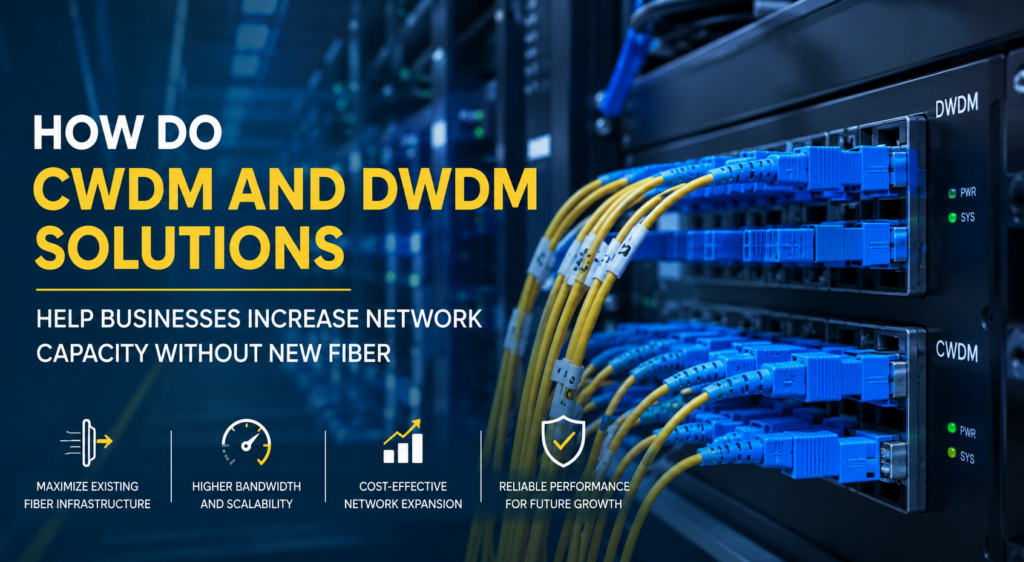
One of the most effective solutions available today is the implementation of CWDM and DWDM technologies, which enable organizations to dramatically increase network capacity without deploying new fiber infrastructure.
What Are CWDM and DWDM Solutions?
CWDM (Coarse Wavelength Division Multiplexing) and DWDM (Dense Wavelength Division Multiplexing) are optical transmission technologies that allow multiple data signals to travel simultaneously over a single fiber strand by assigning each signal a different wavelength.
Instead of installing additional fiber cables, businesses can utilize existing fiber infrastructure more efficiently by transmitting multiple channels through one optical path.
CWDM
CWDM uses wider wavelength spacing and is commonly deployed for:
- Metro networks
- Enterprise campuses
- Access networks
- Cost-sensitive deployments
DWDM
DWDM uses much narrower wavelength spacing, enabling significantly higher channel density and capacity.
It is widely used for:
- Long-haul telecom networks
- Data center interconnects
- Backbone infrastructure
- High-capacity carrier networks
For businesses seeking to expand bandwidth while controlling infrastructure costs, both technologies offer a practical and scalable solution.
How CWDM and DWDM Increase Network Capacity Without New Fiber
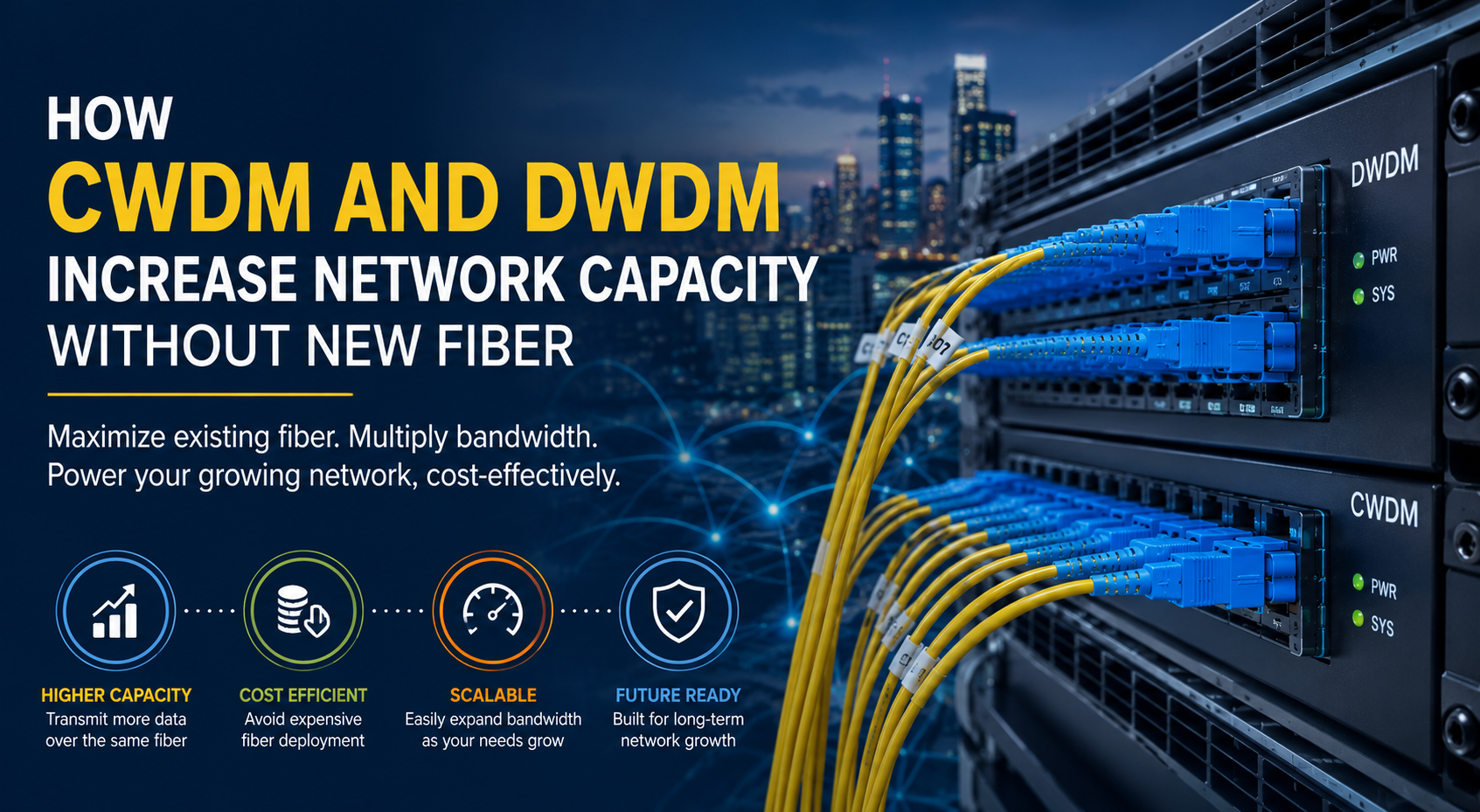
Traditional network expansion often requires additional fiber installation whenever bandwidth demand increases.
CWDM and DWDM eliminate this limitation by allowing multiple independent channels to share the same physical fiber.
Benefits include:
- Higher bandwidth utilization
- Reduced infrastructure costs
- Faster network expansion
- Improved return on fiber investments
- Enhanced scalability for future growth
For example, instead of transmitting a single 10G service over one fiber pair, DWDM technology can support dozens of wavelengths carrying multiple high-speed services simultaneously.
This approach significantly increases network capacity while preserving existing fiber resources.
Applications and Industry Use Cases
CWDM and DWDM technologies are widely deployed across various industries.
Telecom Networks
Telecom operators use wavelength division multiplexing to increase backbone capacity, support mobile backhaul traffic, and expand services without extensive fiber deployment projects.
Data Centers
Data center operators use DWDM systems for high-capacity interconnection between facilities while minimizing fiber consumption.
Enterprise Networks
Large enterprises deploy CWDM solutions across campus environments to support cloud applications, surveillance systems, and internal communications.
Smart City Infrastructure
Municipal networks leverage CWDM and DWDM technologies to connect transportation systems, public safety networks, and utility monitoring platforms.
Industrial and Utility Networks
Power utilities, transportation authorities, and industrial facilities utilize optical multiplexing to support mission-critical communications over existing fiber assets.
Government and Defense Networks
Government agencies often use DWDM infrastructure for secure, scalable, and highly reliable communications systems.
Different projects frequently require unique wavelength configurations, transmission distances, environmental specifications, network architectures, certifications, and integration requirements. As a result, selecting the right supplier becomes a critical factor in ensuring long-term network performance and project success.
Buyer Decision Factors When Selecting CWDM and DWDM Suppliers
This is often the most important stage of the procurement process. The supplier you choose can significantly impact project timelines, network reliability, maintenance costs, and future scalability.
1. OEM Manufacturing Capability
OEM capability demonstrates a supplier’s ability to control production processes, quality standards, and customization requirements.
Buyers should verify:
- Manufacturing facilities
- Engineering resources
- Production equipment
- Product development capabilities
OEM manufacturers typically provide greater flexibility and technical support compared to trading companies.
2. Customization Options
Every network deployment has unique requirements.
Evaluate whether suppliers can provide:
- Customized wavelength plans
- Rack configurations
- Connector options
- Packaging requirements
- Labeling services
- Project-specific designs
Customization can simplify deployment and improve operational efficiency.
3. MOQ Requirements
Minimum Order Quantity requirements directly affect procurement budgets and inventory planning.
Buyers should determine:
- Standard MOQ levels
- Sample availability
- Pilot project support
- Flexible order quantities
Suppliers offering flexible MOQ policies are often better suited for phased deployments.
4. Lead Time Stability
Unpredictable lead times can disrupt project schedules and contractual obligations.
Assess:
- Average production lead times
- Inventory management systems
- Capacity planning processes
- Historical delivery performance
Reliable suppliers help reduce project delays and procurement risks.
5. Product Certifications
Certifications provide confidence in product quality and compliance.
Common certifications may include:
- ISO quality management certifications
- RoHS compliance
- CE compliance
- Telecommunications industry standards
Certification documentation should always be available upon request.
6. Testing Reports
Testing validation is critical for optical networking products.
Request documentation covering:
- Insertion loss testing
- Return loss testing
- Environmental testing
- Reliability testing
- Compatibility testing
Test reports help verify product performance before deployment.
7. Quality Control Procedures
Strong quality control processes reduce field failures and maintenance costs.
Review:
- Incoming material inspection
- Production testing
- Final product verification
- Traceability systems
Consistent quality control directly impacts network reliability.
8. Technical Support Capability
Technical support often becomes essential during planning, deployment, and troubleshooting.
Suppliers should provide:
- Network design assistance
- Product selection guidance
- Configuration support
- Deployment recommendations
Engineering support can significantly reduce implementation risks.
9. Production Capacity
Large infrastructure projects require suppliers capable of scaling production.
Evaluate:
- Monthly output capacity
- Manufacturing resources
- Expansion capabilities
- Resource allocation processes
Production limitations can create supply bottlenecks during large deployments.
10. Supply Chain Reliability
A stable supply chain helps ensure uninterrupted project execution.
Procurement teams should review:
- Supplier sourcing strategies
- Component availability
- Inventory management
- Risk mitigation plans
11. Project References
Successful project experience provides valuable evidence of supplier capability.
Ask for:
- Telecom deployment references
- Data center projects
- Infrastructure installations
- International project experience
Experienced suppliers often have stronger technical knowledge and implementation expertise.
BaymroTech works closely with telecom operators, integrators, contractors, and enterprise customers by providing engineering-focused support, OEM manufacturing capabilities, customization services, and project-specific optical networking solutions designed for demanding deployment environments.
Procurement Risks and Common Supplier Selection Mistakes
Many procurement issues arise from inadequate supplier evaluation.
No OEM Capability
Suppliers without manufacturing control may struggle to meet customization requirements and maintain consistent quality.
Lack of Testing Reports
Without performance validation, buyers may encounter unexpected network issues after deployment.
Limited Customization Support
Standard products may not fit unique project specifications, leading to integration challenges.
Unstable Lead Times
Production delays can impact installation schedules and contractual milestones.
Weak Technical Support
Insufficient engineering assistance can increase deployment risks and troubleshooting costs.
Inconsistent Quality Control
Poor quality management may lead to higher failure rates, service disruptions, and increased maintenance expenses.
Avoiding these mistakes helps protect project budgets, timelines, and long-term network performance.
CWDM and DWDM Supplier Evaluation Checklist
| Evaluation Criteria | Verify Before Purchase |
| OEM Manufacturing Capability | ✓ |
| Flexible MOQ Requirements | ✓ |
| Stable Lead Times | ✓ |
| Product Certifications | ✓ |
| Testing Reports Available | ✓ |
| Customization Options | ✓ |
| Technical Support Team | ✓ |
| Quality Control Procedures | ✓ |
| Project References | ✓ |
| Supply Chain Stability | ✓ |
This checklist can help procurement teams compare suppliers objectively and reduce sourcing risks.
Why Choose BaymroTech for CWDM and DWDM Solutions?
For organizations seeking reliable optical networking solutions, supplier expertise is just as important as product specifications.
BaymroTech serves as an OEM manufacturer and B2B supplier focused on supporting telecom, enterprise, infrastructure, and data center projects with:
- CWDM and DWDM product expertise
- Engineering-driven technical support
- Customization capabilities
- Consistent quality control
- Reliable production capacity
- Flexible project support
- Competitive lead times
- Global project experience
By combining manufacturing capabilities with practical deployment knowledge, BaymroTech helps customers maximize network capacity while minimizing infrastructure investment and operational risks.
Frequently Asked Questions
What are CWDM and DWDM solutions?
They are optical multiplexing technologies that transmit multiple data channels over a single fiber using different wavelengths.
Why are CWDM and DWDM used in telecom projects?
They increase network capacity without requiring additional fiber infrastructure.
Can CWDM and DWDM systems be customized?
Yes. Many OEM manufacturers offer customized wavelength plans, connectors, packaging, and deployment configurations.
What certifications should buyers request?
Buyers commonly request ISO, RoHS, CE, and relevant telecom compliance certifications.
What is the typical lead time for CWDM and DWDM products?
Lead times vary depending on product complexity, customization requirements, and production capacity.
How can buyers verify supplier quality?
Request testing reports, quality control documentation, certifications, and project references.
What is the difference between CWDM and DWDM?
CWDM offers fewer channels and lower costs, while DWDM provides higher channel density and greater capacity.
Why is OEM capability important?
OEM manufacturers generally provide better customization, quality control, technical support, and production flexibility.
Request a Project Consultation and RFQ
If you are planning a telecom, enterprise, infrastructure, or data center project, discussing requirements early can help avoid procurement challenges and deployment delays.
Talk with the BaymroTech team about:
- OEM manufacturing requirements
- Customized CWDM and DWDM configurations
- MOQ expectations
- Lead time planning
- Certification requirements
- Technical specifications
- Project-specific network solutions
Early supplier engagement often leads to better procurement decisions, smoother deployments, and lower total project costs.
Ready to Expand Network Capacity Without Installing New Fiber?
Contact BaymroTech today to evaluate suppliers, compare technical options, discuss project requirements, and request a customized RFQ designed specifically for your network expansion goals.
