Did you know that a single modern data center can guzzle more electricity than a small city—like 100 megawatts or more? If you’re managing servers, scaling operations, or just dipping your toes into IT infrastructure, that stat hits hard. You’re probably wrestling with space crunches, overheating gear, or tangled cables that turn your rack into a spaghetti nightmare. Stick with me—I’ll break down the essentials of data center cabinets, racks, and integrated solutions, showing you how they solve these headaches and keep your data flowing smoothly.
Why Data Center Infrastructure Matters More Than Ever
Picture this: It’s 2 a.m., and your alert pings—downtime because a rack overheated or a cable failed. We’ve all been there (or fear we will be). Data centers power everything from Netflix binges to AI training, and global demand is exploding. According to a Uptime Institute report, data center capacity grew 15% in 2024 alone, with hyperscalers like Google and AWS leading the charge.
The backbone? Cabinets, racks, and smart integrated systems. They organize, cool, power, and connect your hardware efficiently. Get this wrong, and you’re looking at costly outages—ones that cost businesses an average of $9,000 per minute, per Ponemon Institute. But nail it, and you scale effortlessly. Let’s dive in.
Racks: The Skeleton of Your Data Center
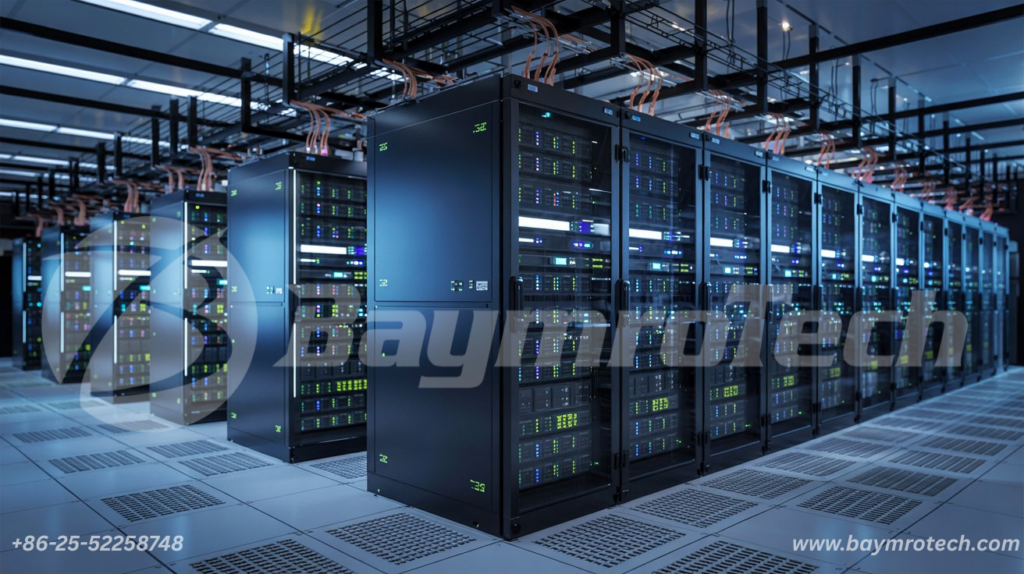
Think of racks as the sturdy shelves holding your server’s world together. Standard 19-inch racks (measured in “U” units, where 1U = 1.75 inches) come in floor-standing or wall-mount varieties. A full 42U rack can pack 1,000+ servers, but it’s not just about stacking boxes.
- Key features to watch: Load capacity (up to 2,000 lbs for heavy-duty models), ventilation holes for airflow, and cable management arms to banish clutter.
- Pro tip: Open-frame racks suit budget setups with good airflow; enclosed ones add security for high-stakes environments.
I remember helping a startup in Kolkata cram their first hyperscale setup into a 48U rack—without proper seismic bracing, it wobbled like Jenga during a quake test. Lesson learned: Always match rack depth (24-48 inches) to your gear. For seamless connectivity in these racks, explore our high-density server racks at Baymro Tech, designed for Indian data centers with tropical heat in mind.
Humor alert: Skip cable ties at your peril—your rack shouldn’t look like my post-Diwali wiring after festive lights come down!
Cabinets: Your Secure, All-in-One Fortress
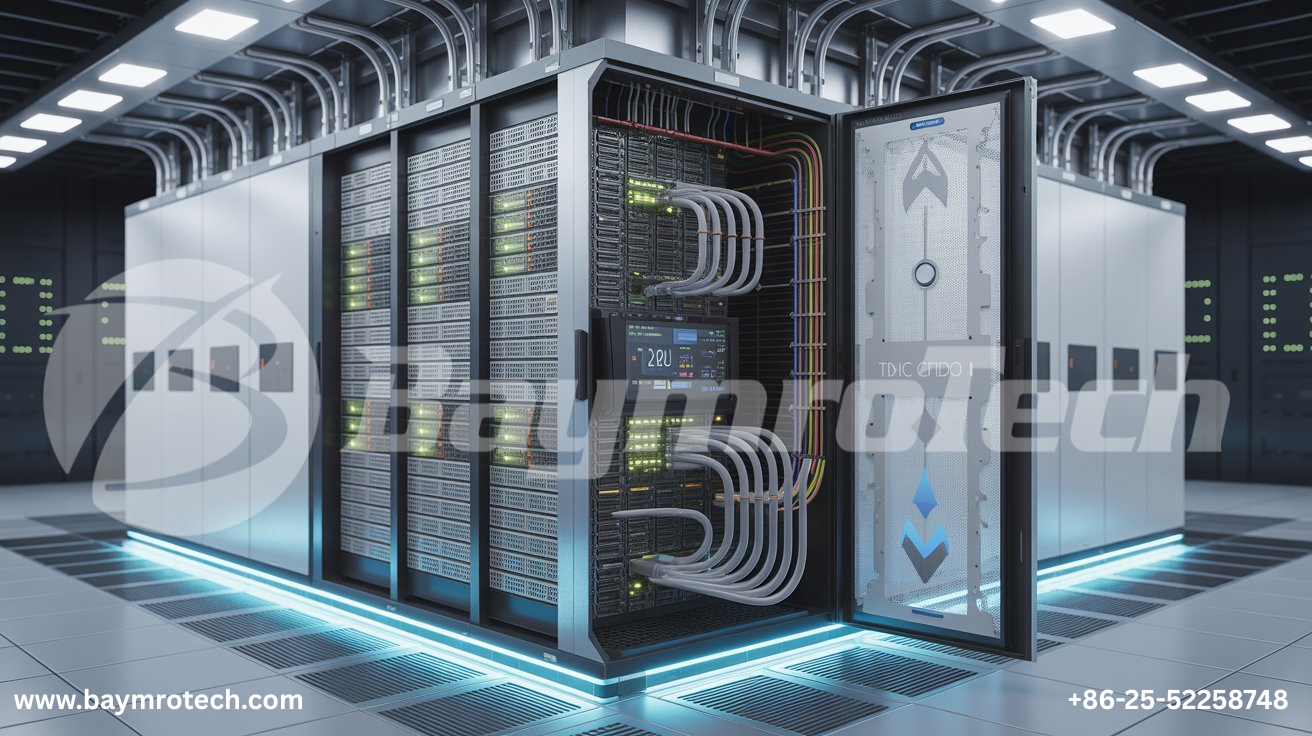
Racks are great, but cabinets enclose them for protection—like giving your servers a armored vault. These metal enclosures (often 600-800mm wide) shield against dust, tampering, and EMI (electromagnetic interference). Expect features like perforated doors for cooling, lockable glass fronts for monitoring, and integrated PDUs (power distribution units).
Why upgrade? A basic rack might handle 10kW; a smart cabinet pushes 40kW+ with redundant power feeds. Gartner predicts that by 2027, 70% of new data centers will use modular cabinets for faster deployment.
Relatable example: Imagine your e-commerce site during peak sales— a cabinet’s built-in cooling prevents meltdowns. We once retrofitted a Mumbai client’s legacy setup with ventilated cabinets; uptime jumped 99.9%. Pair them with advanced cabling like copper fiber composite cable for hybrid speed and reliability—it’s a game-changer for high-bandwidth needs without the bulk.
Integrated Solutions: The Smart Glue Holding It All Together
Here’s where magic happens. Integrated solutions bundle racks, cabinets, and extras like cooling, power, and monitoring into plug-and-play systems. No more piecemeal headaches!
- Cooling innovations: Liquid cooling loops or in-row units slash energy use by 30-40%, per Schneider Electric’s research.
- Power management: Intelligent PDUs with remote metering track usage in real-time.
- Monitoring magic: IoT sensors flag issues before they escalate—think AI predicting failures.
These aren’t gimmicks. In a Data Center Dynamics study, integrated setups cut deployment time by 50%. For Baymro Tech clients, our integrated data center solutions include copper fiber composite cable integrations, blending copper’s reliability with fiber’s speed for 400G+ Ethernet without signal loss.
Anecdote time: A fintech firm I consulted for integrated PDUs and cable management—their ops team high-fived when remote reboots saved a Friday night crisis. It’s practical stuff that feels like superpowers.
Tackling Common Challenges Head-On
You’re not alone if scalability, heat, or cabling trips you up. Here’s empathetic, actionable advice:
- Space squeeze? Go vertical with 52U super-tall cabinets or hyper-converged nodes.
- Heat hell? Direct-to-chip liquid cooling beats air by 1,000x efficiency (source: ASHRAE guidelines).
- Cable chaos? Pre-terminated copper fiber composite cables reduce install time by 70%.
Stats back it: IDC reports integrated infrastructures boost efficiency 25%, saving millions in OPEX. Choose vendors like Baymro Tech who get local needs—monsoons, power fluctuations, you name it.
The Future: Edge, AI, and Sustainability
Data centers aren’t standing still. Edge computing pushes racks closer to users (think 5G towers), while AI demands denser 100kW+ cabinets. Sustainability? Hyperscalers aim for carbon-neutral by 2030, per IEA data.
Integrated solutions lead here—modular designs let you upgrade without full rip-outs. Excited yet?
Wrapping It Up: Build Smarter, Not Harder
From racks organizing your gear, to cabinets securing it, to integrated solutions supercharging efficiency, nailing data center infrastructure means reliability, savings, and scalability. Ditch the guesswork—focus on copper fiber composite cables and modular setups for tomorrow’s demands.
Ready to optimize? Contact the Baymro Tech team today for a free infrastructure audit, or drop your biggest challenge in the comments. What’s your go-to rack hack?