Introduction
Large-scale Fiber to the Home (FTTH) deployments require more than installing fiber optic cables between a central office and subscribers. Internet service providers (ISPs) must also select passive optical components that distribute optical signals efficiently, support planned subscriber capacity and maintain consistent performance across thousands of connections.
Planar Lightwave Circuit (PLC) splitters are essential components in many passive optical network (PON) architectures. They allow one optical input to be distributed across multiple output ports without requiring electrical power at the splitting point. However, choosing the right splitter involves several technical and procurement decisions that can affect network performance, installation efficiency and project costs.
An unsuitable split ratio can consume too much of the available optical power budget. Incorrect connector configurations can delay field installation, while unsuitable packaging may complicate integration into distribution boxes, cabinets or fiber management systems. In large orders, even small inconsistencies between batches can create installation and troubleshooting challenges across multiple deployment sites.
For procurement teams, the objective is not simply to find a PLC splitter at the lowest unit price. It is to source a configuration that matches the network design, performs within the required optical limits and can be supplied consistently in the quantities needed.
What should ISPs check before placing a bulk PLC splitter order? The key factors include split ratio, insertion loss, optical uniformity, wavelength compatibility, connector specifications, packaging, environmental conditions, testing documentation and clearly defined order requirements.
This guide explains how telecom operators, network contractors and system integrators can assess these factors before preparing a PLC splitter request for quotation (RFQ).
What Is a PLC Splitter and How Does It Work?
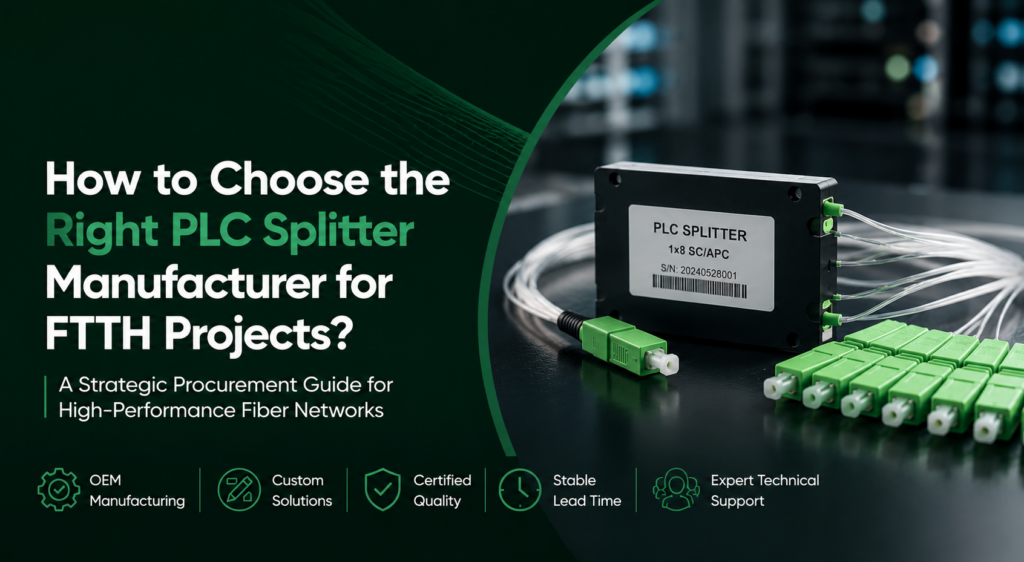
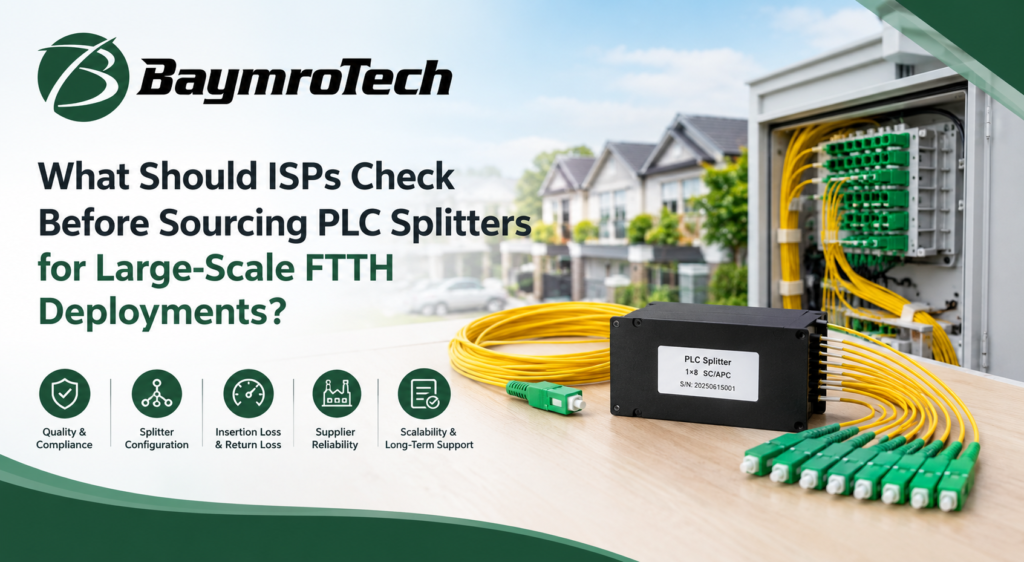
A PLC splitter is a passive optical device that divides an incoming optical signal into multiple output signals. It is widely used in PON-based FTTH networks, where a single feeder fiber serves multiple subscriber connections through an optical distribution network.
The splitter uses a planar lightwave circuit, typically incorporating optical waveguides fabricated on a substrate, to distribute light between the input and output paths. Because it operates passively, it does not require an external electrical power supply to perform the splitting function.
In an FTTH architecture, a PLC splitter may be installed at a central distribution point, an outdoor fiber distribution cabinet, a distribution box or another location defined by the network design. Its placement depends on the operator’s distribution strategy, subscriber density, fiber availability and access requirements.
PLC splitters versus FBT couplers
Fused Biconical Taper (FBT) couplers use a different manufacturing approach in which optical fibers are fused and tapered to transfer light between fiber paths.
PLC splitters are commonly selected for applications requiring multiple output ports and consistent splitting across a broad operating wavelength range. FBT couplers can be suitable for specific splitting configurations, wavelength requirements and applications where their particular optical characteristics meet the design requirements.
The appropriate choice depends on the network architecture, optical specifications, required port count and project economics. Neither technology should be selected solely on the basis of its name or general reputation.
For ISPs planning extensive FTTH deployments, understanding these differences helps establish the technical requirements before supplier quotations are compared.
Technical Specifications ISPs Must Check Before Buying PLC Splitters
The most important step in PLC splitter procurement is translating the network design into a clear technical specification. Buyers should confirm the following parameters before requesting prices or approving samples.
Split ratio and output port count
The split ratio determines how many output paths receive the optical signal from one input. Common configurations include 1:2, 1:4, 1:8, 1:16, 1:32 and 1:64.
A higher split ratio supports more distribution branches from a single input, but the optical power available to each output decreases as more branches are served. The chosen ratio must therefore match the network’s subscriber capacity and optical budget.
Procurement teams should distinguish between the required split ratio and the total number of splitters needed. For example, an order for 1:16 splitters across several distribution cabinets requires the correct number of units, input connections and output connections for the planned installation.
Insertion loss and optical power budget
Insertion loss describes the reduction in optical power caused by a component. PLC splitters introduce unavoidable splitting loss, along with additional losses associated with the device’s construction and connections.
As the split ratio increases, the theoretical power available at each output decreases. Actual insertion loss also depends on the product design and configuration.
ISPs should review the maximum specified insertion loss for the exact splitter model, rather than comparing products using only typical values. The network power budget must account for the transmitter, fiber attenuation, connectors, splices, splitters and any other relevant losses.
A splitter that does not fit within the available optical budget may cause inadequate receiver power at subscriber premises, even when the rest of the installation is completed correctly.
Uniformity and polarization-dependent loss
Uniformity describes the variation in insertion loss between the splitter’s output ports. Consistent output performance is important when multiple subscribers share the same distribution architecture.
Polarization-dependent loss (PDL) describes how a component’s insertion loss varies with the polarization state of the optical signal. Where PDL is specified, buyers should check the applicable limit and test conditions.
For large-scale deployments, it is useful to review both the individual unit’s optical results and the consistency of these results across samples or production batches.
Return loss and directivity
Return loss measures the amount of optical power reflected toward the source relative to the incident power. Directivity describes how effectively a device isolates the intended optical paths from unwanted coupling between ports, where applicable.
These parameters should be assessed according to the selected component’s design and the requirements of the wider optical system. Buyers should not assume that every datasheet uses identical test conditions or includes the same parameters.
Ask the supplier to identify which values are guaranteed, which are typical and which are not applicable to the proposed configuration.
Operating wavelength
A splitter must support the wavelengths used by the intended PON system. Different optical services and network designs may use different upstream and downstream wavelengths.
ISPs should specify the required operating wavelength range and verify compatibility with the network equipment and transmission plan. A product’s stated operating range should be supported by its datasheet or technical documentation.
Do not assume that two splitters are interchangeable simply because they have the same split ratio and connector arrangement.
Fiber type, connectors and connector polish
The fiber type must match the intended network design. For conventional single-mode FTTH applications, buyers should specify the required fiber characteristics rather than relying on a generic description such as fiber optic splitter.
Connector details also need careful attention:
- Connector type: Specify the required interface, such as SC or LC, where applicable.
- Connector polish: Distinguish between UPC and APC configurations according to the network design.
- Input and output arrangement: State the number and type of connections required on each side.
- Pigtail requirements: Confirm fiber length, fiber type and end termination where pigtails are needed.
- Connection compatibility: Ensure the selected connectors and adapters match the installed infrastructure.
APC and UPC connectors should not be treated as interchangeable. Their end-face designs differ, and incompatible mating can impair optical performance or damage connector interfaces.
Packaging and installation format
PLC splitters are available in different packaging formats to suit installation environments and fiber management arrangements.
Bare fiber splitter
Suitable for designs where the splitter element is integrated into a protected assembly or a custom fiber management arrangement. Mechanical protection and fiber handling requirements must be considered.
Mini-module or pigtail splitter
Useful where a compact component with pre-terminated fiber leads suits the installation design. Confirm module dimensions, fiber routing and termination details.
Cassette or rack-mount splitter
Appropriate for compatible cabinets, racks and structured fiber management systems. Buyers should confirm mounting compatibility, dimensions, access and cable routing.
The correct package is the one that fits the intended enclosure, installation method and maintenance process. Buyers should verify physical dimensions and mounting details before approving a bulk order.
Operating temperature and enclosure requirements
Indoor distribution rooms, outdoor cabinets and pole-mounted FTTH enclosures can experience different environmental conditions.
Check the specified operating temperature range, storage conditions and any relevant humidity, moisture, UV exposure or mechanical protection requirements. Where the splitter is installed inside an enclosure, verify that the complete assembly is suitable for the actual environment.
A component’s environmental specification should not be confused with the protection rating of the enclosure containing it.
Important: Actual optical limits, temperature ranges and mechanical requirements depend on the product configuration and the applicable specifications. Buyers should obtain the datasheet for the exact model rather than assume that one set of values applies to every PLC splitter.
How Should ISPs Select the Right Split Ratio for an FTTH Project?
Split ratio selection affects subscriber distribution, available optical power, network design and the number of components required. The highest available split ratio is not automatically the most appropriate option.
A lower split ratio may preserve more optical power for longer fiber routes or loss-intensive networks. A higher split ratio can support more subscribers per feeder path but may leave less margin for fiber attenuation, connectors, splices and other passive components.
Illustrative example: planning a distribution area
Consider an ISP planning to serve 128 subscriber connections within a defined distribution area.
- Option A: Eight 1:16 splitters provide 128 output ports in total.
- Option B: Four 1:32 splitters also provide 128 output ports in total.
Both options provide the same theoretical number of output connections, but they do not necessarily produce the same network design. The number and location of distribution points, feeder routing, cabinet capacity, optical loss and maintenance requirements may differ.
The example illustrates port planning only. It does not establish that either design will satisfy the project’s optical budget or that all output ports will be used.
Before selecting a configuration, the network engineering team should:
- Estimate the required subscriber connections at each distribution point.
- Determine the permitted split ratio for the selected PON architecture.
- Calculate the end-to-end optical power budget, including the proposed splitter’s specified loss.
- Account for fiber distance, splices, connectors and required engineering margin.
- Check cabinet capacity, installation access and possible future expansion.
- Confirm the final configuration before placing the purchase order.
The correct split ratio is the one that meets subscriber demand while preserving adequate optical margin and fitting the physical network design.
PLC Splitter vs FBT Coupler: Which Should Buyers Choose?
PLC splitters and FBT couplers both divide optical signals, but their manufacturing methods and typical configuration suitability differ.
| Evaluation factor | PLC splitter | FBT coupler |
| Splitting technology | Planar optical waveguide circuit | Fused and tapered optical fibers |
| Typical configuration suitability | Commonly suited to multi-output FTTH and PON distribution | Suitable for specific coupling ratios and optical distribution requirements |
| Wavelength considerations | Often selected for broad operating wavelength requirements; verify the exact specified range | Available in wavelength-specific and broader-band configurations; verify the model |
| Output uniformity | Designed for consistent distribution across multiple outputs; verify specified port variation | Depends on coupling design, ratio and configuration |
| Insertion loss | Depends on split ratio and product design | Depends on coupling ratio, wavelength and product design |
| Selection priorities | Port count, PON compatibility, optical budget, package and connector requirements | Coupling ratio, wavelength, port arrangement, optical performance and application requirements |
For an FTTH project requiring numerous subscriber outputs, a PLC splitter is often a practical candidate. An FBT coupler may be more suitable when its specific coupling ratio, wavelength characteristics or configuration better match the application.
Buyers should compare actual datasheets and required performance parameters rather than rely on a general technology ranking.
For additional context, see BaymroTech’s passive optical components and PLC splitter range and its FBT coupler product page.
What Should ISPs Include in a Bulk PLC Splitter RFQ?
A complete request for quotation helps suppliers identify the required configuration, assess technical compatibility and price the correct product. For large FTTH projects, the RFQ should define the component in enough detail that different quotations can be compared fairly.
Essential RFQ information
1. Split ratio and port configuration
Specify the required ratio for each model, such as 1:8, 1:16 or 1:32. Confirm input and output port arrangements, especially when the order includes multiple configurations.
2. Connector and fiber requirements
Identify the required connector interfaces, polish type, fiber type, pigtail length and any special termination requirements. Avoid leaving these decisions until after the quotation.
3. Packaging and installation
State whether the splitter is required as a bare fiber component, mini-module, pigtail assembly, cassette or rack-mounted unit. Include enclosure dimensions, mounting arrangements and cable routing requirements where relevant.
4. Quantity and order breakdown
Provide the estimated total quantity and the number of units required for each split ratio, connector arrangement and package type. If the project involves several deployment locations, provide a breakdown where practical.
5. Environmental conditions
Explain whether the splitter will be installed indoors, in an outdoor cabinet, in a distribution box or in another environment. Specify required operating conditions and enclosure-related requirements.
6. Testing and documentation
Identify the required datasheet, optical test results, labeling details, inspection records and any project-specific acceptance criteria. Confirm which documents will accompany the samples and production shipment.
7. Samples and delivery schedule
Ask whether representative samples can be evaluated before the full order is released. Specify the target delivery schedule, shipment destination and whether deliveries need to be divided into project phases.
Why batch consistency matters
In a large FTTH rollout, splitters may be installed across numerous cabinets and distribution points. If the delivered units vary from the approved configuration, technicians may encounter inconsistent test results, unexpected optical losses or difficulties identifying the correct components.
Buyers should establish acceptance criteria before production. Depending on the project, these may include configuration checks, optical performance testing, connector inspection, product labeling and traceability between units and test records.
Technical support also matters when a design needs clarification. Suppliers should be able to discuss the proposed configuration, explain the applicable specifications and help resolve questions before procurement decisions are finalized.
The purpose is not to add unnecessary purchasing requirements. It is to prevent avoidable mismatches between the network design, quoted product and delivered equipment.
Quality Verification and Common PLC Splitter Purchasing Mistakes
A competitive quotation is only useful if the proposed splitter meets the required specifications. Before approving an order, procurement and engineering teams should review the following areas.
Review the datasheet against the actual RFQ
Check that the quoted model matches the requested split ratio, operating wavelength, insertion loss, connector arrangement, fiber type, packaging and environmental requirements.
A datasheet covering a product family may not establish that every listed configuration offers identical performance. Ask for model-specific information when specifications differ by configuration.
Verify insertion-loss test results
Request optical test results appropriate to the product and agreed acceptance criteria. Confirm the test conditions, relevant wavelengths, port identification and whether the reported values are typical or maximum limits.
Where output uniformity is important, review the variation between output ports rather than examining only one measurement.
Inspect connector quality and labeling
Connector end faces, correct polish, secure termination and clean interfaces all affect optical connections. The inspection process should identify damage, contamination and mismatched connector types.
Labels should make it possible to identify the model, split ratio and relevant batch or unit information. Clear identification can reduce installation errors when several splitter configurations are used in the same project.
Evaluate the approved sample and production consistency
Where practical, test representative samples before authorizing the full order. Define how production units will be checked against the approved specification and how nonconforming units will be handled.
For repeat purchases, retaining the approved product specification and agreed test criteria can help reduce inconsistencies between orders.
Avoid these common mistakes
- Selecting by price alone: A cheaper unit may not meet the required optical performance or installation specifications.
- Choosing an excessive split ratio: More outputs can mean less optical power at each subscriber connection.
- Leaving connector details undefined: Incorrect connector or polish configurations can create installation problems.
- Ignoring packaging dimensions: A splitter may meet optical requirements but fail to fit the intended cabinet or distribution box.
- Accepting incomplete test documentation: Missing results can make it difficult to confirm whether the delivered product meets the RFQ.
- Submitting an incomplete order request: Unclear quantities, environmental conditions or delivery requirements can lead to repeated clarification and quotation delays.
For broader deployment planning, BaymroTech also publishes guidance on common mistakes in large-scale fiber network deployment.
Sourcing PLC Splitters from BaymroTech
BaymroTech lists PLC splitters and FBT couplers within its passive optical components portfolio, which is relevant to buyers sourcing components for fiber optic communications and FTTx passive optical networks.
For ISPs and network contractors, the next step is to match the required product configuration to the actual deployment plan. The key information includes the split ratio, optical performance requirements, connector arrangement, packaging format, installation environment and order quantity.
Where the splitter will be installed within a fiber distribution box or termination enclosure, buyers should also consider the physical compatibility of the complete assembly. BaymroTech provides information about its fiber distribution box range, which can help buyers investigate enclosure and splitter integration requirements.
Product-specific performance limits, available configurations, testing documentation and delivery arrangements should be confirmed directly with BaymroTech before the purchase order is finalized. The published product category alone should not be treated as confirmation that every requested configuration is available.
A well-defined RFQ allows the technical team and supplier to discuss the same requirements, reducing ambiguity during quotation, sample evaluation and order fulfillment.
PLC Splitter Buyer Checklist
Use this checklist before requesting a quotation or approving a bulk purchase.
| Checkpoint | Information to confirm |
| Split ratio | Required ratio for each deployment location |
| Port count | Number of inputs and outputs per unit |
| Optical performance | Insertion loss, uniformity, PDL and other applicable limits |
| Wavelength | Required operating range for the PON architecture |
| Fiber | Fiber type and pigtail requirements |
| Connectors | Connector type, polish and input/output arrangement |
| Packaging | Bare fiber, mini-module, cassette or rack-mount format |
| Environment | Operating temperature and installation conditions |
| Testing | Required test results, acceptance criteria and documentation |
| Quantity | Total order and breakdown by configuration |
| Samples | Sample availability and evaluation requirements |
| Delivery | Target schedule and shipment arrangements |
Complete this checklist with the network engineering team before sending the RFQ. If any parameter is not yet finalized, identify it as an open requirement instead of assuming a default configuration.
Frequently Asked Questions About PLC Splitters
1. Which PLC splitter ratios are commonly used in FTTH networks?
Common configurations include 1:2, 1:4, 1:8, 1:16, 1:32 and 1:64. The appropriate ratio depends on subscriber capacity, optical power budget, network topology and the number of distribution stages.
2. Is a PLC splitter better than an FBT coupler?
Not in every application. PLC splitters are commonly considered for multi-output FTTH distribution, while FBT couplers can suit specific coupling ratios and wavelength requirements. Compare the actual optical specifications and network requirements before selecting either technology.
3. How does split ratio affect optical loss?
Increasing the number of outputs reduces the theoretical optical power available at each output. Actual insertion loss also depends on the splitter design. The selected unit must fit within the complete network’s optical power budget.
4. Can ISPs specify different connector options?
Yes, provided the requested configuration is available from the supplier. Specify the connector interface, polish type, fiber requirements and input/output arrangement in the RFQ, then confirm the exact configuration before ordering.
5. What should ISPs request when ordering PLC splitters in bulk?
Provide the split ratio, quantities, connector configuration, packaging, optical performance requirements, installation environment, testing documentation requirements and target delivery schedule. Request samples where appropriate before approving a large order.
6. Which testing documents should buyers request?
Depending on the project, buyers may request model-specific datasheets, insertion-loss test results, output uniformity measurements, applicable PDL or return-loss results, connector inspection records and batch identification. Required documentation should be agreed with the supplier before production.
7. How can ISPs obtain an accurate PLC splitter quotation?
Share the intended FTTH architecture, split ratio, required optical specifications, port count, connectors, packaging, quantity and delivery destination. Include environmental requirements and testing criteria so the supplier can assess the correct configuration.
Conclusion: How Can ISPs Prepare for a Successful PLC Splitter Purchase?
Selecting PLC splitters for large-scale FTTH deployments requires a clear understanding of optical performance, subscriber capacity, connector compatibility, packaging and installation conditions. A suitable product must meet the network’s optical budget while fitting the physical distribution architecture and project requirements.
For procurement teams, the most effective approach is to finalize the technical specification before comparing quotations. Reviewing model-specific datasheets, agreeing on acceptance criteria, evaluating samples and confirming batch documentation can help reduce avoidable sourcing and installation problems.
BaymroTech’s passive optical components portfolio provides a starting point for discussing PLC splitter requirements alongside related FBT coupler and fiber management products. The exact product configuration, specifications and supply arrangements should be confirmed directly before ordering.
Planning a large-scale FTTH deployment? Share your network architecture, required PLC splitter ratios, connector configuration, order quantities and deployment conditions with BaymroTech to discuss the appropriate product options and request a quotation for your project.