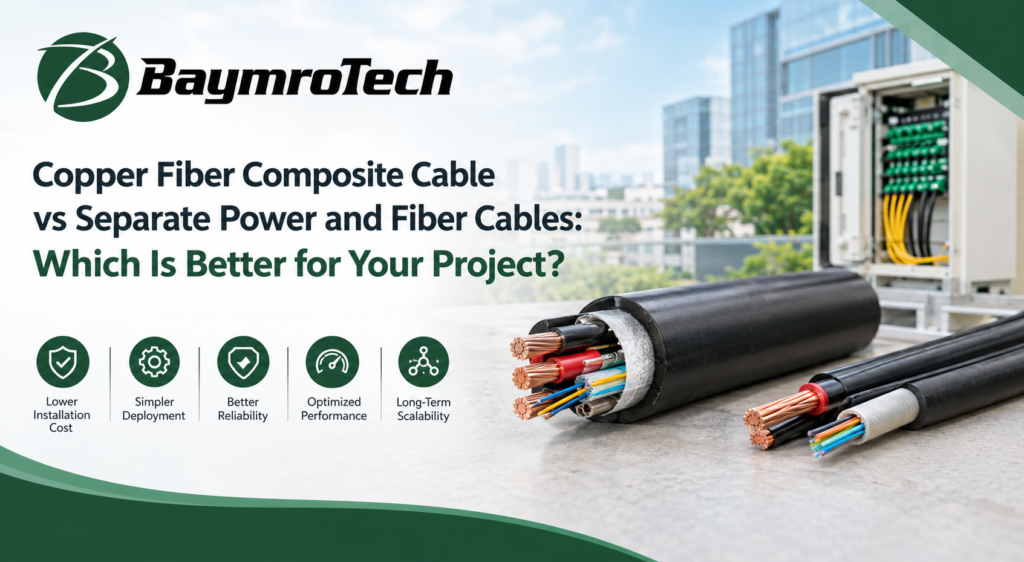
Choosing between copper fiber composite cable and separate power and fiber cables is an important decision when planning telecom infrastructure. The right configuration can influence installation complexity, cable routing, available pathway space, electrical performance, maintenance procedures and overall project expenditure.
For remote telecom equipment, fiber access networks and infrastructure deployments that require both power and optical connectivity, an integrated cable may simplify the physical layout. However, separate cables can offer greater flexibility when electrical and optical systems require independent routing, different protection levels or easier individual replacement.
The best choice depends on your actual power demand, transmission requirements, installation environment and lifecycle costs, not simply the number of cables installed.
This guide explains the differences, compares the technical and commercial trade-offs, and outlines what buyers should verify before requesting a quotation from BaymroTech.
What Is Copper Fiber Composite Cable?
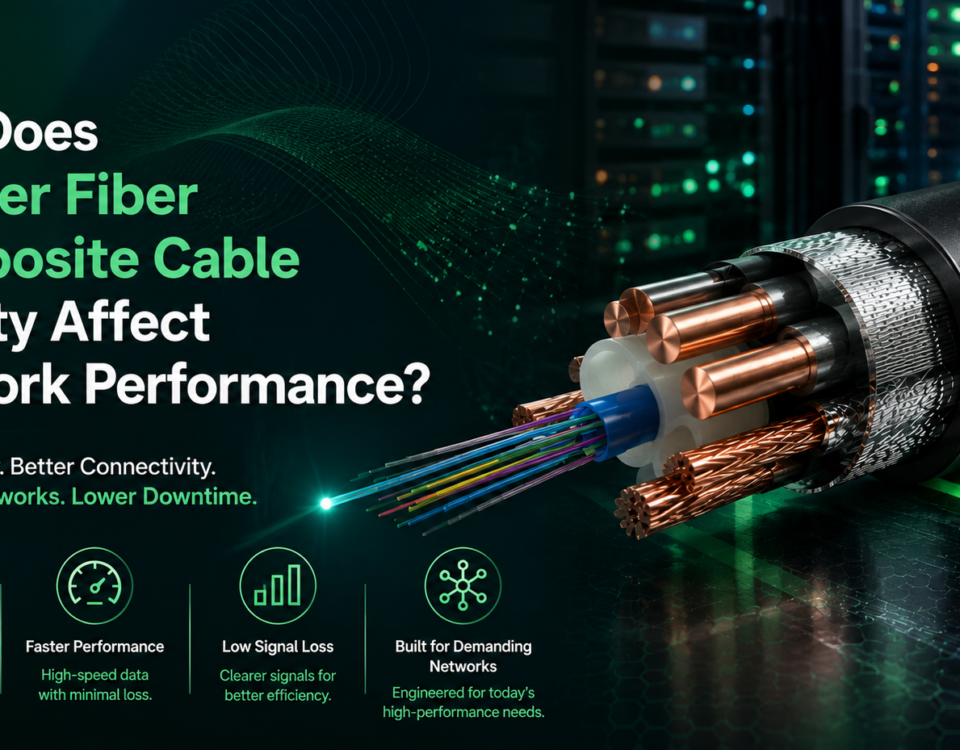
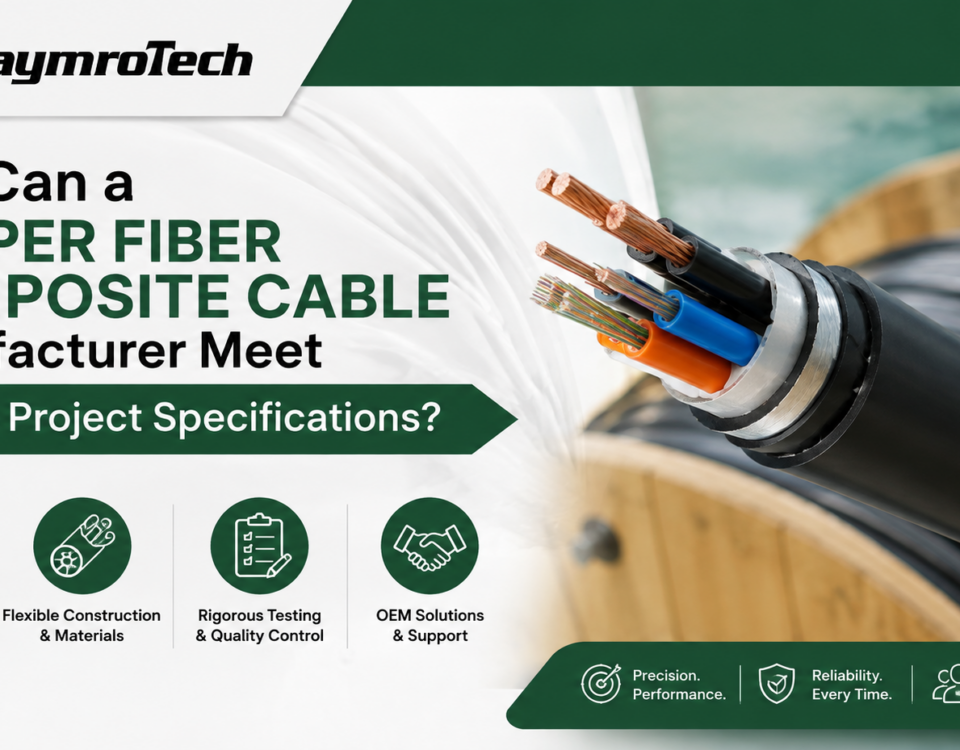
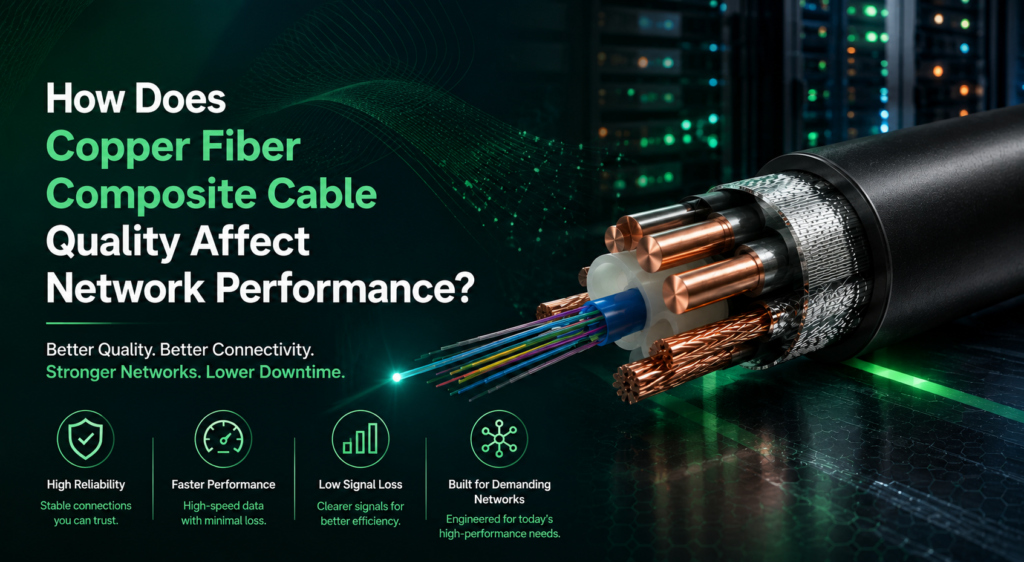
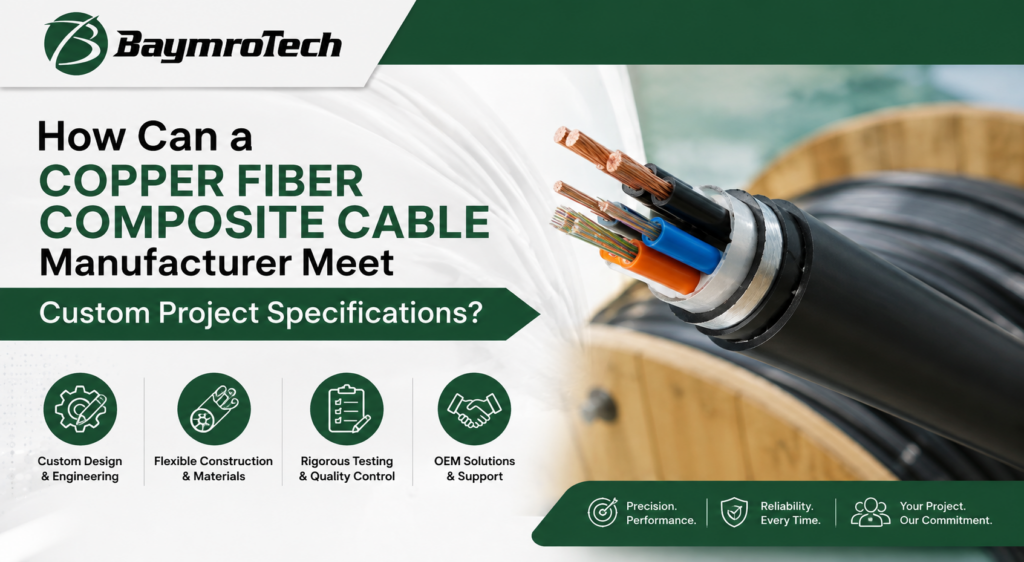
A copper fiber composite cable combines optical fibers for data transmission with copper conductors for electrical power delivery within one cable assembly. Instead of installing an entirely separate fiber cable and power cable, a project can use a shared cable structure designed to accommodate both functions.
The exact construction varies by product. Depending on the design, a composite cable may contain optical fiber units, insulated copper conductors, strength members, protective layers and an outer jacket. Some constructions may also incorporate additional mechanical protection or components intended for particular installation environments.
The optical fibers carry data using light, while the copper conductors carry electrical current. These functions operate through different physical mechanisms, even though their components share a cable assembly.
This arrangement can be useful where remote network equipment needs optical connectivity and a suitable local power supply delivered through the same route.
However, integration does not automatically establish electrical suitability, transmission performance or environmental compatibility. Buyers must verify the cable’s actual construction, conductor dimensions, fiber configuration, ratings and intended installation conditions.
For project planning, see the BaymroTech Copper Fiber Composite Cable product page for the relevant product offering and available information.
How Do Composite Cables Differ From Separate Power and Fiber Cables?
The main difference is the physical arrangement of the electrical and optical components.
Integrated optical fiber and copper conductors
With a composite cable, fiber and copper conductors share a common cable assembly. This can reduce the need to route two independent cable runs along the same pathway, provided the cable’s dimensions, bend radius, installation method and ratings meet project requirements.
For example, a remote telecommunications cabinet may require a fiber connection to the network and a copper-fed power connection from a suitable source. A composite cable could support both functions along a shared route if the electrical design permits it.
The engineering team must still plan appropriate power protection, fiber termination, cable entry arrangements, grounding where applicable and separation from equipment or circuits that could create unacceptable electrical or electromagnetic risks.
Separate power and fiber cables
In a separate arrangement, the power cable and fiber optic cable are installed independently. Each can be selected for its own electrical, optical, mechanical and environmental requirements.
This approach can be useful when the power cable requires a different rating or protective construction from the fiber cable. It can also make it easier to replace one cable without disturbing the other, assuming the pathway and installation arrangement allow independent access.
The trade-off is that separate cables may require additional pathway capacity, supports, routing coordination and installation work. Actual requirements depend on the site layout and whether suitable pathways already exist.
Practical example
Consider a contractor connecting a remote outdoor telecom unit to an equipment cabinet.
- Composite cable approach: One cable route carries the required fiber and power conductors, subject to electrical calculations and environmental verification.
- Separate cable approach: An optical cable and a power cable follow individual routes, allowing each to use a construction and protection system appropriate to its function.
Neither approach is automatically superior. The decision depends on the route, load, distance, installation conditions and maintenance strategy.
Detailed Comparison: Composite Cable vs Separate Cables
The following comparison highlights the factors that should guide a project-specific decision.
| Evaluation factor | Copper fiber composite cable | Separate power and fiber cables |
| Cable routing and installation | Combines both functions along a shared route, potentially simplifying pathway coordination | Requires two cable runs or arrangements, although existing separate pathways may simplify installation |
| Space and pathway requirements | May reduce the number of cable runs, but the overall cable diameter and bend requirements must be checked | May occupy more combined pathway space, depending on individual cable sizes and routing |
| Power and transmission design | Electrical and optical specifications must both match the application | Each cable can be selected independently for its electrical or optical requirements |
| Cable termination and connection | Requires appropriate access to both conductor and fiber elements, with compatible termination arrangements | Each cable can use its own termination method, connector system and access point |
| Maintenance and replacement | Damage to the shared assembly may affect both services and require replacement of the composite cable | Individual cable replacement may be possible without replacing the other cable |
| Environmental suitability | Depends on the composite cable’s jacket, insulation, mechanical protection and verified ratings | Each cable can be selected for its specific environment and protection requirements |
| Project scalability | Can suit planned combined power and fiber routes, but future changes must fit the cable’s available configuration | Allows independent changes to power and optical capacity, subject to pathway availability |
| Initial installation cost | May reduce duplicated routing or support work in suitable installations | May be competitive where separate pathways already exist or specialized cables are required |
| Total cost of ownership | Depends on cable cost, installation, termination, maintenance and potential shared-cable replacement | Depends on combined cable costs, routing, labour and the ability to maintain each service independently |
What does this mean for project engineers?
A composite cable is worth evaluating when a project benefits from a shared route and the electrical and optical specifications can be satisfied by one cable construction.
Separate cables deserve preference when the power circuit and optical link need substantially different routes, protection requirements or maintenance arrangements.
The comparison should also account for cable pulling forces, minimum bend radius, access for repairs, connector space, electrical isolation requirements and the consequences of a single cable failure.
A lower cable count is not sufficient evidence of a lower installed cost. The full installation design determines the outcome.
When Is Copper Fiber Composite Cable the Better Fit?
Composite cable can be a strong candidate when equipment requires both electrical power and optical connectivity along the same route.
Remote telecom equipment
Remote network devices may be located where installing multiple independent cable routes creates additional work. A suitable composite cable can combine power and data connectivity in one assembly, provided the power source, load, cable length and installation conditions meet the design requirements.
Wireless access infrastructure
Wireless access points and other network devices may need both a network connection and remote low-voltage power. Composite cable can be considered when the architecture uses a separate optical data link and copper power conductors, rather than relying on a network technology that delivers power over its data conductors.
The distinction matters because not every wireless installation requires a separate copper power circuit.
Space-constrained installations
Equipment routes, compact enclosures and congested cable pathways may benefit from reducing the number of separate cable runs. The advantage should be assessed against the composite cable’s outside diameter, bend radius, support requirements and accessibility.
Projects with planned combined connectivity
Composite cable is particularly worth assessing when power and fiber must follow the same route for most of the installation and both systems have clearly defined requirements.
Before selection, confirm:
- The connected equipment’s power demand and operating voltage.
- The total cable length and acceptable voltage drop.
- The fiber type, count and optical performance requirements.
- Indoor or outdoor use, exposure to moisture and temperature conditions.
- Termination methods and compatibility with the equipment.
- Applicable electrical, fire and installation requirements.
BaymroTech describes its copper/fiber composite cable offering for applications including remote low-voltage power, security networks, wireless access points and harsh-environment LAN installations. Its published product information lists flexible stranded copper options and multiple fiber configurations. Buyers should confirm the exact available construction and ratings for their intended application before specification.
When Are Separate Power and Fiber Cables Preferable?
Integrated cabling is not the right answer for every project. Separate cables can be more appropriate when electrical and optical infrastructure need independent design decisions.
Independent cable ratings
A power circuit may require a particular insulation system, conductor size, temperature rating or protective arrangement. The fiber cable may need different fire performance, water resistance, mechanical protection or installation characteristics.
If one composite construction cannot meet both sets of requirements, separate cables offer greater selection flexibility.
Independent routing
Some sites require the optical cable to follow a dedicated communications pathway while the power cable follows a separate route. This may be driven by site rules, electrical safety requirements, equipment locations or the need to keep services physically separated.
A composite cable should not be used to bypass required electrical separation or installation rules.
Different maintenance and replacement schedules
If the power circuit and fiber link are expected to be upgraded or replaced independently, separate cables can simplify future changes. For example, an optical capacity upgrade might require a different fiber count without requiring a change to the existing power circuit.
With a composite assembly, future requirements must be checked against the existing fiber and conductor configuration. Replacement may involve disturbing both services.
Existing infrastructure and staged expansion
A site may already have adequate power conduits and fiber pathways. In that situation, using separate cables may avoid unnecessary pathway changes or redesign.
Similarly, projects that will expand electrical loads and optical capacity at different rates may benefit from independent cable selection.
The key trade-off: composite cable prioritizes physical integration, while separate cabling prioritizes independent routing, specification and replacement. Neither architecture guarantees lower maintenance costs or greater reliability in every environment.
Technical Specifications Buyers Must Verify
Cable selection should start with a defined electrical and optical design rather than a general product category.
Fiber count and fiber type
Specify the number of fibers required, whether the application uses single-mode or multimode fiber, and the required optical characteristics.
Confirm the intended transmission equipment, link distance, connector type and compatibility with the network design. Do not assume that any fiber configuration is interchangeable with another.
Copper conductor material and size
Confirm the conductor material, cross-sectional area or AWG size, conductor construction and allowable current under the applicable installation conditions.
BaymroTech’s published product page lists flexible stranded copper options in 12, 14, 16 and 18 AWG. These are product-page-listed options, not a recommendation that any particular size will suit a specific load. Availability and ratings should be confirmed for the required configuration.
Power demand, distance and voltage drop
The electrical design must consider:
- Equipment operating voltage and actual load current.
- Total conductor length and round-trip current path.
- Conductor resistance at the expected operating temperature.
- Acceptable voltage drop at the connected equipment.
- Starting current or transient demand, where relevant.
- Protective devices, installation method and applicable electrical rules.
For a basic DC circuit, voltage drop can be estimated using:
V=IRloop
Here, V is the voltage drop, I is the load current, and Rloop is the total resistance of the outgoing and return conductors at the relevant operating conditions.
The receiving equipment must still get a voltage within its permitted operating range under expected conditions. The formula is a starting point, not a substitute for the complete electrical design.
Insulation, jacket and mechanical protection
Verify insulation construction, jacket material, abrasion resistance, tensile and crush requirements, bending limitations and pulling conditions.
For outdoor or harsh-environment routes, also establish the requirements for water exposure, ultraviolet radiation, temperature variation, chemicals or other site-specific hazards.
Environmental ratings and compliance
Confirm the cable’s documented suitability for the installation location. Indoor riser, plenum, outdoor, direct-burial and industrial requirements are not interchangeable.
BaymroTech’s product page lists certain riser, water-blocked and regulatory classification options. These descriptions should not be interpreted as universal approval for every product configuration or jurisdiction. Request the applicable documentation for the specific cable being quoted.
Termination and testing
Determine whether the cable will be field terminated or supplied in a preconfigured assembly. Confirm the copper termination method, fiber connector requirements, enclosure entry arrangements and access for testing.
Specify the required electrical continuity and insulation checks, as applicable, alongside optical testing and documentation appropriate to the project.
Project Cost and Procurement Considerations
A fair cost comparison should evaluate the complete installed solution rather than the purchase price per metre alone.
For example, a remote equipment deployment with a long shared route may benefit from a composite cable if it reduces duplicated routing work and supports the required electrical and optical configuration. Conversely, a building with existing independent conduits may find separate cables more economical because no major pathway changes are needed.
Include the following costs in the assessment:
- Cable procurement: Required length, conductor size, fiber count, cable construction and any project-specific configuration.
- Installation labour: Cable pulling, supports, pathway preparation, routing and access requirements.
- Accessories: Connectors, termination hardware, enclosures, glands, protective devices and other necessary components.
- Testing and commissioning: Electrical checks, optical testing, inspection and required documentation.
- Maintenance: Fault diagnosis, accessibility, spare cable availability and service interruption.
- Replacement exposure: Whether a cable fault affects both power and fiber services or can be isolated to one cable.
For a bulk procurement exercise, buyers should compare equivalent technical specifications. A quotation for a shorter cable, different conductor size or unsuitable jacket is not a meaningful cost comparison.
What should a copper fiber composite cable RFQ include?
Cable and fiber requirements
Fiber count, single-mode or multimode type, conductor material and size, cable construction and required length.
Electrical requirements
Supply voltage, operating current, load details, cable distance, permissible voltage drop and applicable protection requirements.
Installation environment
Indoor or outdoor location, temperature range, moisture exposure, mechanical protection, fire classification and installation method.
Commercial and delivery details
Estimated quantity, sample requirements, packaging, delivery destination, required schedule, testing reports and compliance documents.
How Can BaymroTech Support Your Cable Sourcing Requirements?
BaymroTech lists copper/fiber composite cables within its telecom connectivity portfolio, with published options covering different conductor sizes, fiber configurations and cable constructions. The company also supplies other fiber connectivity products and FTTx infrastructure components.
For buyers planning remote connectivity or telecom infrastructure, the relevant starting point is the BaymroTech Copper Fiber Composite Cable product.
Before requesting a quotation, share your project requirements rather than specifying only a generic cable name. This allows the discussion to focus on whether the proposed construction matches your electrical, optical, environmental and installation needs.
Where a particular rating, certification, jacket, connector or custom configuration is essential, request confirmation and supporting documentation for the exact proposed product. Do not assume that every listed feature is available in every configuration.
For broader network planning, BaymroTech also provides an FTTx solution overview covering fiber access infrastructure and related connectivity products.
Project-Specific Buyer Checklist
Before finalizing your cable architecture, confirm each of the following:
- Both power and optical connectivity are genuinely required along the same route.
- Equipment voltage, load current and power demand have been established.
- Cable distance and voltage drop have been calculated and verified.
- Fiber count, type, optical performance and termination requirements are defined.
- Conductor size and current-carrying suitability have been verified.
- Environmental, fire, mechanical and installation requirements are documented.
- Cable routing, bend radius, pulling conditions and pathway capacity are understood.
- Maintenance access and the consequences of cable failure have been assessed.
- Initial installation cost and expected lifecycle costs have been compared.
- The supplier has confirmed the proposed configuration and relevant documentation.
Frequently Asked Questions
1. What is the main difference between copper fiber composite cable and separate cables?
A composite cable integrates copper power conductors and optical fibers into one cable assembly. Separate cabling uses an independent power cable and fiber optic cable, allowing each to be selected and routed according to its own requirements.
2. Is copper fiber composite cable suitable for every telecom project?
No. It is suitable only when the cable’s electrical, optical, mechanical and environmental specifications meet the project’s needs. Applications requiring different cable ratings or independent routing may be better served by separate cables.
3. How do buyers calculate the required copper conductor size?
The conductor size must be determined using load current, supply voltage, total circuit length, conductor resistance, acceptable voltage drop, operating temperature and applicable electrical requirements. A supplier should not recommend a conductor size based solely on the equipment type.
4. Can copper fiber composite cable support different fiber configurations?
Available configurations depend on the specific product design. Buyers should confirm fiber count, single-mode or multimode type, optical requirements, connector arrangements and availability for the intended order.
5. What environmental conditions should be checked before purchasing?
Consider indoor or outdoor installation, moisture, temperature, ultraviolet exposure, abrasion, crushing, tensile forces, fire requirements and any chemical or industrial hazards. Verify the ratings of the exact proposed cable rather than relying on a general product description.
6. Can copper fiber composite cable be customized?
Customization depends on the manufacturer’s available designs and technical capabilities. Submit the required conductor size, fiber configuration, cable length, jacket requirements, termination details and compliance needs so the requested configuration can be assessed.
7. Is composite cable always cheaper than buying separate cables?
No. It may reduce duplicated routing and installation work in some projects, but the cable price, termination requirements, accessories, existing pathways and replacement implications can change the overall cost. Compare the complete installed solutions.
8. What information is needed for a bulk quotation?
Provide the required cable specifications, estimated quantity, lengths, conductor and fiber configurations, operating environment, applicable compliance requirements, packaging expectations and delivery schedule. Include power load and distance details so the electrical suitability can be assessed before an order is finalized.
Conclusion: Which Cable Architecture Should Your Project Choose?
Copper fiber composite cable and separate power and fiber cables can both support telecom infrastructure, but they address different installation priorities.
Composite cable is worth considering when power and optical connectivity share a route, space is constrained and one cable construction can meet all electrical, optical and environmental requirements. Separate cables may be preferable when independent routing, cable replacement, specialized ratings or future upgrades are more important.
For telecom operators, contractors and procurement teams, the most effective decision combines engineering verification with a realistic assessment of installation and lifecycle costs.
Planning a telecom deployment? Share your power load, cable distance, fiber requirements, installation conditions and estimated quantity with BaymroTech to discuss the appropriate copper fiber composite cable configuration and request a project-specific quotation.