Introduction
Fiber splicing projects depend on many small components working together consistently. Among them, the fiber optic pigtail directly affects how a spliced fiber connects to an adapter, patch panel, optical distribution frame, or active equipment. Choosing the wrong configuration can create unnecessary insertion loss, poor connector compatibility, difficult installation, and maintenance problems later in the network lifecycle.
This is becoming more important as telecom, FTTH, data center, and enterprise networks move toward higher fiber density and more demanding installation environments. Buyers are not simply looking for a low-cost pigtail. They need an assembly that matches the fiber architecture, connector interface, splice method, environmental conditions, and optical performance requirements of the project.
For this reason, selecting a fiber optic pigtail should begin with the technical requirements of the application.
A suitable pigtail should have the right fiber type, connector and polish, cable construction, optical performance, bend characteristics, and splice compatibility. The choice of a capable fiber optic pigtail supplier then becomes important for ensuring those specifications can be produced consistently at the required quantity and quality.
What Is a Fiber Optic Pigtail?

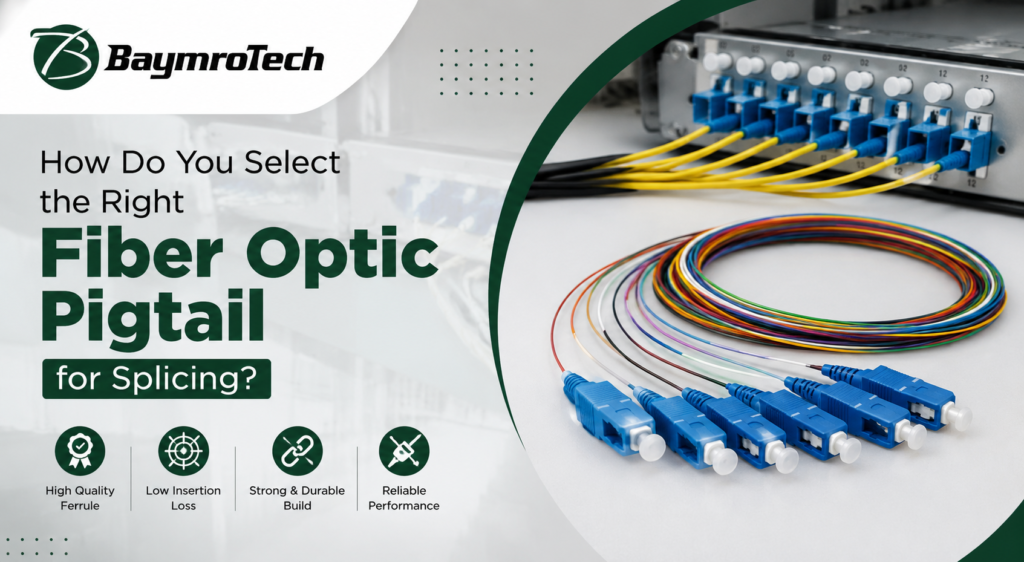
A fiber optic pigtail is a short optical fiber assembly with a connector terminated at one end and exposed fiber at the other. The exposed end is normally fusion spliced to a field fiber, while the connectorized end is connected to an adapter, patch panel, optical distribution frame, splice enclosure, or other fiber management equipment.
Unlike a conventional fiber patch cord, a pigtail is designed specifically for splicing and permanent fiber termination.
A typical fiber optic pigtail consists of:
- Optical fiber
- Fiber coating
- Cable or protective structure
- Connector
- Ferrule
- Connector housing and boot
- Bare fiber section for splicing
The exact construction varies according to the application. A telecom distribution cabinet may require a compact single-mode pigtail, while a data center or enterprise installation may have different connector density and cable management requirements.
How Do You Select the Right Fiber Type?
Fiber type is one of the first specifications a buyer should establish because the pigtail must match the optical fiber used throughout the network.
Single-Mode Fiber Pigtails
Single-mode pigtails are commonly used for telecommunications, FTTH, long-distance transmission, access networks, and other applications where signals travel over significant distances.
Typical single-mode options include fibers designed around common telecom transmission wavelengths and network architectures. They are suitable where low attenuation and long-distance optical transmission are priorities.
For telecom and FTTH projects, buyers should confirm the required single-mode fiber specification rather than simply ordering a generic single-mode pigtail.
Multimode Fiber Pigtails
Multimode pigtails are generally used in shorter-distance applications such as data centers, enterprise networks, and certain LAN environments.
Common multimode categories include OM-series fiber constructions. The correct selection depends on the existing cabling architecture and optical equipment.
Buyer consideration: The pigtail fiber should match the fiber type and transmission requirements of the network. Mixing incompatible fiber specifications can create performance and installation issues.
How Does Connector Type Affect Pigtail Selection?
The connector is one of the most visible differences between pigtail configurations, but its selection should be based on the interface used by the network equipment or fiber management system.
Common connector options include:
- SC
- LC
- FC
- ST
SC Pigtails
SC connectors use a push-pull connection and are widely used in telecom, FTTH, and fiber distribution applications. Their relatively large form factor can be practical for conventional fiber management environments.
LC Pigtails
LC connectors have a smaller form factor and are useful where high-density fiber connections are required. They are commonly found in data centers and compact fiber management systems.
FC Pigtails
FC connectors use a threaded coupling mechanism and can be selected where a secure connection is required in applications designed for this connector interface.
ST Pigtails
ST connectors use a bayonet-style coupling mechanism and may still be required for certain legacy or specialized network installations.
The right fiber optic pigtail supplier should be able to provide the connector configuration required by the customer’s existing equipment rather than forcing the project into a limited standard configuration.
UPC or APC: Which Polish Should You Choose?
Connector polish is another important technical specification.
UPC
Ultra Physical Contact, or UPC, connectors are commonly used in general optical connectivity applications where the network design calls for UPC interfaces.
APC
Angled Physical Contact, or APC, connectors use an angled end face to help reduce reflected optical power. APC configurations are frequently used in applications where low return loss is particularly important, including many FTTH and passive optical network environments.
Important: UPC and APC connectors should not be treated as interchangeable simply because they use the same basic connector format.
For example, an SC/APC pigtail and SC/UPC pigtail have different optical interface requirements. The pigtail should match the adapter and equipment interface used in the network.
Why Do Cable Diameter and Jacket Type Matter?
The pigtail cable structure affects installation, routing, protection, and space utilization.
Common pigtail cable diameters can vary according to the design and application. Smaller-diameter constructions can be useful in high-density environments because they occupy less space and can simplify fiber routing.
However, smaller does not automatically mean better.
The cable must provide sufficient protection for the installation environment while remaining flexible enough for proper fiber management.
PVC and LSZH Jacket Considerations
PVC jackets can be suitable for many conventional installations, depending on the project requirements.
LSZH, or Low Smoke Zero Halogen, materials may be preferred in environments where reduced smoke and halogen emissions are required.
For indoor projects, buyers should consider:
- Fire and material requirements
- Installation location
- Cable routing density
- Flexibility
- Mechanical protection
- Applicable project standards
Outdoor or harsher environments may require a different protective construction altogether.
How Do Insertion Loss and Return Loss Affect Selection?
Optical performance should be considered before selecting a pigtail based only on physical configuration.
Insertion Loss
Insertion loss indicates the amount of optical power lost when a connection is introduced into the optical path.
Lower insertion loss is generally desirable because excessive loss can reduce the available system power budget.
For projects involving many connections and splices, even small losses can accumulate across the network.
Return Loss
Return loss indicates the amount of optical power reflected toward the source.
Higher return loss generally represents lower reflected power and can be important for networks that are sensitive to reflections.
The required performance should therefore be aligned with the optical budget and equipment specifications of the project.
A qualified supplier should be able to provide applicable optical performance specifications and test information for the supplied configuration.
Why Is Splice Compatibility Important?
A pigtail is only useful if it can be reliably spliced to the project fiber.
The bare fiber section should be suitable for the planned fusion splicing process, and its construction should allow technicians to prepare and splice the fiber efficiently.
Buyers should consider:
- Fiber type compatibility
- Fiber coating characteristics
- Bare fiber length
- Coating removal requirements
- Fusion splicer compatibility
- Splice protection sleeve requirements
- Buffer and cable construction
- Routing inside the splice tray
Poor compatibility can increase installation time and make the splicing process more difficult.
For high-volume FTTH or telecom deployment, these installation details become particularly important because even small differences can affect productivity across thousands of connections.
How Does Bend Performance Influence Pigtail Selection?
Modern fiber installations increasingly use compact cabinets, high-density distribution systems, and smaller routing spaces. Bend performance therefore deserves attention during product selection.
A pigtail with appropriate bend characteristics can make fiber routing easier while helping reduce the risk associated with excessive bending.
However, buyers should not select a bend-sensitive or bend-optimized configuration solely because it sounds more advanced. The specification should match the actual network design and fiber requirements.
For dense installations, review:
- Minimum bend radius
- Cable flexibility
- Routing space
- Splice tray design
- Fiber management method
- Expected installation movement
The goal is to achieve a balance between mechanical protection, flexibility, and reliable optical performance.
Which Fiber Optic Pigtail Is Right for Different Applications?
Different network environments require different combinations of specifications.
| Application | Typical Selection Considerations |
| FTTH | Single-mode fiber, often APC configuration, compact construction, splice compatibility |
| Telecom distribution | Single-mode fiber, appropriate connector and polish, reliable optical performance |
| Data center | High-density connector configuration, compact cable construction, suitable multimode or single-mode fiber |
| Enterprise network | Fiber type and connector matched to existing equipment |
| Fiber distribution frame | Connector compatibility, manageable cable diameter, reliable termination |
| Splice enclosure | Splice compatibility, protective construction, suitable fiber length |
| Outdoor network | Appropriate jacket and environmental protection, bend and mechanical requirements |
These are starting points rather than universal specifications. The final configuration should be based on the network architecture and installation environment.
What Should Buyers Check When Ordering Fiber Optic Pigtails?
Once the technical requirements are established, procurement teams can evaluate suppliers based on their ability to deliver the required configuration consistently.
Manufacturing Capability
For larger telecom and infrastructure projects, an OEM manufacturer can provide greater control over configuration, production, and repeat orders.
This is particularly useful when buyers require non-standard lengths, connector combinations, labeling, packaging, or project-specific specifications.
Customization
A supplier should be able to discuss the technical configuration rather than simply provide a fixed catalog item.
Potential customization areas include:
- Fiber type
- Connector type
- Connector polish
- Cable diameter
- Cable length
- Jacket material
- Fiber count
- Labeling
- Packaging
Testing and Quality Documentation
Buyers should request appropriate testing information for the agreed product configuration.
Depending on the project, this can include insertion loss, return loss, connector inspection, continuity, dimensional inspection, and other quality checks.
MOQ and Production Planning
MOQ becomes important when ordering customized pigtails. Procurement teams should confirm whether the supplier has different minimum quantities for standard and customized products.
For large deployments, production capacity and repeat-order consistency are also important.
Lead Time
Lead time should be evaluated against the project’s installation schedule. Customized configurations may require additional production planning compared with standard assemblies.
A reliable supplier should be able to communicate realistic production and delivery expectations before an order is placed.
Technical Support
Technical support is particularly useful when buyers are unsure about connector compatibility, polish type, fiber construction, or cable configuration.
A technically capable fiber optic pigtail supplier can help review the specification before production, reducing the risk of ordering an unsuitable configuration.
Common Fiber Optic Pigtail Selection Mistakes
Selecting the Wrong Fiber Type
A pigtail should match the optical fiber architecture of the network. Choosing based only on connector type can result in an unsuitable assembly.
Mixing UPC and APC Interfaces
UPC and APC should be selected according to the equipment and adapter interfaces. They should not be mixed without confirming compatibility.
Ignoring Cable Diameter
A pigtail that is physically unsuitable for a dense splice tray or fiber management system can make installation unnecessarily difficult.
Focusing Only on Connector Type
SC, LC, FC, and ST identify the mechanical interface, but connector type alone does not define the complete optical specification.
Fiber type, polish, optical performance, cable construction, and application must also be considered.
Overlooking Bend Requirements
Dense fiber routing requires careful consideration of bend performance and minimum bend radius.
Buying Without Technical Documentation
For B2B projects, technical specifications and test documentation provide useful evidence that the supplied product matches the approved configuration.
Choosing Only by Unit Price
A cheaper pigtail may not provide the required optical performance, mechanical construction, documentation, or repeatability. Procurement decisions should consider the complete project requirement rather than unit cost alone.
Fiber Optic Pigtail Buyer Checklist
Before placing an order, confirm the following:
✓ Single-mode or multimode fiber
✓ Required fiber specification
✓ SC, LC, FC, ST, or other connector
✓ UPC or APC polish
✓ Cable diameter
✓ Cable length
✓ Jacket material
✓ Insertion loss requirement
✓ Return loss requirement
✓ Minimum bend radius
✓ Bare fiber and splice compatibility
✓ Required certifications or compliance documentation
✓ Testing requirements
✓ Packaging and labeling requirements
✓ Required quantity and MOQ
✓ Production and delivery schedule
Why Choose BaymroTech as Your Fiber Optic Pigtail Supplier?
For B2B buyers, the value of an OEM manufacturer is not simply the ability to supply a standard product. It is the ability to translate a technical requirement into a repeatable product configuration.
BaymroTech supplies fiber optic pigtails for telecom, FTTH, data center, ISP, enterprise, and fiber infrastructure applications.
As an OEM-focused B2B supplier, BaymroTech can support requirements involving different fiber types, connector configurations, cable constructions, lengths, and project-specific specifications.
This is particularly useful when a project requires more than a standard off-the-shelf assembly. Procurement and engineering teams can discuss the intended application, connector interface, optical requirements, splice environment, quantity, and delivery expectations before finalizing the product specification.
For repeat infrastructure deployments, maintaining consistent specifications across orders can also help simplify installation, maintenance, and inventory planning.
Frequently Asked Questions
What is a fiber optic pigtail?
A fiber optic pigtail is a short fiber assembly with a connector on one end and bare fiber on the other. The bare fiber is normally fusion spliced to another optical fiber.
Which fiber type should I choose for a pigtail?
Single-mode is commonly selected for telecom, FTTH, and long-distance applications, while multimode is often used in shorter-distance data center and enterprise environments. The pigtail should match the existing network fiber.
Should I choose UPC or APC?
The choice depends on the optical interface and network requirements. APC is commonly used where low reflected optical power is important, while UPC is used in many conventional optical connections.
Which connector is best for a fiber optic pigtail?
There is no single connector that is best for every project. SC, LC, FC, and ST should be selected according to the equipment, adapter, density, and network architecture.
Why does cable diameter matter?
Cable diameter affects fiber routing, space utilization, flexibility, and installation inside splice trays, cabinets, and other fiber management systems.
What optical specifications should buyers check?
Insertion loss and return loss are two important specifications. Buyers should also review fiber type, connector polish, bend performance, and splice compatibility.
Can a fiber optic pigtail be customized?
Yes. Depending on the supplier’s manufacturing capabilities, pigtails can be customized for fiber type, connector, polish, cable length, diameter, jacket, labeling, packaging, and other project requirements.
How can I choose a reliable fiber optic pigtail supplier?
Start with the technical specification. Then verify whether the supplier can consistently manufacture the required configuration, provide appropriate testing documentation, support customization, meet required quantities, and maintain reliable delivery.
Request a Fiber Optic Pigtail RFQ
The right pigtail starts with the right technical specification.
Before requesting a quotation, define the fiber type, connector and polish, cable diameter, length, jacket, optical performance, bend requirements, splice environment, quantity, and any project-specific requirements.
Once these details are clear, procurement teams can compare suppliers on their ability to manufacture and deliver the required product consistently.
BaymroTech can support B2B buyers evaluating fiber optic pigtails for telecom, FTTH, data center, ISP, enterprise, and infrastructure projects. Buyers can discuss OEM requirements, customization, MOQ, testing documentation, lead times, and project-specific configurations directly with the team.
Ready to specify the right fiber optic pigtail for your next splicing project? Contact BaymroTech to discuss your technical requirements and request a project-specific RFQ.
Get the right fiber optic pigtail specification, supplier support, and project-ready solution from BaymroTech.