Introduction
For telecom operators, system integrators, infrastructure developers, and engineering contractors, selecting a fiber distribution box supplier is rarely just a matter of comparing unit prices. A supplier may offer an attractive quotation, but if product quality varies between batches, customization is limited, lead times are unreliable, or technical support is difficult to access, the initial savings can quickly disappear.
Fiber network projects are also becoming more demanding. High-density deployments, FTTH expansion, PON networks, data transmission infrastructure, and customized network architectures require distribution boxes that can match specific installation environments and connection requirements.
That makes supplier evaluation a strategic procurement decision.
A reliable fiber distribution box manufacturer should be able to demonstrate consistent manufacturing, customization capability, controlled quality processes, dependable supply capacity, technical support, and a clear understanding of project requirements. Buyers should evaluate the complete supply proposition rather than selecting a supplier based only on product price.
What Is a Fiber Distribution Box Manufacturer?
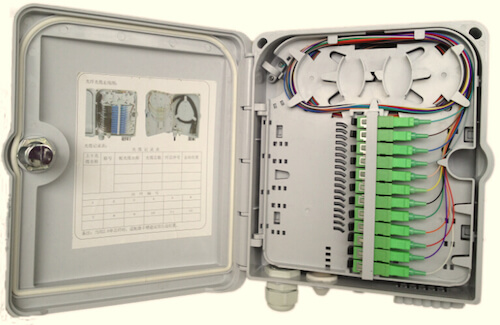
A fiber distribution box manufacturer designs and produces enclosures used to organize, protect, terminate, splice, and distribute optical fiber connections within communication networks.
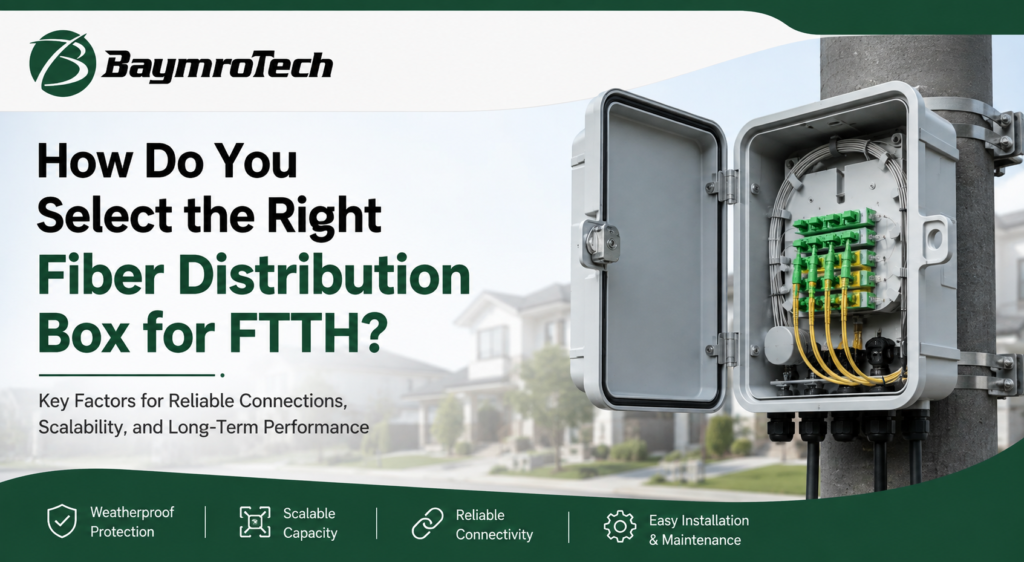
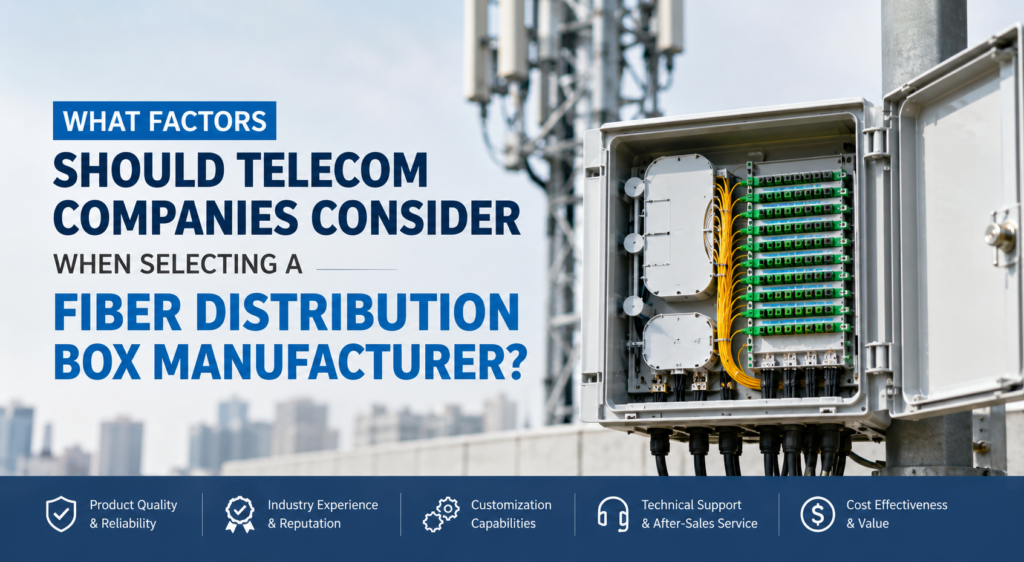
A fiber distribution box, commonly called an FDB, can support fiber termination, splicing, adapter connections, and in some configurations PLC splitter integration. Depending on the project, boxes may be designed for indoor or outdoor use and wall or pole mounting.
For B2B buyers, the manufacturer matters because production capability directly influences enclosure durability, fiber management, connection reliability, installation efficiency, and long-term maintenance requirements.
BaymroTech offers fiber distribution boxes in multiple capacity configurations, including options ranging from smaller port counts to higher-capacity solutions. Its product range also supports different adapter and splitter configurations, with customization available for project requirements.
Applications and Industry Use Cases
Fiber distribution boxes are used across a wide range of optical communication environments. The right configuration depends on fiber count, installation location, connection method, environmental exposure, and network architecture.
FTTH and FTTx Deployments
FTTH networks require organized fiber distribution between feeder cables, distribution cables, and subscriber connections. A properly designed FDB helps installers manage connections while protecting sensitive fiber components.
For FTTx projects, procurement teams may need different capacities and configurations depending on the number of subscribers and network topology.
PON Networks
Passive optical networks depend on efficient optical signal distribution. Fiber distribution boxes can provide a practical location for fiber termination, splicing, and splitter integration.
Depending on the network design, buyers may require boxes that accommodate PLC splitters such as 1:4, 1:8, 1:16, or higher split configurations. The required splitter capacity should be considered together with the available internal space, adapter arrangement, fiber routing, and expected network expansion.
Telecom and Broadband Networks
Telecom operators use fiber distribution equipment within access networks, optical communication infrastructure, and broadband deployments. The enclosure must provide reliable fiber organization while allowing technicians to perform installation and maintenance efficiently.
CATV and Optical Communication Systems
Fiber distribution boxes can also support CATV, optical LAN, WAN, high-speed broadband transmission, active device termination, and other fiber communication applications.
Building and Infrastructure Projects
In residential buildings, commercial properties, and infrastructure developments, distribution boxes provide structured termination and distribution points for optical cables. Indoor or outdoor mounting requirements can influence material selection and enclosure design.
Different projects often require different specifications, environmental ratings, certifications, fiber capacities, splitter configurations, and customization options. This makes supplier evaluation critical because the appropriate model must be selected according to the actual installation environment rather than simply the number of ports listed in a product catalog.
How Should Buyers Differentiate Indoor and Outdoor Fiber Distribution Boxes?
One of the most important technical decisions is whether the project requires an indoor or outdoor fiber distribution box. These models may look similar, but their housing, sealing, protection, and environmental requirements can differ significantly.
Indoor Fiber Distribution Boxes
Indoor models are generally installed in relatively controlled environments such as telecom rooms, equipment rooms, buildings, offices, cabinets, and indoor communication infrastructure.
Because they are normally protected from direct rainfall, prolonged UV exposure, and severe weather conditions, indoor models may prioritize compact construction, easy installation, fiber management, and accessibility.
For indoor deployments, buyers should consider:
- Available installation space
- Required fiber capacity
- Wall or rack mounting requirements
- Adapter configuration
- Cable entry arrangement
- Ease of maintenance
- Required splitter integration
A highly weather-protected enclosure may not always be necessary for a controlled indoor environment.
Outdoor Fiber Distribution Boxes
Outdoor models require a higher level of environmental protection because they may be exposed to rain, humidity, dust, temperature fluctuations, sunlight, and other environmental stresses.
Outdoor boxes should therefore be evaluated for:
- Sealing performance
- Waterproof protection
- Dust resistance
- UV resistance
- Housing durability
- Cable entry protection
- Locking or secure closure
- Temperature and environmental suitability
For pole-mounted, roadside, building-exterior, FTTH access, or other exposed installations, selecting an outdoor-rated design is particularly important.
Sealing and Waterproof Performance
Sealing is a critical difference between many indoor and outdoor configurations. Outdoor boxes require effective protection around the enclosure opening and cable entry points to reduce the risk of moisture and dust entering the internal fiber management area.
Buyers should ask the manufacturer about the enclosure’s IP protection rating or applicable waterproof performance rather than relying on general descriptions such as “waterproof.”
The sealing design should also remain compatible with repeated maintenance. A box that provides environmental protection but becomes difficult to reseal after servicing can create practical maintenance problems.
For outdoor projects, procurement teams should confirm the expected environmental conditions and select the protection level accordingly.
Housing Materials: ABS vs. PC
Housing material directly affects the durability, weight, impact resistance, and environmental suitability of a fiber distribution box.
ABS Housing
ABS, or acrylonitrile butadiene styrene, is commonly used for fiber enclosures because it offers a practical balance between strength, weight, manufacturability, and cost.
ABS can be suitable for many indoor and certain protected outdoor applications when the enclosure design and environmental protection meet project requirements.
For procurement teams, ABS can be attractive when the project requires cost-efficient production and adequate mechanical performance without unnecessarily increasing enclosure weight.
PC Housing
PC, or polycarbonate, generally offers strong impact resistance and good durability for demanding enclosure applications. It can be considered when the project requires a housing with higher mechanical robustness and better resistance to demanding environmental conditions.
For outdoor installations, material selection should not be evaluated independently. A PC housing alone does not automatically make a product suitable for outdoor deployment. Buyers should evaluate the complete enclosure design, sealing system, UV resistance, temperature performance, and applicable protection rating.
How Should Buyers Select ABS or PC?
The choice should be based on the installation environment and project requirements rather than material name alone.
| Requirement | ABS | PC |
| Indoor applications | Suitable for many applications | Suitable |
| Weight considerations | Generally lightweight | Lightweight to moderate |
| Mechanical durability | Good for standard applications | Strong impact resistance |
| Outdoor exposure | Depends on enclosure design and protection | Often preferred for demanding applications |
| Environmental requirements | Evaluate UV and temperature suitability | Evaluate UV and temperature suitability |
| Cost sensitivity | Often advantageous | May involve higher material cost |
| Custom enclosure requirements | Widely manufacturable | Suitable for demanding designs |
The supplier should be able to recommend the appropriate housing material based on installation conditions, protection requirements, project volume, and budget.
Different Fiber Capacity Configurations
Fiber distribution boxes are available in different capacity configurations because network requirements vary considerably between projects.
Smaller-capacity boxes may be appropriate for low-density access points, residential applications, or installations where only a limited number of fibers need to be terminated or distributed.
Medium-capacity configurations can support larger FTTH distribution points and building-level network deployments.
Higher-capacity boxes are more suitable for larger telecom infrastructure, centralized distribution points, and projects where multiple fibers, adapters, splice trays, or splitters need to be managed within the same enclosure.
Capacity selection should consider more than the current fiber count. Buyers should also account for:
- Number of incoming fibers
- Number of outgoing connections
- Adapter ports
- Splice capacity
- PLC splitter requirements
- Available internal routing space
- Future network expansion
- Installation location
Selecting a box that is too small can create crowded fiber routing and make maintenance difficult. Selecting a significantly oversized enclosure can increase cost and consume unnecessary installation space.
Splitter Integration Options
For PON and FTTH deployments, splitter integration can be an important supplier capability.
A fiber distribution box may be configured to accommodate PLC splitters, depending on its internal structure and available space. Common configurations can include different split ratios based on the network architecture.
When evaluating splitter integration, buyers should confirm:
- Supported splitter type
- Available split ratio
- Splitter mounting arrangement
- Internal fiber routing
- Connector configuration
- Splice management
- Space for future expansion
- Accessibility for maintenance
The supplier should clarify whether splitter integration is part of the standard configuration or requires an OEM customization.
This is particularly important for project buyers because adding a splitter after production may not be practical if the enclosure was not designed with sufficient internal space and fiber routing.
Selecting the Model According to Environmental Conditions
Environmental conditions should directly influence model selection.
For an indoor telecom room, an enclosure may primarily need appropriate capacity, mounting compatibility, fiber management, and easy maintenance.
For a sheltered outdoor location, buyers may need stronger environmental protection and improved sealing.
For fully exposed installations, the enclosure should be evaluated for rainfall, humidity, UV exposure, dust, temperature variation, mechanical impact, and long-term outdoor durability.
A useful procurement approach is to provide the manufacturer with the actual installation environment before requesting a final quotation.
For example:
| Installation Environment | Key Requirements | Typical Selection Considerations |
| Indoor telecom room | Controlled environment | Compact design, capacity, accessibility |
| Indoor commercial building | Protected environment | Mounting, fiber organization, capacity |
| Sheltered outdoor area | Moderate exposure | Sealing, material, environmental protection |
| Pole-mounted outdoor installation | High exposure | Waterproofing, UV resistance, mechanical durability |
| Roadside or exposed infrastructure | Demanding environment | Strong housing, sealing, protection rating, secure closure |
| High-density telecom deployment | High fiber count | Larger capacity, splitter and splice integration |
What Manufacturing Capabilities Should Buyers Evaluate?
This is the most important part of supplier selection. Procurement teams should look beyond catalog specifications and assess what the manufacturer can consistently produce, test, customize, and deliver.
1. OEM Manufacturing Capability
OEM capability is important when the buyer needs products manufactured according to specific drawings, branding requirements, dimensions, labeling, packaging, or technical specifications.
A true OEM manufacturer should be able to work from customer requirements instead of simply reselling standard products.
Ask suppliers:
- Can you manufacture according to customer drawings?
- Can you modify the enclosure design?
- Can you support private labeling?
- Can you customize packaging and identification?
- Can you recommend ABS or PC according to the environment?
- Can you modify sealing and internal configuration?
- Who controls the production process?
For infrastructure projects involving large quantities, OEM capability can provide greater consistency and purchasing flexibility.
2. Customization Options
Standard products are useful for straightforward deployments, but many B2B projects require modifications.
Customization may involve:
- Fiber capacity
- Adapter type
- Connector configuration
- Splitter integration
- Cable entry design
- Mounting method
- Internal fiber management
- Enclosure dimensions
- Housing material
- Sealing configuration
- Labeling
- Packaging
For example, a buyer may require a compact indoor ABS enclosure for a building project but a more robust outdoor PC configuration with enhanced sealing for a roadside deployment.
BaymroTech supports customization for fiber distribution box requirements, allowing project teams to discuss capacity, adapter and splitter configurations, and other application-specific requirements.
3. MOQ Requirements
Minimum order quantity can significantly affect project economics.
A supplier with a very high MOQ may create unnecessary inventory, particularly for pilot projects, phased deployments, or multiple product configurations.
Before requesting a quotation, clarify:
- Standard MOQ
- OEM MOQ
- Sample availability
- Trial order quantities
- Repeat-order requirements
- Mixed-model ordering options
4. Lead Time Stability
A quoted lead time is only useful if the supplier can consistently meet it.
Unstable production schedules can affect installation teams, warehouse planning, project milestones, and downstream equipment deployment.
Ask suppliers how they manage raw material availability, production scheduling, capacity planning, quality inspection, packaging, and export preparation.
5. Product Certifications
Certifications and compliance documentation help buyers determine whether a product is appropriate for the intended market and installation environment.
Depending on the project, buyers may need documentation relating to materials, safety, environmental performance, enclosure protection, or applicable telecom requirements.
Do not simply ask, “Is the product certified?” Request the actual documentation and confirm that it applies to the specific product configuration being purchased.
6. Testing Reports
Testing documentation gives procurement teams evidence that the manufacturer has defined quality requirements and verification procedures.
Depending on product design and project requirements, buyers may request documentation covering dimensions, material performance, sealing or environmental protection, mechanical performance, and other applicable tests.
For outdoor models, buyers should pay particular attention to documentation supporting the claimed protection level and environmental performance.
7. Quality Control Procedures
Quality control should cover the entire manufacturing process, not just final inspection.
A mature manufacturing system should address:
Incoming materials: Verify ABS, PC, connectors, seals, and other components before production.
Production control: Monitor assembly and manufacturing consistency.
In-process inspection: Identify defects before products reach final assembly.
Final inspection: Check finished products against defined specifications.
Packaging inspection: Ensure products are protected for transportation and storage.
For buyers, the goal is consistency. A supplier should be able to deliver the same specification repeatedly across production batches.
8. Technical Support Capability
Technical support becomes particularly important when the project includes customization.
Procurement teams may need assistance with product selection, capacity planning, material selection, indoor versus outdoor model selection, mounting requirements, connector configurations, splitter integration, drawings, or installation questions.
A responsive supplier can help engineering teams resolve issues before production begins.
9. Production Capacity
Production capacity should match the buyer’s current order as well as expected future demand.
Ask about:
- Manufacturing capacity
- Available production lines
- Capacity during peak periods
- Expansion capability
- Repeat-order handling
- Quality control during high-volume production
10. Supply Chain Reliability
A fiber distribution box is only one component of a larger network project. Delays in materials, connectors, plastics, seals, packaging, or other components can affect delivery.
Reliable manufacturers should have controlled sourcing processes and contingency planning for critical materials.
11. Project References
Past project experience can help buyers understand whether the supplier has handled comparable requirements.
Ask for relevant evidence involving FTTH deployments, telecom infrastructure, PON networks, outdoor applications, high-volume orders, customized products, and international supply.
Procurement Risks and Common Supplier Selection Mistakes
Choosing the wrong fiber distribution box supplier can create problems long after the purchase order has been issued.
Selecting the Wrong Indoor or Outdoor Model
Using an indoor enclosure in an exposed outdoor environment can increase the risk of moisture ingress, UV-related degradation, and premature product failure.
Similarly, specifying an unnecessarily high-protection outdoor model for a controlled indoor environment may increase costs without providing meaningful operational benefits.
Choosing Material Without Considering the Environment
Selecting ABS or PC based only on price can be a mistake. Material selection should consider impact resistance, UV exposure, temperature conditions, installation environment, and the complete enclosure design.
Ignoring Sealing and Waterproof Performance
A supplier may describe a box as weather-resistant without providing a clearly defined protection rating or supporting documentation. Buyers should verify the actual sealing and environmental protection requirements.
Selecting Insufficient Fiber Capacity
A box that barely accommodates the current fiber count may create congestion and leave little room for expansion. Capacity should account for present requirements and reasonable future growth.
Overlooking Splitter Integration
If a PON project requires PLC splitter integration, the box should be selected with sufficient internal space and suitable mounting arrangements from the beginning.
No OEM Capability
If a supplier depends entirely on standardized products, it may struggle when project specifications change. This can lead to redesigns, alternative sourcing, or additional engineering work.
Accepting Products Without Test Reports
Without testing documentation, buyers have less evidence to verify product consistency and protection performance.
Focusing Only on Price
A lower unit price does not necessarily mean a lower project cost. Poor quality can increase installation labor, replacement requirements, maintenance costs, inventory needs, and project delays.
Procurement Checklist
Before approving a fiber distribution box supplier, procurement and engineering teams should verify:
- OEM manufacturing capability
- Indoor or outdoor suitability
- ABS or PC housing material
- Required waterproof and sealing performance
- Appropriate protection rating
- Required fiber capacity
- Splitter integration options
- Required MOQ and sample policy
- Stable and documented lead times
- Relevant certifications
- Product testing reports
- Required customization options
- Technical support availability
- Defined quality control procedures
- Relevant project references
- Reliable supply chain and production capacity
This checklist can also be used during RFQ evaluation to compare multiple suppliers using the same criteria.
Why BaymroTech?

For B2B buyers, BaymroTech can be evaluated as an OEM-focused manufacturer and engineering-oriented supplier rather than simply as a catalog vendor.
Its fiber distribution box portfolio includes different capacity options and supports adapter and splitter configurations. Customization is also available, allowing project teams to discuss specific requirements instead of being limited to a single standard configuration.
The selection of housing material, capacity, mounting method, splitter arrangement, and environmental protection should be based on the intended installation conditions. BaymroTech’s fiber distribution box solutions can be discussed according to these project requirements, helping buyers identify a configuration suitable for indoor, outdoor, FTTH, PON, telecom, and other optical network applications.
The product range includes options for indoor and outdoor applications as well as wall and pole mounting. Outdoor requirements should be evaluated in relation to housing construction, UV exposure, sealing, rain resistance, and the applicable environmental protection level.
For procurement teams, the value of working with an engineering-focused supplier is the ability to discuss requirements before placing a large order. Instead of selecting a product solely from a standard specification sheet, buyers can clarify capacity, material, connector type, mounting configuration, splitter requirements, sealing, packaging, and project quantities.
BaymroTech’s broader portfolio also covers fiber optic cable assemblies, passive components, fiber optic management products, cabinets and racks, and copper cable assemblies, which can be useful for buyers looking to consolidate connectivity sourcing.
Frequently Asked Questions
What is a fiber distribution box?
A fiber distribution box is an enclosure used to organize, terminate, splice, protect, and distribute optical fiber connections in communication networks.
What is the difference between indoor and outdoor fiber distribution boxes?
Indoor models are designed for relatively controlled environments, while outdoor models require stronger environmental protection, sealing, weather resistance, and suitable housing construction for exposure to rain, dust, UV radiation, and temperature changes.
Is ABS or PC better for a fiber distribution box?
Neither material is universally better. ABS can be suitable for many standard and indoor applications, while PC can be advantageous where stronger impact resistance and demanding environmental performance are required. The complete enclosure design and environmental conditions should also be evaluated.
How important is waterproof performance for outdoor models?
It is highly important. Outdoor boxes should have appropriate sealing and a clearly defined protection level to reduce the risk of water and dust entering the enclosure.
What fiber capacities are available?
Capacity varies by manufacturer and model. Buyers can select smaller configurations for low-density applications and larger configurations for higher-density telecom, FTTH, and PON deployments.
Can a fiber distribution box integrate a splitter?
Yes. Depending on the enclosure design, fiber distribution boxes can support PLC splitter integration. Buyers should confirm the supported splitter type, split ratio, mounting arrangement, and available internal space.
How should buyers select a model for outdoor use?
Consider rainfall, humidity, dust, UV exposure, temperature changes, mechanical impact, mounting location, sealing performance, and the required protection rating before selecting the model.
How can buyers verify supplier quality?
Request material information, testing reports, protection documentation, quality control procedures, samples, production details, and relevant project references. The supplier should be able to explain how product quality is maintained from raw materials through final inspection.
Request a Project-Specific RFQ
The right fiber distribution box supplier should be evaluated against the actual project, not just a standard product page.
When contacting a manufacturer, provide as much information as possible about:
- Required fiber capacity
- Indoor or outdoor installation
- Expected environmental conditions
- ABS or PC material preference, if specified
- Required sealing and protection level
- Adapter and connector type
- Splitter requirements
- Wall or pole mounting
- Custom dimensions
- Branding and labeling
- Packaging requirements
- Expected MOQ
- Target delivery schedule
- Project quantity
- Destination market
- Required certifications or documentation
With these details, suppliers can provide a more useful quotation and engineering recommendation.
For telecom operators, system integrators, contractors, and procurement teams, BaymroTech can discuss OEM requirements, housing material, indoor or outdoor configurations, fiber capacity, splitter integration, customization needs, MOQ, lead times, and project-specific fiber distribution solutions.
Final Takeaway
Choosing a fiber distribution box supplier should involve more than comparing quotations. Manufacturing capability, housing material, protection level, sealing performance, indoor or outdoor suitability, fiber capacity, splitter integration, OEM flexibility, quality control, testing documentation, production capacity, technical support, lead time stability, and supply chain reliability all influence the success and long-term cost of a fiber network project.
The right model should match the environment, capacity requirement, network architecture, and maintenance expectations. At the same time, the right manufacturer should be capable of producing that configuration consistently and supporting the project from specification through delivery.
Ready to identify the right fiber distribution box configuration for your next telecom or infrastructure project? Contact BaymroTech to discuss your material, protection level, capacity, splitter integration, OEM customization, MOQ, lead time, and RFQ requirements.