

Ever stared at your buffering video call during a crucial work meeting and wondered, “Why isn’t this fiber connection living up to the hype?” You’re not alone—millions face frustrating slowdowns despite “high-speed” plans, often because the Optical Distribution Network (ODN) backbone is overlooked or poorly designed. In this post, we’ll demystify ODN solutions, breaking down their architecture, key components, and proven best practices to help you build reliable, scalable networks that deliver gigabit speeds without the headaches.
What Exactly Is an ODN Solution?
Picture ODN as the unsung highway system ferrying data at light speed from your ISP’s central office straight to your doorstep. It’s the passive optical infrastructure in Fiber-to-the-Home (FTTH) and FTTx setups that splits one fiber signal to serve dozens or hundreds of users. Without a solid ODN, even the fastest upstream tech falls flat.
The global ODN market hit around $15 billion in 2025 and is barreling toward $28 billion by 2033 at an 8% CAGR, fueled by 5G rollout and streaming demands. For network planners like you, getting ODN right means fewer outages, lower costs, and happier end-users. I remember helping a small ISP in a rural area upgrade their ODN—they went from constant complaints to raving reviews in months.
Core Components of ODN Networks
ODN isn’t one thing; it’s a symphony of parts working together. Here’s the breakdown:
- Feeder Fiber: The high-capacity “main artery” from the central office to the first splitter, often buried or aerial for durability.
- Distribution Fiber: Branches out like side roads, connecting splitters to neighborhoods or buildings.
- Drop Fiber: The last leg delivering service directly to homes or offices—think of it as your personal data driveway.
- Passive Optical Splitters: Magic boxes (1×32, 1×64 ratios common) that divide signals without power, maximizing efficiency.
- Optical Distribution Frames (ODF) and Adapters: Central hubs for patching and connecting; reliable keystone jack manufacturer products ensure seamless integration in hybrid copper-fiber setups.
- Access Terminals (FAT/FDT): Weatherproof boxes at street level for drops and splits.
These components form a tree-like structure: trunk (feeder), branches (distribution), and leaves (drops). Pro tip: Opt for pre-connectorized cables to slash install time by 50%—I’ve seen crews finish days ahead.
(If available, a diagram of ODN layers would clarify the feeder-to-drop flow here.)
ODN Architecture Explained: Pick Your Flavor
You wouldn’t build a house without a blueprint, right? Same goes for ODN architecture—choose wrong, and scaling becomes a nightmare.
Centralized vs. Cascaded Splitting
- Centralized: One big splitter near the hub serves everyone. Simple management, but a single failure hits hard. Great for dense urban spots.
- Cascaded/Distributed: Smaller splitters (1:4 or 1:8) staged along the path. More flexible for growth, isolates faults better—ideal for suburbs.
For more on FTTx layouts, check Bwnfiber’s FTTH architecture guide, a gold standard in the industry.
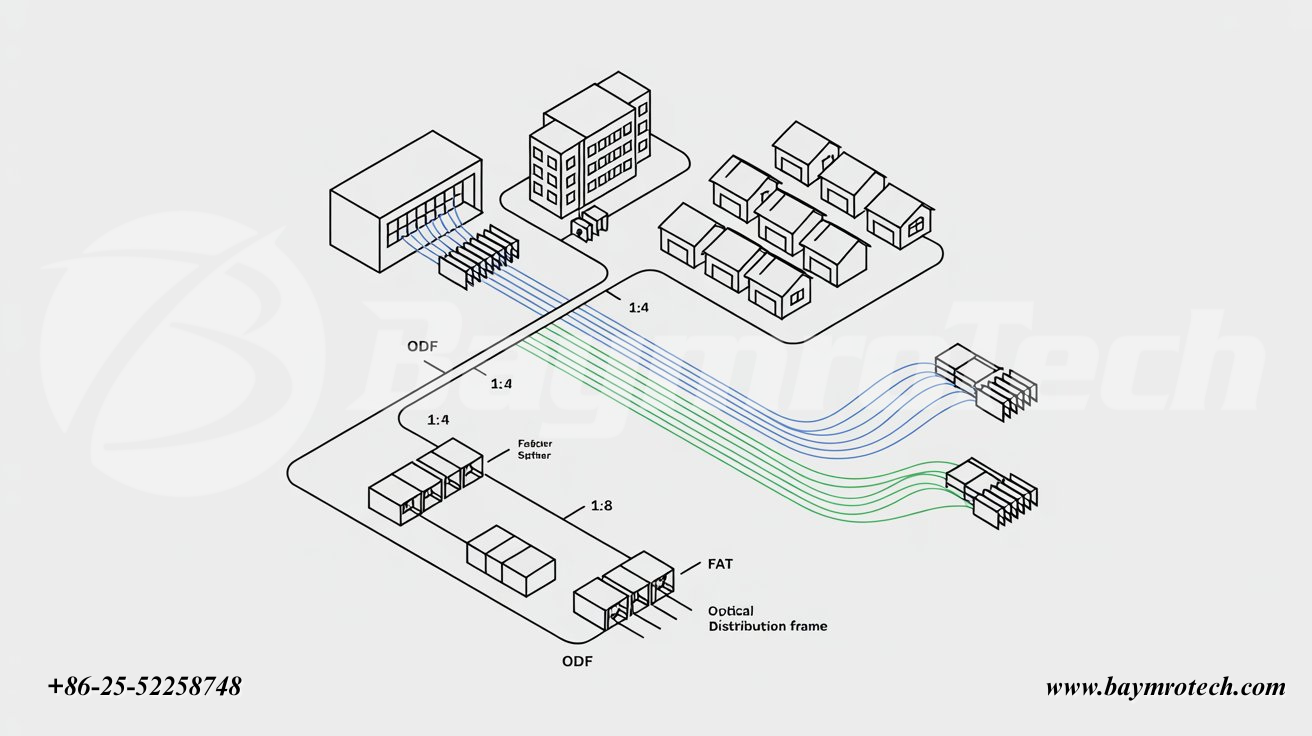
Layered Design Best Fit
Feeder prioritizes capacity (redundant paths), distribution handles scalability, access focuses on quick drops. This separation cuts maintenance chaos.
A leading keystone jack manufacturer like those supplying Baymro notes that modular jacks shine here, snapping into ODFs for easy swaps in mixed-media ODNs.
Best Practices for Bulletproof ODN Deployments
Want networks that hum for years? Follow these field-tested tips—drawn from real deployments where skipping them cost operators big.
- Layer Discipline: Keep feeder for bulk, distribution for splits, access for drops. Blurring lines invites scalability woes.
- Splitter Strategy: Use 1:4/1:8 cascades, not 1×128 singles. Place them accessibly, with spares for upgrades.
- Pre-Terminated Wins: Factory-polished connectors mean predictable loss (IL/RL tested), faster installs, fewer errors.
- Monitoring Magic: Tap 1-5% signals via ports in multiplexers for OTDR/OSAs—spot issues live without downtime.
- Label & Protect: Clear tags, IP68 seals, bend-radius guards. One unlabeled splice? Hours lost troubleshooting.
- Future-Proof: Plan 20-30% excess capacity. AI digital twins predict growth—game-changer for OPEX savings.
Humor break: I once found a splitter in a manhole labeled “Dave’s Fave”—don’t be Dave. Proper labeling saves sanity!
Link up with Baymro’s ODF and splitter solutions for plug-and-play gear that embodies these practices. External cred: Precision OT’s hardening guide nails resilience.
Real-World Wins and Pitfalls
Take a mid-sized city FTTH rollout: Switched to cascaded splitting and pre-conns, OPEX dropped 30% via fewer truck rolls. Pitfall? Ignoring EMI—ground ODFs properly, or noise kills signals.
As a trusted keystone jack manufacturer partner might advise, integrate them in wall plates for hybrid ODN-to-LAN handoffs.
Emerging Trends in ODN Evolution
5G and edge computing demand more: SDN for dynamic routing, green low-loss fibers, IP68 everything for harsh installs. ODN products hit $8.32B in 2025 at 14% CAGR—your upgrade window is now.
Dive into Baymro’s telecom solutions for FTTx-ready cabinets and racks.
Wrapping It Up: Build Smarter Today
Mastering ODN means nailing architecture (centralized or cascaded), components (splitters to drops), and practices (pre-term, monitor, label)—unlocking reliable gigabit networks that scale effortlessly. You’ll dodge 70% of FTTH costs traps and keep users streaming happily.
Ready to supercharge your setup? Explore Baymro’s ODN gear at baymrotech.com/electric, contact our team for a custom audit, or drop your ODN war stories in the comments—we’re all ears!