Ever felt like your business network is stuck in the slow lane, no matter how many upgrades you make? Maybe you’re expanding your office, launching a new branch, or just tired of dropped Zoom calls and sluggish downloads. The cable you choose—copper or fiber optic—can make or break your network’s performance. So, how do you decide which is right for your business? Let’s cut through the confusion and help you make a smart, future-proof choice.
Understanding the Basics: Copper and Fiber Optic Cables
Before you dive into technical specs, let’s break it down:
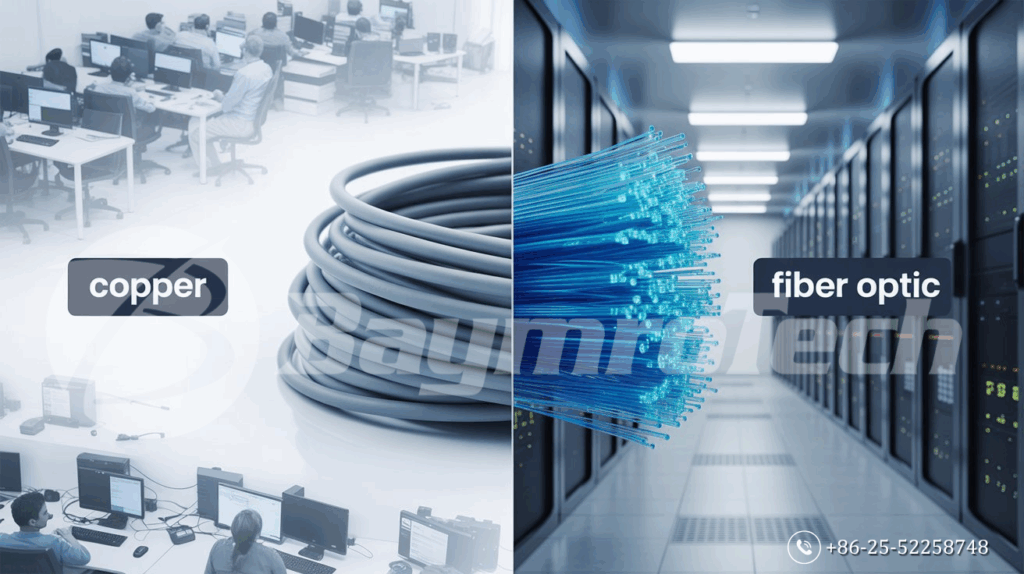
- Copper cables have been the backbone of business networks for decades. They transmit data using electrical signals through twisted pairs of copper wires.
- Fiber optic cables use pulses of light to send data, allowing for much faster speeds and longer distances.
But there’s more to the story than just speed. Let’s look at what really matters for your business.
Copper Cables: The Reliable Workhorse
Copper cables—think Cat5e, Cat6, and coaxial—are everywhere. They’re tried, tested, and easy to install. Here’s why businesses still love them:
- Cost-effective for short distances: If your office is small or you’re just wiring a conference room, copper is budget-friendly.
- Compatible with existing hardware: Most devices already support copper connections, so upgrades are painless.
- Supports Power over Ethernet (PoE): Need to power cameras or wireless access points? Copper does double duty.
But… copper has its limits:
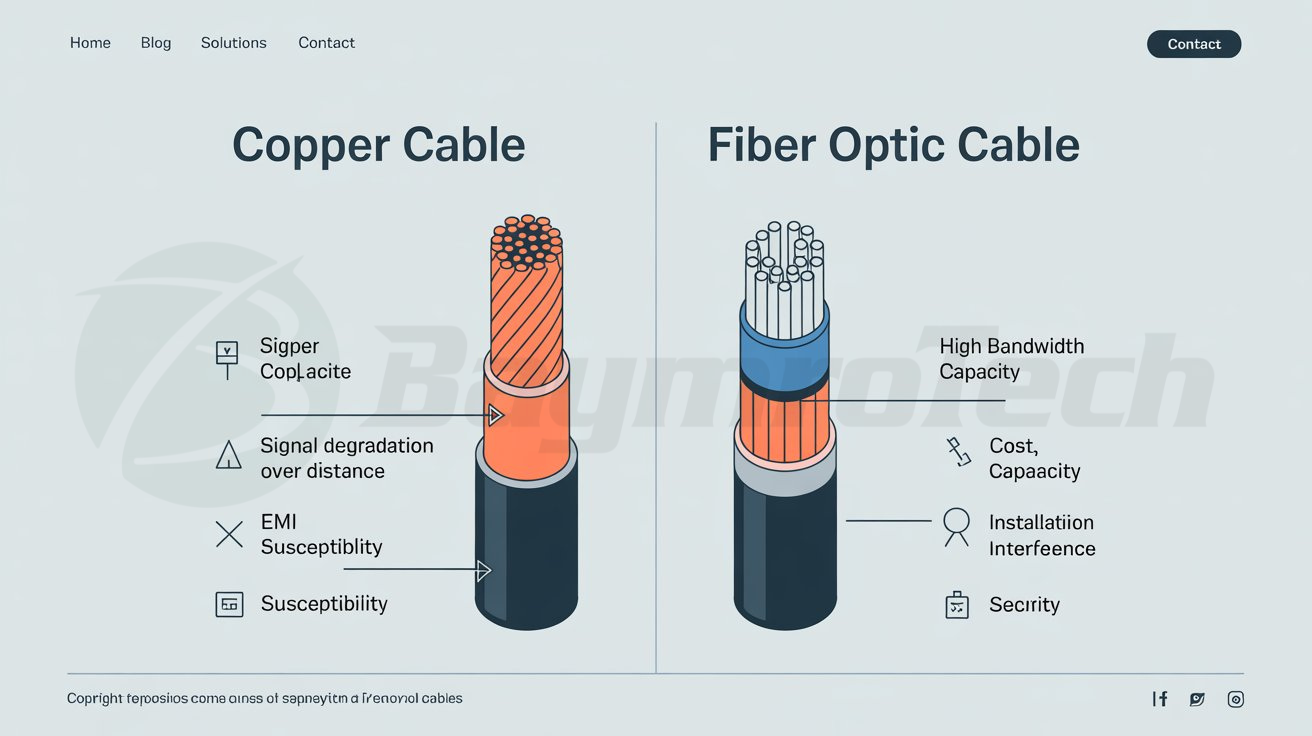
- Speed and bandwidth: Copper tops out around 10 Gbps over short distances, while fiber is already hitting 800 Gbps (and aiming for 1.6 Tbps soon)1.
- Distance: Signals degrade after about 100 meters—fine for a single floor, but not for sprawling campuses1.
- Susceptibility to interference: Copper can pick up electromagnetic interference (EMI) from nearby equipment, causing data loss or slowdowns12.
- Bulk and weight: Copper cables are heavier and bulkier, making them tough to manage in dense installations1.
Fiber Optic Cables: The Speed Demon
Fiber optic cables are the go-to choice for businesses with big data needs, multiple locations, or a focus on future growth. Here’s what sets them apart:
- Blazing speed and bandwidth: Fiber can handle terabits per second, supporting everything from video conferencing to cloud backups without breaking a sweat13.
- Long-distance champion: Fiber maintains signal quality over several kilometers, perfect for connecting buildings or remote offices12.
- Immune to interference: No more worrying about EMI—fiber is rock-solid even in noisy environments12.
- Lightweight and durable: Easier to install (yes, really!) and less prone to damage2.
- Enhanced security: Since fiber doesn’t emit signals, it’s much harder to tap or hack, making it ideal for sensitive data2.
However:
- Higher upfront cost: Fiber installation costs more initially, but the long-term savings in maintenance and upgrades often balance it out1.
- Specialized installation: You’ll need trained technicians for splicing and termination, though this is becoming more common (and affordable) every year.
Copper/Fiber Composite Cable: The Best of Both Worlds?
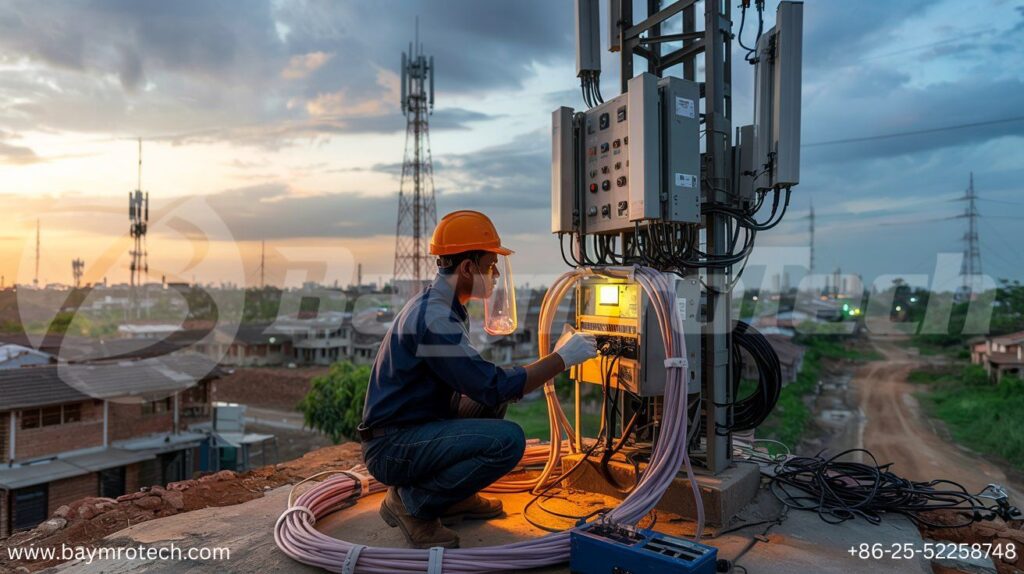
Here’s a twist: you don’t always have to choose one or the other. Copper/Fiber Composite Cable combines both technologies in a single, rugged jacket. This hybrid solution is perfect for applications where you need high-speed data and low-voltage power—think security cameras, wireless access points, or remote devices45.
- One cable, many functions: Reduce labor costs and installation time by pulling a single cable instead of two or three4.
- Customizable: Baymro Technology offers composite cables tailored to your needs, whether it’s indoor, outdoor, single-mode, or multi-mode fiber5.
- Built to last: These cables are designed for harsh environments and demanding applications5.
Curious about how composite cables could streamline your next project? Check out our Copper/Fiber Composite Cable solutions for more details.
Comparing Copper and Fiber: What Really Matters
Let’s stack them up side by side:
| Feature | Fiber Optic Cables | Copper Cables |
|---|---|---|
| Data Transmission Speed | Up to 800 Gbps+ | Up to 10 Gbps (short range) |
| Distance | Several kilometers | Up to 100 meters |
| EMI Susceptibility | Immune | Susceptible |
| Power Consumption | Lower | Higher |
| Initial Cost | Higher | Lower |
| Total Cost of Ownership | Lower (long-term) | Higher (maintenance/upgrade) |
| Installation Complexity | Specialized | Simple |
| Security | High | Moderate |
For a deeper dive into the technical side, visit our Industry Insights page for expert analysis and case studies.
Real-World Example: When Fiber Makes the Difference
A client of ours recently upgraded their network to support a new cloud-based ERP system. They initially considered copper for cost reasons, but after factoring in the need for high-speed connectivity between floors and future expansion, fiber optic won out. The result? Zero downtime, lightning-fast file transfers, and a network that’s ready for whatever comes next.
So, Which Should You Choose?
Ask yourself:
- How big is your space? For small offices, copper might be all you need. For larger buildings or campuses, fiber is a no-brainer.
- What are your speed and bandwidth needs? If you’re streaming video, running cloud apps, or planning for growth, fiber is worth the investment.
- Is security a priority? Fiber’s resistance to tapping and interference makes it the safer bet.
- What’s your budget? Copper wins on upfront cost, but fiber often pays off in the long run.
And don’t forget—you can always mix and match, or use composite cables for the best of both worlds45.
Final Thoughts: Future-Proof Your Business
Choosing between copper and fiber isn’t just about today’s needs—it’s about setting your business up for the future. With data demands only going up, investing in the right infrastructure now can save you headaches (and money) down the road.
Still not sure which path to take? Reach out to our team at Baymro Technology for a free consultation. We’ll help you design a network that’s fast, reliable, and built to grow with you.
Ready to level up your connectivity? Explore our Copper/Fiber Composite Cable solutions or browse more expert advice on our Industry Insights page. Have questions or your own cable story? Drop a comment below—we’d love to hear from you!
External Resources:
- For more on the technical differences, see Hexatronic’s Data Center Cabling Guide.
- Learn about fiber’s security and performance advantages at AFL Global’s Fiber Basics.
- Compare real-world use cases at FiberMall’s Network Cable Comparison.
Let’s build a network that works as hard as you do!