

If your office network feels more like a plate of spaghetti than a sleek, efficient system, you’re not alone. Many businesses struggle with deciding between structured cabling and point-to-point connections. Both have their strengths, but choosing the wrong one can mean frustrating downtime, rising costs, and a whole lot of cable chaos. So, how do you know which setup is right for your business? Let’s untangle the options and figure it out—together.
The Challenge: Keeping Networks Efficient and Scalable
As your business grows, so does your IT infrastructure. What might start as a few devices quickly expands into dozens (or hundreds). More servers, more workstations, more wireless access points… and more cables.
Here’s the pain point:
- A messy, inefficient cabling system can slow down performance.
- Troubleshooting becomes a nightmare when you can’t trace a connection.
- Scaling up often means starting over instead of building on what you already have.
This is where the debate begins: structured cabling vs. point-to-point wiring.
What Is Point-to-Point Cabling?
Point-to-point (P2P) cabling is exactly what it sounds like—a direct connection from one piece of hardware to another. For example, running an Ethernet cable directly from a server to a switch.
Advantages of Point-to-Point
- Simplicity: For very small setups, point-to-point can be quick and easy.
- Lower initial cost: Fewer components mean lower installation costs.
- Good for temporary setups: Ideal for test environments, labs, or small offices.
Disadvantages of Point-to-Point
- Cable clutter: It gets messy fast as equipment increases.
- Hard to scale: Adding devices means more cables running everywhere.
- Troubleshooting nightmare: If something breaks, finding the problem connection can take hours.
Think of point-to-point like adding extension cords around your house. At first, no big deal—but by the time every room has cords snaking under doors, you’ll wish you had a smarter solution.
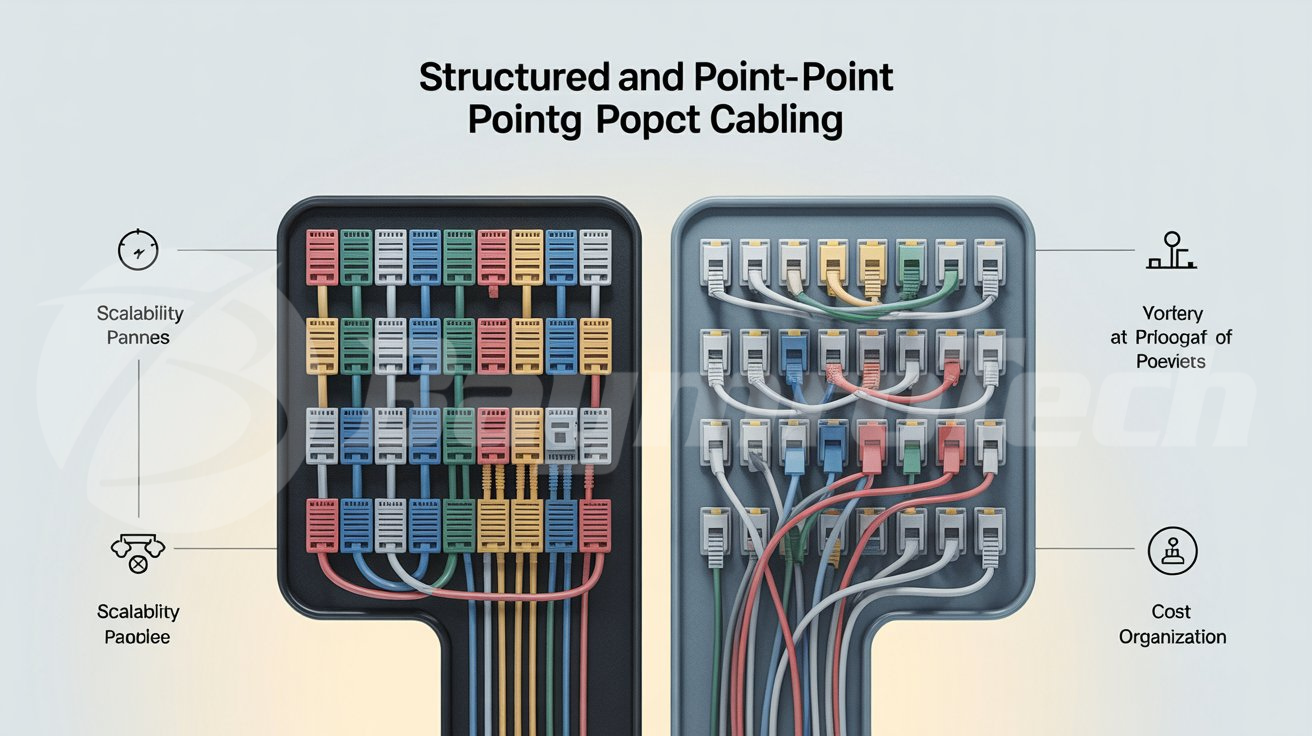
What Is Structured Cabling?
Structured cabling is a standardized approach to building network infrastructure. Instead of running individual cables directly between devices, all cables route through a central patch panel. From there, connections are managed logically and neatly.
Advantages of Structured Cabling
- Scalability: Adding new devices is simple—just plug into the patch panel.
- Better organization: Easy-to-trace cabling reduces downtime.
- Future-proofing: Supports high-speed data and complex networks.
- Longevity: Structured cabling systems often last 10+ years with proper planning.
Disadvantages of Structured Cabling
- Higher upfront cost: Installation requires more planning, components, and skilled labor.
- Setup time: Takes longer to install compared to running direct cables.
It’s like upgrading from loose extension cords to a professionally wired circuit panel. Sure, it costs more upfront, but it’s built to last and ready to handle the load.
Real-world Example: Growth Challenges
A small law firm I once consulted for had five employees when they started. A couple of direct cables here and there worked fine. But within five years, they grew to thirty employees, needing VoIP phones, cloud backup, and stronger Wi-Fi. Their patchwork point-to-point network couldn’t keep up.
Migrating them to structured cabling was a game-changer. The office looked cleaner, internet speed improved, and downtime dropped to almost zero. Yes, the initial bill stung a little—but the ROI quickly became clear.
Copper/Fiber Composite Cable: The Future-Proof Option
When considering structured systems, many businesses now turn to Copper/Fiber Composite Cable. This hybrid solution combines the speed and bandwidth of fiber with the power and simplicity of copper in one cable. It’s excellent for setups requiring both network data transmission and power delivery—like powering Wi-Fi access points while ensuring lightning-fast speeds.
By investing in technologies that support future upgrades, you avoid costly overhauls down the road.
Key Differences at a Glance
| Feature | Point-to-Point Wiring | Structured Cabling |
|---|---|---|
| Scalability | Low | High |
| Installation cost | Low upfront | Moderate to high |
| Organization | Messy as devices increase | Neat and manageable |
| Troubleshooting | Time-consuming | Quick and simple |
| Best for | Small offices, labs | Growing businesses, enterprises |
Expert Insights
According to a report by Cabling Installation & Maintenance, structured cabling systems can reduce network downtime costs by up to 50%. Similarly, Cisco emphasizes the importance of scalable infrastructure for businesses adapting to cloud and hybrid workplace models.
The bottom line? Think long-term. While point-to-point may feel like a shortcut, structured cabling creates stability and efficiency for years to come.
Choosing the Right Setup for You
Here’s how to decide:
- Small businesses/startups with fewer devices: Point-to-point may suffice temporarily. But keep scalability in mind.
- Rapidly growing or mid-to-large businesses: Structured cabling is almost always the better investment.
- Tech-heavy environments (data centers, call centers, hybrid offices): Structured cabling with Copper/Fiber Composite Cable ensures maximum performance.
If you’re unsure which direction to go, start by having a site assessment done. A structured cabling consultant can map out what you have, what you’ll need, and how to future-proof your system.
Internal Resources You’ll Love
If you’re considering structured cabling, check out our network installation services to learn how we can streamline your infrastructure. You might also find our guide on fiber optic upgrades useful if you’re evaluating next-gen connectivity options.
Final Thoughts
At the end of the day, the choice between structured cabling and point-to-point comes down to scale, budget, and long-term vision. If you’re building for the future, structured cabling offers cleaner organization, easier troubleshooting, and the flexibility to grow without chaos. Point-to-point may feel cheaper now, but it’s only a temporary fix.
Ready to untangle your network? Reach out to our team at Baymrotech—we’ll help you design a cabling system that actually makes sense for where your business is headed.