
Have you ever wondered how the world’s data moves at lightning speed—so quickly you can stream movies, make instant video calls, or read this blog post without a hitch? That’s the magic of fiber optic cables. If you’re feeling overwhelmed by the technical jargon surrounding different cable types, you’re not alone. Many newcomers (and quite a few seasoned pros) puzzle over which fiber optic cable to use for a particular application, and sorting through the options can feel like decoding a secret language. Don’t worry—I’m here to help you untangle it all (pun intended!).
Why Fiber Optics? The Game-Changer in Communication
Let’s start with a mind-blowing fact: a single fiber optic cable can carry about 25,000 phone calls simultaneously—that’s a lot of grandma chats! Unlike traditional copper wires, fiber optics use pulses of light to transmit information at blazing speeds, making them the backbone of modern communication, business networks, and even smart homes. Of course, with great power comes… great cable options.
The Big Picture: Core Types of Fiber Optic Cables
Fiber optic cables aren’t all the same. Choosing the right one can mean the difference between seamless performance and endless troubleshooting. Here are the major types you’ll encounter:
1. Single-Mode Fiber (SMF)
- Best for: Long-distance, high-bandwidth applications (think: telcos and massive data centers).
- Core diameter: About 8–10 microns (microscopic!).
- Bonus: Minimal signal loss over many kilometers.
- Real-world story: Remember that time you called someone overseas with zero lag? Thank single-mode fiber for that crystal-clear connection.
- Pro tip: Not great for short distances—overkill for your home setup.
2. Multi-Mode Fiber (MMF)
- Best for: Short-distance runs—inside a building, across a campus, etc.
- Core diameter: 50 or 62.5 microns (fatter than single-mode).
- Quick benefit: Less expensive electronics, simpler installation.
- Use case: Connecting office floors or joining equipment racks in a server room.
- Drawback: Limited range before the signal gets fuzzy.
3. Armored Fiber Optic Cable
- Best for: Harsh environments—underground, outdoor, or industrial sites.
- Superpower: Tough outer jacket resists rodent bites and crushing.
- Example: Think about those cables running under your city streets—they need serious protection.
4. A Modern Twist: Copper Fiber Composite Cable
- What’s this? Sometimes, you need power and data together—say, to provide electricity alongside information to a remote camera or Wi-Fi access point.
- Combines: Fiber optics for data + copper for power.
- Ideal for: Security systems, industrial sensors, and smart infrastructure.
- Why choose it? Cuts installation costs and simplifies projects by running both power and data through a single cable.
(Interested in the nitty-gritty? Check out Baymrotech’s overview of copper fiber composite cable applications for specific use cases and technical specs.)
Inside the Cable: Construction Basics
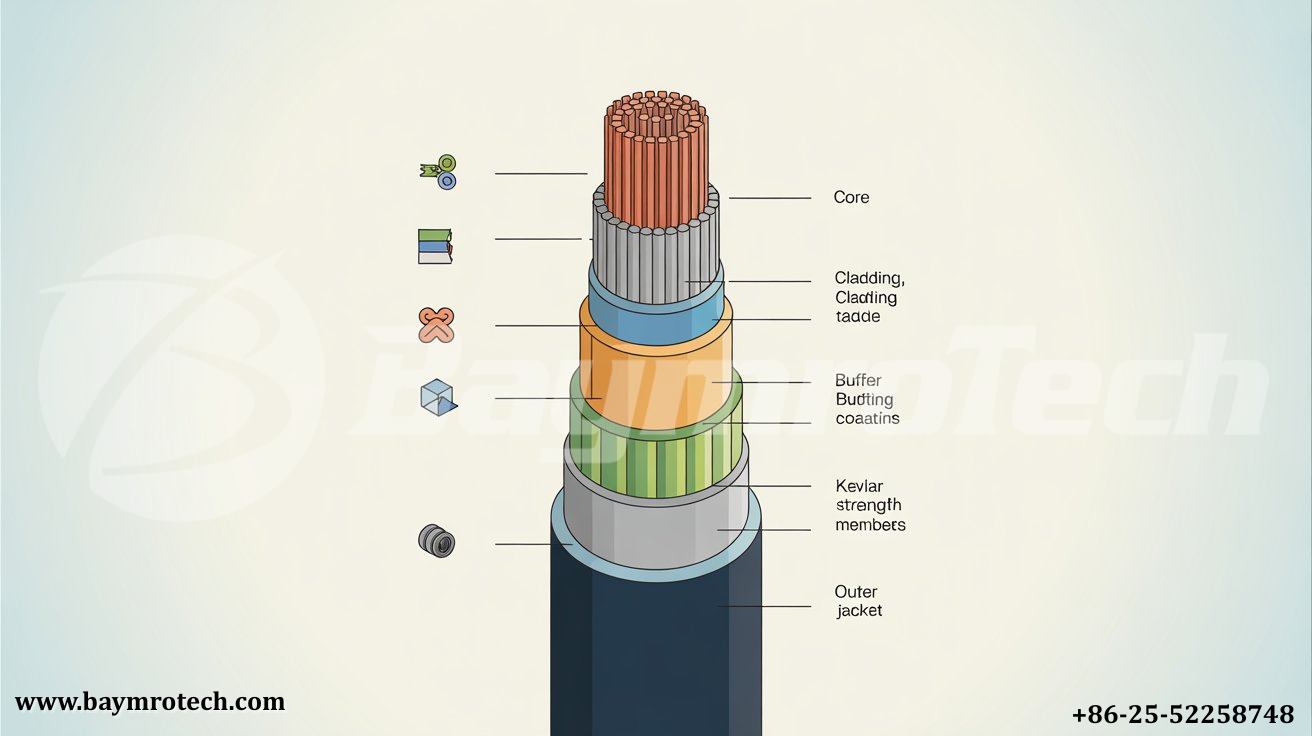
Curious what makes up a fiber optic cable? Let’s take a peek inside:
- Core: The glass (or plastic) strand where the magic happens—light travels here!
- Cladding: Surrounds the core, reflecting light and keeping it on track.
- Buffer coating: Adds protection from scratches or moisture.
- Strength members: Materials like Kevlar (yep, the bulletproof stuff) reinforce the cable.
- Outer jacket: Shields the cable from the environment, UV rays, and enthusiastic squirrels.
For more details on cable construction and the right build for your environment, visit Baymrotech’s cable structure guide.
Application Scenarios: What to Choose and When
Ever found yourself at a crossroads—standing in the cable aisle, facing a wall of technical terms? Here’s a quick cheat sheet to save your sanity:
- Home internet/FTTH (Fiber to the Home): Single-mode fiber for long reach, or multi-mode for short distances.
- Data centers: Multi-mode for connecting equipment racks; single-mode for connections between buildings.
- Industrial automation: Armored or copper fiber composite cable to transmit both data and power in challenging environments.
- Security systems: Copper fiber composite cable for cameras and access points far from power outlets.
Why Not Just Stick With Copper?
A fair question! Traditional copper cables (think Cat5 or Cat6) have their place, but they:
- Suffer significant signal loss over long distances.
- Are vulnerable to electromagnetic interference (EMI).
- Can’t match the ultra-high speeds and bandwidth of fiber optics.
Fiber, on the other hand, is immune to EMI and future-proofs your setup for tomorrow’s applications (hello, 8K streaming and ultra-low-latency gaming).
FAQs and Fun Facts
- Q: Can I bend fiber optic cables?
- A little—but not too much. Excessive bends can damage the core and block the signal. Most cables have a “minimum bend radius” listed on the spool.
- Q: How durable are they?
- Today’s cables (especially armored ones) stand up to plenty of abuse, but stepping on a bare fiber strand is still a “bad hair day” for your network.
- Q: Are fiber optics safe?
- Yes! The light isn’t powerful enough to harm you. But always follow proper handling and installation guidelines.
Real-World Quotes
“Fiber optics are the nervous system of the modern digital world.” — PCMag Network Editor
“Demand for high-speed data keeps growing exponentially…and only fiber can meet that need.” — Fiber Broadband Association
Where to Learn More
Want to dive deeper? Here are a couple of reputable resources:
- The Fiber Optic Association offers training, certifications, and lots of practical guides.
- Check out this in-depth guide from Corning for an insider’s look at fiber technology.
Bringing It All Together
You don’t have to be a tech wizard to make smart decisions about fiber optic cables—but having a clear sense of the basics (and knowing where to get help!) makes all the difference. Whether you’re upgrading your home internet, planning a company network, or installing critical infrastructure, the right cable keeps your world connected and future-ready.
Still confused about which cable fits your needs—or want expert advice on installation? Take a look at more helpful insights on Baymrotech’s blog or reach out to our friendly team. Your connection (and your peace of mind) is just a click away.