

Ever found yourself staring at a pile of cables, adapters, and technical docs, only to realize one crucial detail—your fiber optic solution is perfectly designed… for the wrong country? Welcome to the club! If you’ve ever tried to roll out seamless fiber optic networks across borders, you probably know the stress of juggling different standards, certifications, and terminology. But don’t worry—you’re about to learn how to navigate this international maze, make your deployments frustration-free, and maybe even become your team’s fiber optic hero.
Why Regional Standards Matter in Fiber Optics
So, why can’t we just ship the same kit everywhere? Here’s the deal: every region enforces its own blend of technical, safety, and environmental rules. From the US National Electrical Code (NEC) to Europe’s CE marking, and a tangle of certifications in Asia, each standard is designed with local priorities like safety, compatibility, and durability in mind. If your solution doesn’t tick the right boxes, you could face delays, fines, or unhappy customers—not exactly the kind of feedback you want!
The Core of Customization: Understanding Regional Fiber Optic Standards
To customize fiber optic solutions effectively, you first need to know what makes each region tick. Here are some major players:
- IEC (International Electrotechnical Commission): Sets universal standards for optical fibers and cables (IEC 60793, IEC 60794).
- ISO/IEC 11801: Global guidelines for cabling customer premises, with sub-sections for offices, industrial, and data center environments.
- TIA/EIA (North America): Governs cable specs, connectors, and transmission requirements (such as TIA-568.3-D).
- CE Marking (Europe): Ensures products meet safety, health, and environmental criteria.
- FCC (USA): Sets essential electromagnetic compatibility rules.
- RoHS and WEEE: Restrict hazardous substances and dictate environmental safety (mandatory in the EU).
Every one of these standards affects how you design, test, and certify your fiber optic solution.
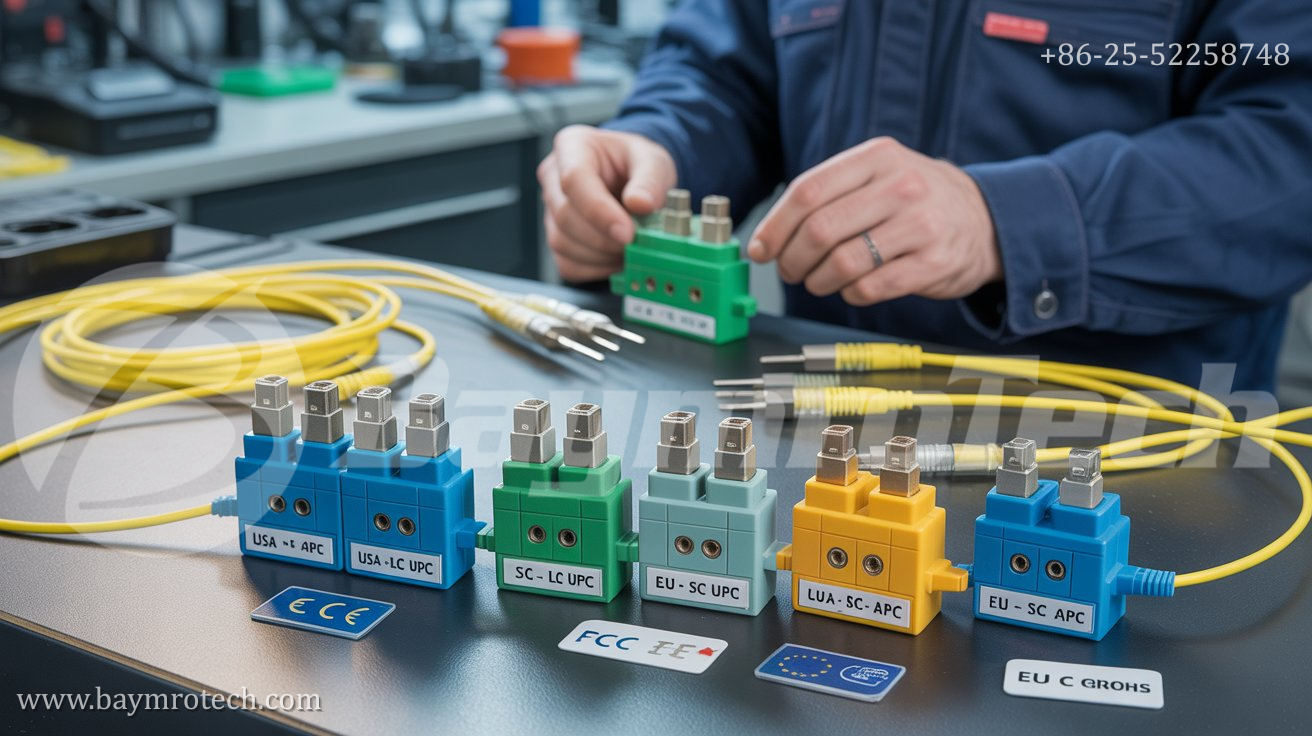
Customization in Action: Step-by-Step
Let’s walk through what it actually takes to get compliant, custom fiber optic solutions for different regions.
1. Pin Down Technical and Regulatory Requirements
- Check local codes early—this saves you from costly redesigns.
- Example: Europe’s CE marking may require fire-resistant cables and proof that your adapters won’t give off toxic smoke in a fire.
2. Choose the Right Fiber Optic Adapter (And Customize It!)
Your choice of fiber optic adapter can make or break your solution. Do you need a hybrid singlemode/multimode version, a specific connector (like SC, LC, or ST), or color-coding for easy identification? Different countries often specify connector types, ferrule materials, or even polishing styles (UPC vs APC)—and getting it wrong means a failed inspection.
- Many reputable manufacturers (like BAYMRO Fiber Optic Solutions) offer customization services for adapters, from unique labeling to tailored loss specifications—so always ask!
3. Testing and Quality Certification
No shortcuts here:
- Run loss measurements, mechanical stress tests, and environmental trials to replicate real conditions.
- Get certified! Industry-recognized documentation (like ISO 9001) boosts your credibility and speeds up customs clearance.
4. Train Your Team
Imagine landing the perfect hardware, only to have it fumbled by untrained hands. Regular training ensures every installer is up to speed on local best practices and can spot potential compliance issues before they turn into headaches.
Real Talk: Common Regional Challenges and Solutions
Challenge: Bouncing between SC and LC connectors in the EU and US, each with their own performance metrics.
Solution: Consider hybrid adapters and modular components. For example, you can deploy custom-bundled fiber solutions from Baymrotech that feature both connector types in one ready-to-go assembly. Check out our custom cable assembly page for options tailored to every region—no matter how unique the requirements.
Challenge: Navigating overlapping environmental and safety standards (e.g., RoHS in Europe, FCC in the US).
Solution: Work with suppliers who have a track record in multi-region compliance. At Baymrotech, for example, our regulatory compliance guide can help you decode these requirements, and our team is always a message away for support.
Practical Tips for Smoother Regional Customization
- Make friends with your compliance officer—seriously, their advice is gold!
- Maintain crystal-clear documentation for every product version (technical sheets, certifications, links to standards).
- Partner with global certification bodies—having that third-party gold stamp can save weeks (or months) of delays.
- Lean on modular, scalable solutions where possible. You’ll cut costs and simplify inventory—another win!
Expert Advice & Outside Perspective
Industry associations like Fiber Optic Association (FOA) and standards bodies like ISO regularly update best practices. Stay plugged in—these updates can be the difference between a smooth rollout and a regulatory headache.
As Commscope points out, keeping tabs on updates to North American TIA and international ISO/IEC standards isn’t just smart—it’s essential for future-proofing your network. Meanwhile, a report by FS.com recommends double-checking that hybrid adapters and couplers are compliant across all regions you serve.
Wrapping Up: Embrace the Challenge
Customizing fiber optic solutions to regional standards isn’t just a “nice to have”—it’s the difference between global growth and shipping delays, headaches, or worse. It’s part technical know-how, part relationship building, and part international savvy. Whether it’s ensuring your Fiber Optic Adapter meets both FCC and CE requirements, or deploying custom-labeled assemblies across continents, tackling standards with confidence makes you a true network champion.
Have a deployment coming up? Curious if your fiber solution is up to code for your next market? Don’t leave it to chance—explore our custom fiber optic solutions at BAYMRO Tech, or reach out to our experts for personalized advice. We’re here to help you build brighter, faster, and compliant connections worldwide.