Introduction
Choosing between wall-mounted and pole-mounted fiber distribution boxes is an important decision when planning fiber-to-the-home (FTTH) networks, telecom access infrastructure and outdoor fiber distribution systems. Although both mounting designs can support fiber organization and distribution, they are intended for different installation conditions and access requirements.
Selecting an unsuitable design can complicate cable routing, increase installation effort, restrict technician access and create maintenance challenges. An enclosure intended for a protected indoor location may not be suitable for an exposed outdoor installation. Similarly, a box selected without considering pole attachment requirements or available working space can make installation and servicing more difficult.
For telecom operators, contractors and procurement teams, the right choice depends on the deployment environment, required fiber capacity, cable entry arrangement, environmental exposure, mounting surface and future network expansion plans.
Wall-mounted fiber distribution boxes are generally suitable for accessible building surfaces and designated indoor or protected locations, while pole-mounted designs are intended for compatible pole-based installations. However, the actual suitability of either design must be confirmed against the product specifications and site conditions.
This guide compares both mounting options, explains the technical details buyers should verify and outlines the information needed to request a suitable fiber distribution box quotation from BaymroTech.
2. What Is a Fiber Distribution Box?
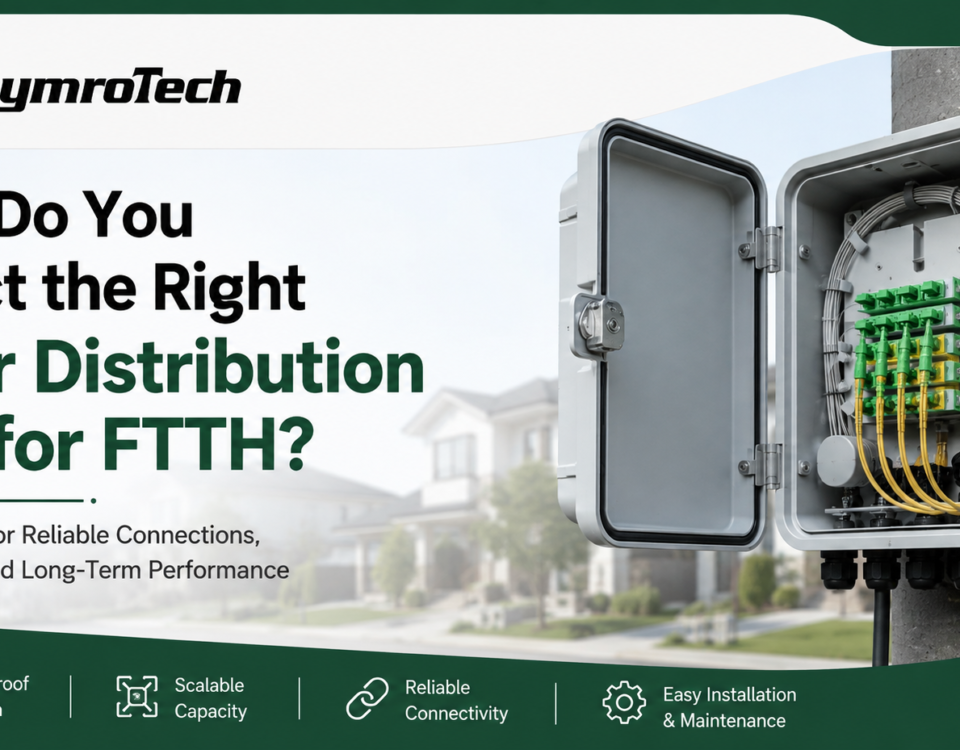
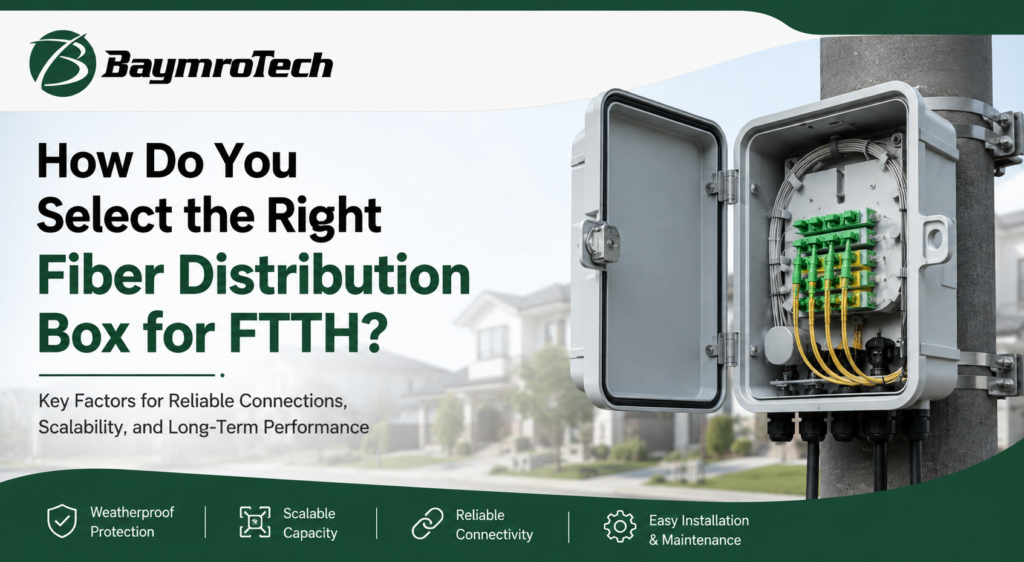
A fiber distribution box is an enclosure used to organize, protect and distribute fiber-optic connections within an access network. Depending on its design, it can accommodate fiber adapters, incoming and outgoing cables, connectorized connections, splice trays and other fiber management components.
These enclosures are commonly used in FTTH deployments, telecommunications infrastructure, building distribution networks and other fiber access applications.
Their primary functions include:
- Organizing incoming and outgoing fiber connections.
- Providing a structured point for fiber distribution.
- Supporting connector or splice management where the design permits.
- Helping protect fiber connections from physical disturbance and relevant environmental exposure.
- Making network connections easier to identify, inspect and maintain.
The exact functions depend on the enclosure’s internal configuration. A connector-based distribution box may use adapter panels and patch cords, while a design intended for splicing may include splice trays and appropriate fiber storage arrangements. Some configurations support both functions.
Capacity, cable entry options, mounting hardware and environmental protection also vary between products. Buyers should therefore evaluate the complete configuration rather than assuming every fiber distribution box supports the same number of ports, cable sizes or installation methods.
A useful starting point is the BaymroTech Fiber Distribution Box product page, which can be used to review the relevant product range and identify the specifications that need confirmation for a particular deployment.
3. Wall-Mounted Fiber Distribution Boxes
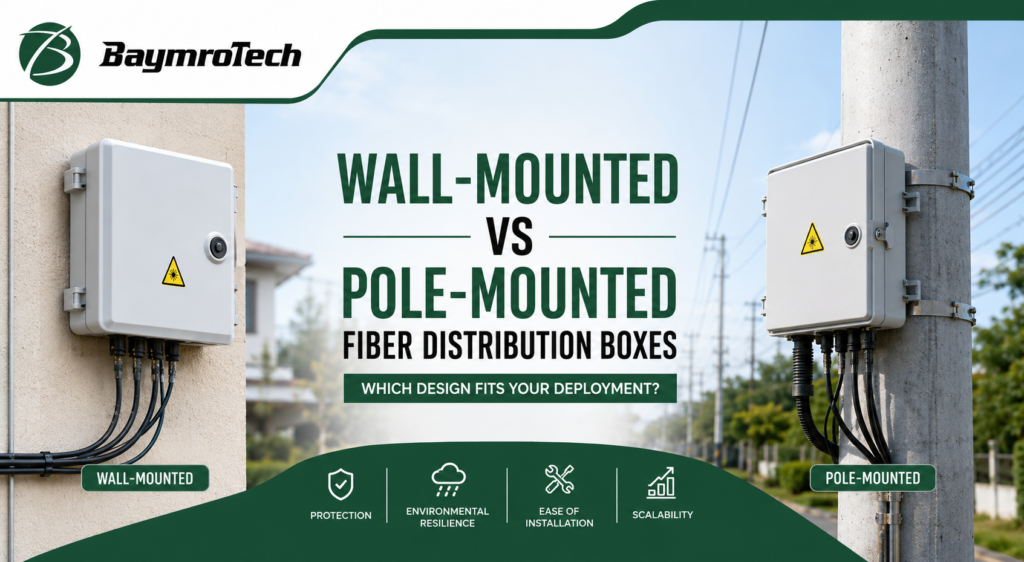
Wall-mounted fiber distribution boxes are installed on suitable vertical surfaces, such as building walls, designated telecom room surfaces and appropriate exterior walls. They are particularly useful when the network distribution point needs to remain accessible without requiring a separate pole installation.
Where are wall-mounted boxes suitable?
Common applications include:
- Indoor telecom rooms and building distribution areas.
- Residential and commercial building FTTH installations.
- Building exteriors where the selected enclosure is suitable for outdoor exposure.
- Designated fiber distribution points with an appropriate mounting surface.
- Network locations where technicians need convenient access for inspection and servicing.
The suitability of a location depends on the enclosure’s design, environmental protection and installation requirements. An indoor-rated box should not be installed outdoors simply because a wall is available.
Mounting and cable entry
Before installation, contractors should verify that the wall can support the enclosure and associated cables. The installation plan should account for the mounting surface, available working space, cable bend requirements and the route between the incoming feeder cable and outgoing distribution cables.
Cable entry positions must also match the planned routing. Poor alignment between cable conduits, entry openings and the enclosure can complicate installation or require additional accessories.
Accessibility and maintenance
Wall mounting can provide convenient working access when the box is positioned at an appropriate height in a safe, accessible location. Technicians can inspect connections, manage fibers and perform routine servicing without necessarily requiring pole-access equipment.
However, accessibility depends on the actual installation. A wall-mounted enclosure placed behind fixed equipment, in a restricted service area or at an unsuitable height can still create maintenance difficulties.
A wall-mounted design is generally the stronger option when a suitable wall already exists, cable routes are straightforward and technicians need practical access to the distribution point.
4. Pole-Mounted Fiber Distribution Boxes
Pole-mounted fiber distribution boxes are intended for distribution points installed on compatible poles rather than directly on building walls. They can be useful in aerial fiber networks, roadside telecommunications infrastructure and access networks where poles provide practical locations for fiber distribution.
Where are pole-mounted boxes suitable?
Typical deployment scenarios include:
- Aerial FTTH distribution networks.
- Residential areas served by overhead fiber routes.
- Outdoor access points where no suitable building wall is available.
- Telecom infrastructure using designated utility or communications poles.
- Distributed networks where the cable route follows an existing pole-based infrastructure.
A pole-mounted design can help place the distribution point close to the relevant cable route. However, pole availability alone does not establish suitability. The mounting arrangement, structural conditions, access requirements and environmental exposure must all be considered.
Mounting hardware and structural compatibility
The mounting arrangement must be compatible with the enclosure and the specific pole. Depending on the product and installation, suitable brackets, clamps, straps or other approved mounting components may be required.
Buyers should verify:
- Pole material, dimensions and structural condition.
- Enclosure attachment method and hardware compatibility.
- Space available for mounting and cable routing.
- Mechanical stability under expected site conditions.
- Clearance from other equipment and cables.
- Any applicable utility-owner or site-owner requirements.
Do not assume that a wall-mounting bracket can also secure an enclosure to a pole. The manufacturer should confirm the intended mounting method and required accessories for the selected model.
Outdoor exposure and maintenance planning
Pole-mounted boxes can be exposed to sunlight, rain, dust, temperature changes, wind and other site-specific conditions. The enclosure’s environmental suitability must be established from the exact product specifications rather than from its appearance alone.
Maintenance access is equally important. The box should be positioned so authorized technicians can inspect and service it using the appropriate access equipment and safety procedures. Locations that require specialized access can increase maintenance time and operating costs.
A pole-mounted design is generally preferable when the distribution point must follow an aerial cable route and the enclosure, mounting hardware and site conditions have been confirmed as compatible.
5. Wall-Mounted vs Pole-Mounted: Detailed Comparison
The two mounting options can serve similar fiber distribution functions, but they differ in installation requirements, accessibility and project planning.
| Selection factor | Wall-mounted box | Pole-mounted box |
| Installation location | Building walls, telecom rooms and suitable exterior surfaces | Compatible utility or telecom poles |
| Mounting requirements | Secure, suitable wall surface and compatible fixings | Compatible pole, attachment hardware and structural assessment |
| Cable entry and routing | Often routed through building conduits, ducts or wall entries | Usually planned around aerial or pole-based cable routes |
| Environmental exposure | Depends on indoor or outdoor location and enclosure rating | Commonly exposed to outdoor conditions; exact protection must be verified |
| Capacity and port configuration | Selected according to fiber demand and available enclosure options | Selected according to fiber demand, physical space and compatible enclosure options |
| Maintenance access | Can be convenient where the box is safely accessible | May require ladders, elevated work platforms or other approved access arrangements |
| Protection and locking | Confirm enclosure security and access-control requirements | Confirm enclosure security, locking and site-specific protection requirements |
| Installation labour and accessories | Wall preparation, fixings and cable-entry accessories may be needed | Pole attachment hardware, access equipment and cable-routing accessories may be needed |
| Expansion and servicing | Depends on spare capacity, internal layout and wall space | Depends on spare capacity, internal layout, pole space and cable-route flexibility |
| Project cost considerations | Consider enclosure, wall preparation, cable routing and service access | Consider enclosure, mounting hardware, installation labour, access equipment and ongoing servicing |
Which design should buyers choose?
Choose a wall-mounted box when the distribution point is located inside a building or on a suitable exterior wall, and the cable route allows convenient entry and maintenance.
Choose a pole-mounted box when the network architecture requires an aerial distribution point and the selected enclosure supports the intended pole attachment and outdoor operating conditions.
For projects that combine building connections and aerial distribution, both mounting types may be appropriate at different points in the same network.
The cost comparison should cover the complete installed solution rather than just the enclosure’s purchase price. Installation labour, accessories, cable preparation, technician access and future maintenance can materially affect the total cost of ownership.
6. Technical Specifications to Verify Before Ordering
Mounting type is only one part of the selection process. The enclosure must also meet the network’s optical, mechanical and environmental requirements.
Fiber capacity and port configuration
Confirm the required number of fibers, adapter ports, connector types and any splitter configuration. Allow for planned expansion without selecting a box that is unnecessarily large for the application.
Splice capacity and bend management
Verify whether the application requires splicing, connectorized distribution or both. Check splice tray availability, fiber storage space, routing paths and the manufacturer’s minimum bend-radius requirements.
Enclosure material and environmental protection
Confirm material, dimensions, sealing arrangements, UV resistance and the declared ingress protection rating where applicable. Match the specification to the real installation environment.
Mounting compatibility and accessories
Verify bracket design, fixing points, pole compatibility, cable-entry accessories, locks and installation clearances. Confirm which components are included and which must be ordered separately.
Additional checks should cover cable diameter compatibility, incoming and outgoing cable quantities, adapter alignment, internal access, labeling and the documentation required for project approval.
If an outdoor deployment has a defined temperature range, water exposure or other environmental demands, request the exact model’s supporting technical documentation. Avoid substituting a general product-family statement for evidence relating to the model being purchased.
7. Site Planning and Deployment Examples
Different installation environments create different priorities. The following are illustrative scenarios, not actual BaymroTech customer projects.
Scenario A: Fiber distribution inside a commercial building
A contractor needs to distribute incoming fiber to several floors or designated building areas. A suitable wall-mounted enclosure in a telecom room may provide convenient access, a controlled installation environment and straightforward cable routing.
The buyer should verify the required connection count, available wall space, cable entry arrangement and whether splicing or connector-based distribution is required.
Scenario B: FTTH connections in a residential area
A network planner is extending fiber service through a residential area with existing overhead cable routes. A compatible pole-mounted distribution box may be appropriate where the network design requires distribution along those routes.
The selection should account for pole compatibility, environmental exposure, mounting hardware, subscriber connection capacity and safe maintenance access.
Scenario C: Fiber distribution on a building exterior
A deployment requires a distribution point on an exterior wall near the incoming fiber route. Wall mounting may reduce the need for a separate pole installation, provided the enclosure is suitable for the exposure and the wall offers adequate support.
The project team should confirm weather protection, cable entry sealing, physical security and technician access before approving the installation.
Scenario D: Network expansion at an existing distribution point
An operator expects additional subscribers or fiber routes to be connected later. Rather than selecting a box solely on today’s port count, the procurement team should consider spare capacity, internal cable management, available installation space and the feasibility of future servicing.
The right decision may involve a higher-capacity enclosure, a second distribution point or a revised network layout. It should be based on engineering requirements rather than port count alone.
8. Procurement and RFQ Requirements
A well-prepared request for quotation (RFQ) helps suppliers evaluate the application and quote a suitable configuration. For B2B projects, the goal is to define the required product and installation conditions clearly enough to avoid mismatched specifications.
Include the following information in your RFQ:
| RFQ requirement | Information to provide |
| Installation location | Indoor, building exterior, roadside or aerial network |
| Mounting type | Wall-mounted, pole-mounted or both |
| Fiber capacity | Required number of fibers and connection ports |
| Connector configuration | Required adapter and connector types |
| Splicing requirements | Splice capacity and tray requirements, if applicable |
| Cable routing | Cable types, entry positions, quantities and relevant dimensions |
| Environmental conditions | Rain, UV exposure, dust, temperature and other site demands |
| Mounting accessories | Required brackets, clamps, fixings and cable-entry components |
| Enclosure requirements | Dimensions, material, sealing, locking and applicable protection rating |
| Order quantity | Initial quantity and expected repeat-order requirements |
| Customization | Port layout, labeling, branding or other project-specific changes |
| Documentation | Drawings, specifications, test reports and applicable compliance documents |
| Delivery expectations | Destination, required delivery schedule and packaging requirements |
Buyers should also clarify whether they need a standard configuration or a customized solution. If the project includes several installation environments, specify the quantity and requirements for each configuration separately.
Request confirmation of the final product specification, included accessories, manufacturing lead time and delivery arrangements before placing a purchase order.
9. BaymroTech Fiber Distribution Box Product Relevance
BaymroTech’s published Fiber Distribution Box (FDB) product range describes enclosures for fiber distribution and termination in FTTH applications. The product page lists 2-, 4-, 6-, 8-, 12-, 24-, 48- and 96-port configurations, PC/ABS alloy construction, selected SC and LC connector options, and wall- and pole-mounting applications. It also describes locking and outdoor-resistance features.
These published options provide a starting point for evaluating the range, but buyers should confirm the precise configuration and specifications of the model intended for their project.
In particular, ask BaymroTech to clarify:
- Whether the required mounting method is supported by the selected model.
- Which brackets and mounting accessories are supplied.
- Whether the required port count and connector arrangement are available.
- Whether the enclosure supports the intended splice or splitter configuration.
- What environmental protection documentation is available for the selected model.
- Whether the required cable diameters and entry arrangements are compatible.
- Which customization options, quantities and delivery schedules can be quoted.
For projects involving subscriber-side termination rather than a larger distribution point, it may also be useful to review the BaymroTech Fiber Termination Box range. The two product categories can serve related but distinct roles, so selection should follow the network architecture and termination requirements rather than the product name alone.
For broader network planning, BaymroTech’s fiber management and telecom product range provides additional context on its fiber-optic infrastructure offerings.
10. Buyer Checklist and Frequently Asked Questions
Use this checklist before approving a fiber distribution box for procurement.
Pre-procurement checklist
The installation location and mounting surface have been identified.
Wall or pole mounting compatibility has been confirmed for the exact model.
Required fiber capacity and port configuration are defined.
Splicing, splitter and connector requirements are documented.
Cable entry, routing and bend management have been checked.
Environmental protection requirements match the site.
Mounting hardware and other accessories are identified.
Technician access and future servicing have been considered.
Required technical documentation has been requested.
Order quantity, customization and delivery expectations are agreed.
Copy checklist
Frequently Asked Questions
1. Is a wall-mounted fiber distribution box better than a pole-mounted box?
Neither is universally better. Wall-mounted boxes are generally suitable for accessible building surfaces, while pole-mounted boxes suit compatible aerial distribution points. The preferred design depends on the network layout, environmental conditions, mounting compatibility and maintenance requirements.
2. Can a wall-mounted fiber distribution box be installed outdoors?
Yes, if the specific enclosure is designed and documented as suitable for the intended outdoor conditions. Verify its environmental protection, sealing, UV resistance and installation requirements before use.
3. Can any fiber distribution box be attached to a telecom pole?
No. The enclosure must support the intended mounting arrangement, and compatible hardware must be available. Buyers should confirm pole dimensions, attachment requirements and structural suitability before ordering.
4. How do I determine the required fiber distribution box capacity?
Calculate the incoming fibers, required outgoing connections, adapter ports, splice requirements and splitter configuration. Consider reasonable future expansion, but do not assume that port count and splice capacity are interchangeable.
5. What environmental protection should I specify for an outdoor box?
Specify the actual site conditions, including rain, dust, UV exposure and expected temperature range. Ask the supplier to confirm the exact model’s protection rating and supporting documentation against those requirements.
6. Can mounting type, port configuration or other product features be customized?
Customization depends on the product design and manufacturer’s available options. BaymroTech invites inquiries about customization for its fiber distribution box range. Buyers should submit their mounting, capacity, connector and cable-entry requirements for confirmation.
7. What information is needed for a bulk fiber distribution box quotation?
Provide the mounting type, installation environment, required port count, connector configuration, cable-entry requirements, accessories, total quantity, customization details, documentation requirements and delivery destination. Include drawings or site specifications where available.
8. Should I select the box based on price or mounting type first?
Start with deployment suitability and technical compatibility. Once the product meets the installation and network requirements, compare the total installed cost, including accessories, labour, servicing and future expansion.
11. Conclusion: Select the Right Fiber Distribution Box for Your Deployment
Wall-mounted and pole-mounted fiber distribution boxes both play important roles in FTTH and telecom infrastructure. The difference is not simply how the enclosure is attached. It is how well the design fits the installation location, cable routing, environmental exposure, fiber capacity and long-term maintenance plan.
Wall mounting is often the practical choice for suitable building surfaces and accessible distribution points. Pole mounting is appropriate when the network requires aerial distribution and the enclosure’s mounting arrangement is compatible with the pole and site conditions.
Before procurement, verify the complete product specification, including port configuration, splice capacity, cable entry, internal fiber management, environmental protection and mounting accessories. These checks help reduce installation problems and make the purchasing decision more reliable.
Discuss Your Fiber Distribution Box Requirements with BaymroTech
BaymroTech’s fiber distribution box range provides a starting point for buyers evaluating FTTH distribution and termination requirements. Share your site conditions, preferred mounting method, required fiber capacity, connector and cable configuration, project quantity and customization needs to discuss a suitable product and quotation.
Contact BaymroTech through its Fiber Distribution Box product page to discuss your project requirements and request an RFQ.