Introduction
Selecting a fiber optic adapter is often treated as a simple matter of matching connector types. In real network projects, however, the decision involves much more than choosing between SC, LC, FC, or ST.
The adapter affects connector alignment, optical loss, connection repeatability, installation density, and long-term connection stability. A mismatch between the adapter, connector polish, fiber type, or installation environment can create unnecessary optical loss and maintenance problems.
This becomes more important in FTTH networks, telecom cabinets, data centers, fiber distribution systems, and enterprise infrastructure where hundreds or thousands of optical connections may be installed. A small difference in component performance can become significant across a large deployment.
For procurement teams, the objective should therefore be to select an adapter that matches the optical and mechanical requirements of the network first, and then confirm that the manufacturer can consistently supply that specification.
What Is a Fiber Optic Adapter?
A fiber optic adapter, also called a fiber optic coupler in some applications, is a passive component used to align and connect two compatible fiber optic connectors.
Its main function is precise mechanical alignment. Inside the adapter, an alignment sleeve positions the connector ferrules so that the fiber cores remain properly aligned when the connectors are mated. This helps maintain a stable optical connection while allowing connectors to be connected and disconnected when required.
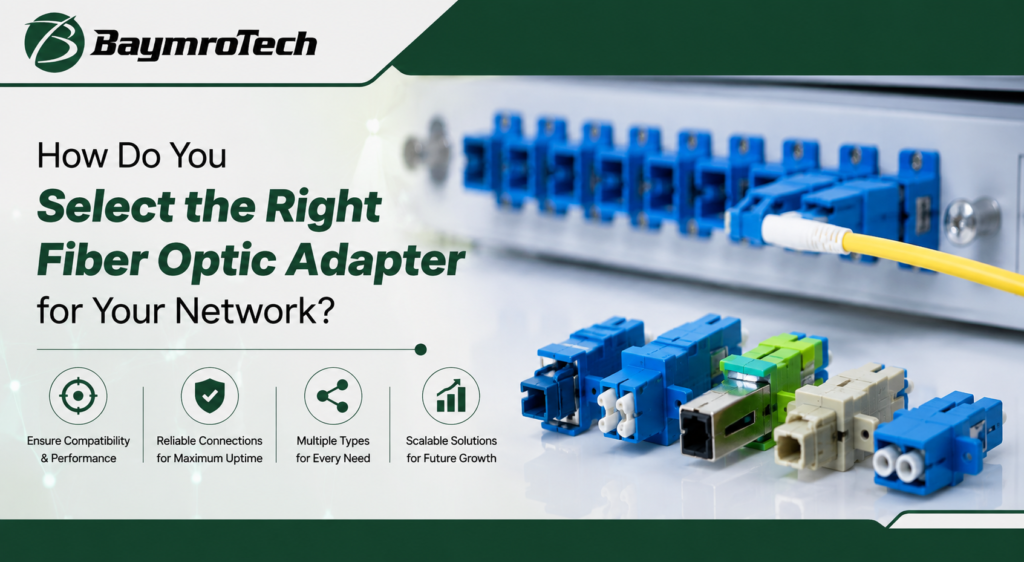
Common adapter configurations include:
- SC fiber optic adapters
- LC fiber optic adapters
- FC fiber optic adapters
- ST fiber optic adapters
- Simplex adapters
- Duplex adapters
- Single-mode adapters
- Multimode adapters
- UPC-compatible adapters
- APC-compatible adapters
The housing may also be designed for panel mounting, rack-mounted fiber panels, fiber distribution boxes, optical distribution frames, or other passive fiber management equipment.
For buyers, the important question is not simply “Which adapter fits?” It is “Which adapter provides the correct optical alignment, connector compatibility, density, and mechanical performance for this network?”
How Do You Choose Between SC, LC, FC, and ST Adapters?
Connector type is one of the first technical decisions because the adapter must match the connectors being used in the optical link.
SC Fiber Optic Adapter
SC adapters use a push-pull coupling mechanism and are widely used in telecom, FTTH, fiber distribution, and passive optical network equipment.
Their relatively large housing makes them easy to handle during installation and maintenance. They are particularly practical where space is less restrictive and straightforward connector handling is preferred.
SC adapters are commonly available in simplex and duplex configurations and can support both UPC and APC connector applications when the correct adapter design is selected.
LC Fiber Optic Adapter
LC adapters use a smaller form factor than SC adapters. This makes them particularly useful for high-density applications.
Data centers, rack-mounted fiber panels, switches, and high-port-count optical systems often use LC connectivity because more connections can be accommodated within limited panel space.
When network density is a major consideration, LC adapters can provide a practical advantage over larger connector formats.
FC Fiber Optic Adapter
FC adapters use a threaded coupling mechanism that provides a secure connection. They are commonly associated with applications where connector retention and mechanical stability are important.
FC adapters may be found in telecom equipment, test systems, and other optical applications requiring a robust connector interface.
ST Fiber Optic Adapter
ST adapters use a bayonet-style coupling mechanism. Although newer infrastructure frequently uses LC or SC connectivity, ST adapters remain relevant for certain legacy systems, industrial installations, testing environments, and existing network infrastructure.
The key procurement principle is simple: select the adapter according to the connector interface already specified for the optical system rather than selecting a connector type based only on availability.
UPC or APC: Which Fiber Optic Adapter Should You Select?
The connector polish must also be considered.
UPC, or Ultra Physical Contact, uses a highly polished ferrule end face designed to provide close physical contact between mating connectors.
APC, or Angled Physical Contact, uses an angled end face that can reduce reflected optical power. APC connectivity is commonly associated with applications where low return loss and reduced back reflection are important, including many passive optical network applications.
An APC connector should be mated with the appropriate APC adapter. Likewise, UPC and APC configurations should not be treated as interchangeable simply because the connector housing appears similar.
When preparing an RFQ, buyers should clearly specify:
- UPC or APC
- Connector type
- Fiber mode
- Adapter configuration
- Required optical performance
This avoids compatibility problems during installation.
Why Does the Alignment Sleeve Material Matter?
The alignment sleeve is one of the most important internal parts of a fiber optic adapter.
Its job is to position the ferrules accurately so that the optical fibers remain aligned. Poor alignment can increase insertion loss and reduce connection consistency.
Zirconia ceramic sleeves are widely used for precision fiber optic applications because of their dimensional stability, hardness, and ability to maintain accurate ferrule alignment.
For demanding network applications, buyers should ask about the sleeve material rather than evaluating the adapter solely by its external housing.
A well-designed adapter typically combines:
- Precision alignment sleeve
- Stable connector retention mechanism
- Accurate ferrule positioning
- Durable housing
- Suitable mounting structure
- Consistent dimensional tolerances
For large deployments, manufacturing consistency is equally important. Even a technically suitable design can cause problems if dimensional tolerances vary significantly between production batches.
Simplex or Duplex: Which Configuration Fits the Installation?
Another important selection factor is whether the adapter should be simplex or duplex.
A simplex adapter accommodates one fiber connection, while a duplex adapter accommodates two connections in a paired configuration.
The choice depends on the equipment and patching architecture.
Simplex adapters can be suitable where individual fiber connections are managed separately. Duplex adapters can help organize paired connections and make more efficient use of panel space.
For procurement, the physical mounting dimensions should also be checked. A duplex adapter should not be selected simply because it provides more ports. It must fit the intended panel, distribution box, or fiber management system.
Single-Mode or Multimode Fiber Optic Adapter?
Fiber mode is another consideration, although the mechanical adapter interface may appear similar across applications.
Single-mode fiber is commonly used for longer-distance telecom, FTTH, ISP, and infrastructure networks.
Multimode fiber is commonly used for shorter-distance applications, including certain data center and enterprise environments.
The adapter should be specified for the intended connector and application. More importantly, the adapter and connector assembly should provide the optical performance required by the complete link.
For a procurement specification, buyers should identify:
- Single-mode or multimode
- Connector type
- UPC or APC where applicable
- Simplex or duplex
- Required insertion loss
- Required return loss
- Environmental requirements
What Optical Performance Should Buyers Check?
Insertion Loss
Insertion loss represents the optical power lost when a connection is introduced into the fiber link.
Lower insertion loss is generally desirable because excessive loss reduces the available optical power budget.
For large networks, buyers should not evaluate an adapter in isolation. The adapter forms part of the connector assembly, so its performance needs to be considered together with the mating connectors and the overall link design.
Return Loss
Return loss indicates how much optical power is reflected back toward the source.
Higher return loss generally indicates lower reflected power. This can be particularly important in applications that are sensitive to back reflection.
APC connectivity is often selected where minimizing reflected optical power is a priority.
Repeatability
An adapter may perform well during the first connection but still need to maintain consistent performance after repeated mating and unmating.
Repeatability matters in networks where technicians regularly change patching configurations, troubleshoot connections, or replace equipment.
Buyers should therefore consider whether the manufacturer provides relevant test information for repeated connection performance.
Mating Durability
Fiber adapters are mechanical interfaces, meaning the components may experience repeated connector insertion and removal.
The housing, sleeve, retention mechanism, and dimensional tolerances all contribute to mating durability.
For high-maintenance environments, buyers should pay particular attention to the expected mating performance and the manufacturer’s applicable testing procedures.
How Does Adapter Design Affect Network Installation?
A technically suitable adapter also needs to work with the physical installation environment.
Consider the following factors before placing an order:
Panel Mounting
Check whether the adapter is compatible with the intended fiber panel, rack, distribution box, or enclosure.
Mounting dimensions and flange design can vary between product configurations.
Port Density
LC adapters can be advantageous when high port density is required. SC adapters may be preferred where easier handling and larger connector interfaces are more important.
Adapter Housing
The housing protects the alignment mechanism and provides the mechanical interface with the installation panel.
Depending on the application, buyers may need different housing materials, mounting structures, colors, or identification features.
Dust Protection
Unused optical connection points can be exposed to dust and contamination during installation and maintenance. Appropriate protective components and clean installation practices are therefore important for maintaining connection performance.
Indoor or Outdoor Installation
The adapter itself may be installed inside a protected enclosure, distribution box, or cabinet. In outdoor deployments, buyers should evaluate the complete enclosure and environmental protection rather than assuming that an adapter designed for indoor use is automatically suitable for direct outdoor exposure.
Fiber Optic Adapter Selection by Application
| Application | Common Adapter Considerations | Key Selection Priorities |
| FTTH / PON | SC, often APC | Connector compatibility, low optical loss, panel fit |
| Data center | LC, often duplex | High density, repeatability, mechanical stability |
| Telecom cabinet | SC, LC, FC | Mounting, durability, optical performance |
| Fiber distribution box | SC, LC | Port layout, mounting, environmental conditions |
| Optical test equipment | FC, SC, LC | Precision alignment, repeatability, connector compatibility |
| Enterprise network | LC, SC | Density, compatibility, installation requirements |
| Legacy infrastructure | ST, FC, SC | Existing connector compatibility and replacement fit |
The application should determine the adapter specification. Choosing a product simply because it is the most commonly available type can create unnecessary compatibility issues later.
How Should Buyers Specify a Fiber Optic Adapter?
A strong technical specification makes sourcing much easier.
Instead of sending an RFQ that simply states “fiber optic adapter,” provide the relevant product details.
For example:
Connector: LC
Configuration: Duplex
Fiber: Single-mode
Polish: UPC
Sleeve: Zirconia ceramic
Application: High-density fiber patch panel
Performance: Specify required insertion and return loss
Mounting: Confirm panel dimensions
Quantity: Project requirement
Packaging: Project-specific if required
This level of detail gives the manufacturer a clearer understanding of the required product and reduces the risk of receiving an adapter that is mechanically compatible but unsuitable for the intended optical system.
Fiber Optic Adapter Technical Selection Checklist
Before approving a product, procurement and engineering teams should verify:
| Technical Requirement | What to Confirm |
| Connector type | SC, LC, FC, ST or other required interface |
| Polish | UPC or APC where applicable |
| Fiber mode | Single-mode or multimode |
| Configuration | Simplex or duplex |
| Alignment sleeve | Zirconia ceramic or specified alternative |
| Insertion loss | Meets project optical budget |
| Return loss | Meets application requirement |
| Repeatability | Consistent performance after repeated mating |
| Mating durability | Suitable for expected connection cycles |
| Housing | Appropriate material and mechanical design |
| Mounting | Compatible with panel, rack, box, or enclosure |
| Environment | Suitable for intended installation conditions |
What Role Does the Manufacturer Play in Technical Selection?
Once the technical requirements have been defined, supplier capability becomes relevant.
The manufacturer should be able to confirm whether the requested SC, LC, FC, or ST configuration is available and whether UPC, APC, simplex, duplex, single-mode, or multimode options can be supplied.
For customized projects, buyers may also need specific housing designs, mounting dimensions, colors, labeling, packaging, or other mechanical requirements.
BaymroTech supports B2B buyers looking for fiber optic adapter solutions for telecom, FTTH, ISP, data center, and network infrastructure applications. As an OEM manufacturer and engineering-focused supplier, BaymroTech can support discussions around product configuration and project-specific requirements rather than limiting buyers to a generic catalog selection.
This becomes particularly useful when the adapter needs to integrate with a specific fiber distribution box, patch panel, rack, cabinet, or other passive optical system.
What Are the Most Common Fiber Optic Adapter Selection Mistakes?
Choosing the Wrong Connector Interface
An adapter must match the connector configuration. SC, LC, FC, and ST adapters are not interchangeable simply because they perform the same basic function.
Mixing UPC and APC Requirements
UPC and APC should be clearly identified in the procurement specification. Using an unsuitable mating configuration can affect optical performance.
Ignoring Fiber Mode
The network application should determine whether single-mode or multimode connectivity is required.
Selecting Only by External Appearance
Two adapters can look almost identical while having different sleeve materials, dimensional tolerances, or performance characteristics.
Ignoring Insertion and Return Loss
A mechanically compatible adapter may still fail to meet the optical requirements of the network.
Overlooking Repeated Mating
For patch panels and serviceable network infrastructure, the adapter may be connected and disconnected many times. Repeatability and mating durability should therefore be considered during product qualification.
Failing to Check Panel Compatibility
Even the correct connector type can create installation problems if the adapter does not fit the intended mounting interface.
How Can BaymroTech Support Your Fiber Optic Adapter Requirement?
For a straightforward replacement, buyers may only need a standard configuration. For a new telecom, FTTH, data center, or fiber management project, the requirement can be more detailed.
BaymroTech can support B2B sourcing discussions around:
- SC, LC, FC, and ST configurations
- UPC and APC requirements
- Simplex and duplex designs
- Single-mode and multimode applications
- Alignment sleeve requirements
- Optical performance specifications
- Mechanical and mounting requirements
- Customization requirements
- Project quantities and packaging
- OEM production requirements
The most efficient approach is to provide the application, connector type, fiber specification, required performance, installation environment, and estimated quantity when requesting a quotation.
FAQ: Fiber Optic Adapter Selection
What is the main function of a fiber optic adapter?
A fiber optic adapter aligns and connects two compatible fiber optic connectors while maintaining a stable optical connection.
Which is better, SC or LC adapter?
Neither is universally better. SC is practical for many telecom and FTTH installations, while LC is often preferred where high-density connectivity is important.
Can UPC and APC adapters be used interchangeably?
No. UPC and APC configurations should be matched correctly according to the connector and optical system requirements.
Why is a zirconia ceramic sleeve used?
A zirconia ceramic sleeve provides precise ferrule alignment and dimensional stability, helping maintain consistent optical connections.
Should I choose simplex or duplex?
Choose simplex when individual fiber connections are required and duplex when paired connections and higher connection density are appropriate for the system.
What is the difference between single-mode and multimode adapter applications?
The adapter must support the connector and network configuration being used. Single-mode is common in telecom and long-distance infrastructure, while multimode is frequently used in shorter-distance network environments.
What insertion loss should buyers look for?
The required insertion loss depends on the project optical budget and complete connector assembly. Buyers should specify the required performance rather than selecting an adapter solely by its product name.
Why does return loss matter?
Return loss indicates reflected optical power at the connection. Applications sensitive to back reflection may require connector and adapter configurations designed for higher return loss.
How can buyers check adapter quality?
Review technical specifications, optical test data, dimensional requirements, material information, manufacturing controls, samples, and applicable compliance documentation. Repeated mating performance can also be relevant for serviceable installations.
Request a Fiber Optic Adapter RFQ
The right fiber optic adapter starts with the right technical specification.
Whether you need SC, LC, FC, or ST adapters, UPC or APC configurations, simplex or duplex designs, or customized solutions for a telecom, FTTH, data center, or fiber management project, provide your technical requirements to BaymroTech for evaluation.
When requesting an RFQ, include your connector type, polish, fiber mode, adapter configuration, sleeve requirement, optical performance target, mounting requirements, quantity, and application environment.
This gives the manufacturer the information needed to recommend or produce a suitable configuration and provide a more accurate commercial proposal.
Ready to Specify Your Next Fiber Optic Adapter?
Send your technical requirements to BaymroTech and discuss the right fiber optic adapter configuration, optical performance, customization, and OEM supply solution for your next network project.