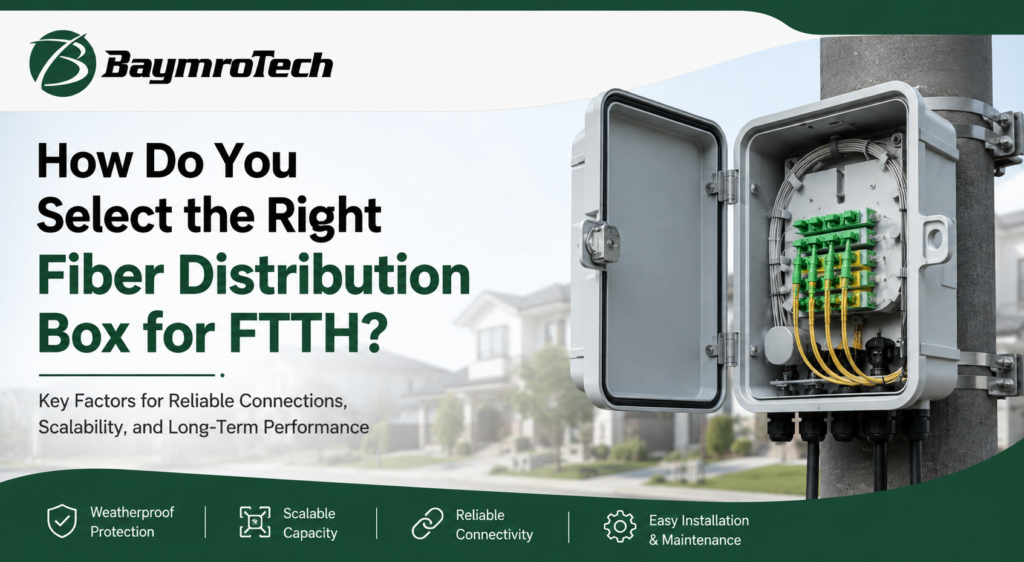
Introduction
Selecting a fiber distribution box for an FTTH project is not simply a matter of choosing an enclosure with enough ports. The box has to accommodate the required fiber count, splice arrangement, adapters, splitter configuration, cable routing, installation environment, and future network expansion.
A product that looks suitable on a quotation may create problems during installation if the internal fiber management is too crowded, the cable entry does not match the deployment, the enclosure lacks adequate environmental protection, or there is insufficient space for future connections.
These issues can increase installation time, complicate maintenance, and create additional replacement costs.
This is why telecom operators, ISPs, system integrators, engineering contractors, and procurement teams should evaluate a fiber distribution box according to the actual network architecture and installation conditions.
The current trend in FTTH infrastructure is toward higher-density, better-organized, application-specific fiber distribution solutions. Instead of selecting a generic box based primarily on price or external dimensions, buyers are increasingly considering fiber capacity, splitter integration, adapter configuration, splice management, environmental protection, and expansion requirements before finalizing the specification.
What Is a Fiber Distribution Box?
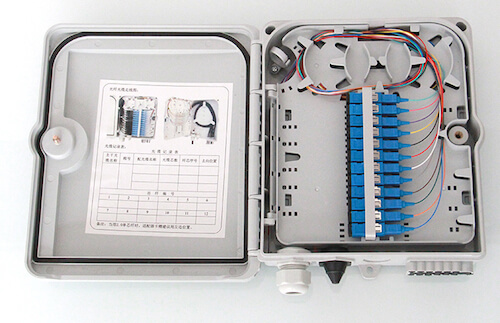
A fiber distribution box, commonly called an FDB, is an enclosure designed to organize and protect optical fiber connections at a distribution point within a fiber network.
Depending on its design, an FDB can accommodate fiber splicing, adapters, pigtails, patch cords, PLC splitters, cable storage, and other passive optical components.
The box creates a controlled location where incoming and outgoing fibers can be managed without exposing sensitive connections to unnecessary mechanical or environmental risks.
For FTTH projects, the appropriate configuration depends heavily on where the box will be installed and how many fibers and connections it needs to manage.
A small indoor box for a building may have very different requirements from a high-capacity outdoor distribution box serving multiple subscribers.
What Should You Check First When Selecting an FTTH Fiber Distribution Box?
Before comparing manufacturers or quotations, buyers should define the technical requirements of the installation.
The most important parameters include:
- Required fiber capacity
- Number and type of adapters
- Splice capacity
- Splitter configuration
- Cable entry and exit arrangement
- Indoor or outdoor installation
- Required IP protection
- Enclosure material
- Available installation space
- Fiber routing requirements
- Current connection requirements
- Future expansion capacity
These specifications should be established before selecting the final FDB model because the wrong configuration can affect both installation efficiency and long-term network management.

1. Fiber Capacity: How Many Fibers Does the Box Need to Handle?
Fiber capacity is one of the first technical factors buyers should evaluate.
An FDB may be designed for a relatively small number of fiber connections or a much higher-density deployment. The required capacity depends on the number of incoming fibers, outgoing connections, splice points, adapters, and passive components that need to be accommodated.
Buyers should distinguish between fiber splice capacity and adapter capacity because these are not always identical.
For example, a box may provide a certain number of splice positions while supporting a different number of adapter ports depending on its internal configuration.
It is also important to consider whether the project will expand.
If a network is initially using only part of the available capacity, selecting a box with reasonable reserve space can reduce the need to replace the enclosure when additional subscribers or fibers are connected.
What to confirm:
- Maximum fiber capacity
- Splice capacity
- Adapter port capacity
- Available internal storage
- Reserve capacity for future expansion
- Physical dimensions required for installation
2. Splitter Configuration and Integration
Splitter integration is another important consideration for FTTH deployments.
A fiber distribution box may be designed to accommodate PLC splitters or other passive optical splitting configurations. The required arrangement depends on the network architecture and the number of optical paths being distributed.
For example, buyers may need to determine whether the box should accommodate a single splitter, multiple splitter modules, or a specific splitter ratio.
The physical arrangement matters because splitter modules require appropriate space and cable routing. An enclosure that technically supports a splitter but provides poor internal organization can make installation and maintenance more difficult.
When specifying an FDB, buyers should confirm:
- Splitter type
- Splitter ratio
- Number of splitter positions
- Module or cassette configuration
- Fiber routing space
- Access for maintenance
- Compatibility with the required adapters and pigtails
For projects where splitters are integrated directly into the distribution point, the internal layout should allow fibers to be routed without excessive bending or congestion.
3. Adapter Layout and Port Configuration
The adapter arrangement determines how fibers are terminated and connected within the box.
Depending on the application, buyers may require different adapter types and layouts. Common configurations can accommodate connectors such as SC or LC, while other project requirements may call for different arrangements.
Port density should be evaluated alongside physical accessibility.
A high-density box may offer more ports within a smaller enclosure, but if the ports are difficult to access during installation or maintenance, the practical benefit can be reduced.
Buyers should examine:
- Adapter type
- Number of adapter ports
- Adapter orientation
- Port spacing
- Front-access or internal-access arrangement
- Compatibility with existing patch cords and pigtails
- Space around connectors for installation and maintenance
For high-density FTTH projects, organized adapter positioning can make a significant difference to field installation efficiency.
4. Splice Tray Design and Fiber Management
Splice management is one of the most important internal design considerations.
A well-designed splice tray should provide an organized location for fiber splices while maintaining appropriate fiber routing and protection.
The tray needs to accommodate the required splice method and fiber quantity without forcing fibers into excessively tight bends or disorganized paths.
Buyers should consider:
- Splice capacity per tray
- Number of trays
- Fiber routing paths
- Fiber bend management
- Tray accessibility
- Splice protection arrangement
- Space for additional fibers
The relationship between splice tray capacity and overall enclosure capacity should also be checked.
A box advertised with high fiber capacity may not provide the same practical capacity if the internal splice management system is limited.
For this reason, procurement teams should review the internal structure rather than relying only on the external product description.
5. Cable Entry and Exit Design
Cable entry points affect installation efficiency and fiber protection.
Depending on the installation, an FDB may need to accommodate different incoming and outgoing cable arrangements. Cable glands, entry ports, routing channels, and sealing systems should be compatible with the cable types used in the project.
Buyers should check:
- Number of cable entry points
- Cable diameter compatibility
- Entry direction
- Sealing method
- Cable fixation
- Fiber routing after entry
- Available cable storage
A poorly designed cable entry can create installation difficulties and may compromise environmental protection.
For outdoor installations, the cable entry system becomes particularly important because the enclosure must maintain its intended protection against moisture and dust.
6. IP Protection for Indoor and Outdoor Installation
The installation environment should determine the required enclosure protection.
Indoor FTTH installations generally have different environmental requirements from outdoor deployments. Outdoor boxes may be exposed to rain, humidity, dust, temperature variation, sunlight, and mechanical conditions.
An appropriate IP rating can help protect internal components from environmental ingress, but buyers should select the required protection level according to the actual installation environment.
For outdoor applications, procurement teams should evaluate:
- Required IP protection
- Sealing structure
- Door or cover design
- Cable entry sealing
- Material resistance
- UV exposure
- Temperature conditions
- Mounting environment
A box designed primarily for indoor use should not automatically be assumed to be suitable for outdoor deployment.
7. Enclosure Material and Mechanical Construction
The enclosure material affects durability, weight, environmental resistance, and installation characteristics.
Depending on the product design and application, fiber distribution boxes may use different polymer or metal construction approaches.
The right choice depends on the project environment and required mechanical performance.
Buyers should examine:
- Enclosure material
- Wall thickness
- Mechanical strength
- Corrosion resistance where relevant
- UV resistance for outdoor use
- Door and hinge construction
- Locking mechanism
- Mounting structure
For infrastructure projects with repeated field access, the enclosure should also be practical to open, close, and maintain without damaging internal fiber connections.
8. Indoor vs Outdoor Fiber Distribution Boxes
One of the simplest but most important selection decisions is whether the FDB will be installed indoors or outdoors.
Indoor Applications
Indoor boxes may be used in:
- Residential buildings
- Commercial buildings
- Telecom rooms
- Equipment rooms
- Floor distribution areas
- Enterprise network installations
The priorities may include compact dimensions, easy access, organized fiber management, and efficient port utilization.
Outdoor Applications
Outdoor boxes may be used in:
- FTTH access networks
- Telecom poles
- Outdoor cabinets
- Distribution points
- Utility infrastructure
- Street-level network deployments
Outdoor models require greater attention to sealing, environmental protection, mounting, enclosure materials, and cable entry.
Selecting an indoor configuration for an outdoor environment simply because it is less expensive can create avoidable reliability and maintenance problems.
9. Plan for Future Network Expansion
FTTH infrastructure is rarely static.
Additional subscribers, network upgrades, new fiber routes, or changes in distribution architecture may increase the number of required connections.
This makes future expansion an important part of FDB selection.
Buyers should ask:
Will the box still provide sufficient space if the number of active connections increases?
A suitable solution should provide enough capacity without creating unnecessary excess size and cost.
Future expansion can be evaluated through:
- Spare adapter positions
- Additional splice capacity
- Internal fiber storage
- Available splitter positions
- Cable routing space
- Modular internal design
The objective is to balance current requirements with realistic future demand.
10. How Does Product Design Affect Installation and Maintenance?
The best FDB is not necessarily the one with the highest capacity. It is the one that provides the right combination of capacity, accessibility, protection, and fiber management for the intended application.
Installation teams benefit from:
- Clearly organized fiber routing
- Accessible splice trays
- Logical adapter positioning
- Secure cable fixation
- Adequate internal working space
- Easy enclosure access
- Proper labeling areas
For maintenance teams, these features can reduce the time required to identify and work on individual connections.
A well-organized internal layout can therefore contribute to lower operational effort throughout the network lifecycle.
Fiber Distribution Box Selection Checklist
| Technical Parameter | What Buyers Should Check | Why It Matters |
| Fiber capacity | Total fiber and splice capacity | Prevents capacity limitations |
| Adapter configuration | Type, number, layout and spacing | Ensures connector compatibility |
| Splitter configuration | Type, ratio and available positions | Supports the network architecture |
| Splice tray | Capacity, access and fiber routing | Protects and organizes splices |
| Cable entry | Quantity, diameter and sealing | Simplifies installation and protects fibers |
| IP protection | Required environmental protection | Supports outdoor reliability |
| Enclosure material | Mechanical and environmental properties | Improves durability |
| Installation type | Indoor or outdoor | Determines enclosure requirements |
| Fiber management | Bend control and routing | Reduces congestion and handling issues |
| Expansion | Spare space and capacity | Supports future network growth |
What Procurement Teams Should Confirm With the Manufacturer
Once the technical requirements are established, supplier evaluation becomes much more straightforward.
Instead of asking only for the lowest quotation, procurement teams should confirm whether the manufacturer can supply the specified configuration consistently.
Important commercial and technical questions include:
- Can the manufacturer produce the required fiber capacity?
- Can the adapter and splitter layout be customized?
- What MOQ applies to standard and customized configurations?
- What is the confirmed production lead time?
- Are product drawings available for approval?
- Can samples be supplied before mass production?
- What testing and inspection documentation is available?
- Can packaging and labeling be customized?
- Is technical support available during specification development?
These questions support the technical selection rather than replacing it.
For large projects, OEM capability can be particularly useful because the manufacturer can work directly with the buyer on enclosure dimensions, internal layouts, fiber capacity, mounting arrangements, and other project-specific requirements.

Why BaymroTech?
BaymroTech supplies fiber optic infrastructure products for B2B telecom, FTTH, ISP, data center, and network infrastructure applications.
As an OEM manufacturer and engineering-focused supplier, BaymroTech can support buyers who need more than a generic fiber distribution box. Project discussions can focus on the actual configuration required for the deployment, including fiber capacity, adapter arrangement, splitter integration, enclosure requirements, cable management, and customization.
This approach is particularly relevant for system integrators, telecom operators, contractors, and procurement teams handling projects where the FDB specification needs to match an existing network design.
For buyers comparing suppliers, the key consideration should be whether the manufacturer can provide the required technical configuration while maintaining consistent production and dependable project support.
Common Fiber Distribution Box Selection Mistakes
Choosing Capacity Based Only on Port Count
Port count does not always represent the complete usable capacity of the box. Buyers should also consider splice capacity, splitter space, internal routing, and reserve capacity.
Ignoring the Installation Environment
An enclosure suitable for an indoor telecom room may not provide the environmental protection needed for outdoor deployment.
Selecting a Box Without Checking Cable Entry
Cable diameter and entry configuration can affect installation and sealing. These requirements should be confirmed before ordering.
Overlooking Internal Fiber Management
A compact enclosure with high port density may not be practical if the internal routing is difficult to manage.
Buying Without Reviewing the Product Drawing
For customized or project-specific requirements, technical drawings should be reviewed before production. This helps identify dimensional, port-layout, mounting, and internal configuration issues early.
Selecting Only on Initial Price
A cheaper enclosure may become more expensive if it creates installation delays, poor fiber management, difficult maintenance, or early replacement requirements.
How Can Buyers Prepare an Accurate Fiber Distribution Box RFQ?
A detailed RFQ helps the manufacturer understand the application and provide a technically appropriate quotation.
Buyers should ideally include:
- Required quantity
- Fiber capacity
- Splice capacity
- Adapter type and quantity
- Splitter type and ratio
- Indoor or outdoor installation
- Required IP protection
- Enclosure material preference
- Cable diameter and entry requirements
- Mounting method
- Required dimensions
- Labeling requirements
- Packaging requirements
- Required certifications or documentation
- Target delivery schedule
- Customization requirements
If available, buyers should also provide product drawings, network diagrams, installation photographs, or reference specifications.
This allows the manufacturer to evaluate the requirement based on the actual deployment instead of making assumptions from a general product description.
FAQ
What is a fiber distribution box used for?
A fiber distribution box protects and organizes optical fibers at a network distribution point. It can accommodate splicing, adapters, splitters, pigtails, and fiber management components.
How do I choose the right FDB fiber capacity?
Determine the number of fibers, splices, adapters, and passive components required for the current deployment, then allow reasonable capacity for future expansion.
Can a fiber distribution box include PLC splitters?
Yes. Some FDB designs can accommodate PLC splitters or splitter modules. The required configuration should be confirmed according to the network architecture.
What is the difference between an indoor and outdoor fiber distribution box?
Outdoor FDBs generally require greater environmental protection, appropriate sealing, suitable materials, and a design capable of handling outdoor installation conditions.
Why is the splice tray important?
The splice tray provides an organized and protected location for fiber splices. Its capacity and routing design can directly affect installation and maintenance efficiency.
What should I check about cable entry?
Check the number of entry points, compatible cable diameters, entry direction, cable fixation, fiber routing, and sealing method.
Should I choose an FDB with spare capacity?
Yes, when future network expansion is expected. Reasonable spare capacity can help avoid replacing the enclosure when additional fibers or connections are added.
Can a fiber distribution box be customized?
Depending on the manufacturer, customization may include fiber capacity, adapter configuration, splitter arrangement, enclosure dimensions, mounting structure, cable entry, labeling, and other project-specific requirements.
How can I verify that an FDB matches my project?
Review the product drawing and confirm fiber capacity, splice capacity, adapter layout, splitter configuration, cable entry, IP protection, dimensions, mounting method, and environmental requirements before placing the production order.
Request Your Fiber Distribution Box Specification From BaymroTech
The right fiber distribution box should be selected according to the network architecture, fiber capacity, internal configuration, installation environment, and future expansion requirements, not simply by price or external dimensions.
If you are sourcing FDBs for an FTTH, telecom, ISP, or infrastructure project, BaymroTech can discuss your required fiber capacity, splitter configuration, adapter layout, splice arrangement, enclosure requirements, customization needs, MOQ, and delivery expectations.
Provide your project specifications or existing reference drawing to start a more accurate technical and commercial discussion.
Ready to specify the right fiber distribution box for your FTTH project?
Send your requirements to BaymroTech today and get a project-focused FDB solution built around your fiber capacity, configuration, installation environment, and future network needs.