
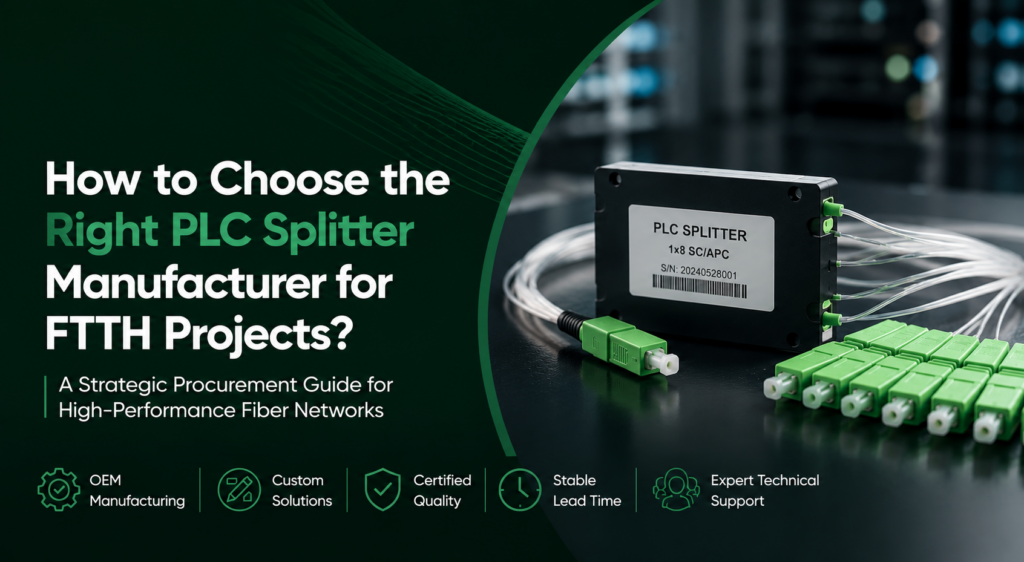
Introduction
As Fiber to the Home (FTTH) deployments continue to expand, procurement teams face increasing pressure to deliver high performance network infrastructure while controlling project costs and maintaining strict delivery schedules. One of the most important purchasing decisions in these projects is selecting the right PLC splitter manufacturer.
Choosing the wrong supplier can create problems that extend far beyond the initial purchase price. Inconsistent product quality, delayed shipments, limited customization, poor technical support, and unstable lead times can disrupt installation schedules and increase maintenance costs throughout the network lifecycle. These issues often result in higher total ownership costs and unnecessary operational challenges.
For telecom operators, engineering contractors, infrastructure developers, system integrators, and procurement managers, supplier selection should never be treated as a simple price comparison. Instead, it should be viewed as a strategic sourcing decision that directly affects project quality, customer satisfaction, and long term network reliability.
This guide explains what buyers should evaluate when selecting a PLC splitter manufacturer, the role of FBT coupler manufacturers in fiber optic networks, the procurement factors that truly matter, and how an experienced OEM partner such as BaymroTech can support successful FTTH projects.
What Is a PLC Splitter and FBT Coupler Manufacturer?
Before comparing suppliers, buyers should understand the products they manufacture and where each solution fits within modern optical communication networks.
What Is a PLC Splitter?
A Planar Lightwave Circuit (PLC) Splitter is a passive optical component that distributes a single optical signal into multiple output fibers while maintaining consistent signal quality across each channel.
Unlike active equipment, PLC splitters require no electrical power, making them highly reliable for Passive Optical Network (PON) architectures used in FTTH deployments.
Key advantages include:
- Uniform optical signal distribution
- Low insertion loss
- Excellent wavelength stability
- Compact design
- Long operational life
- High reliability for outdoor and indoor installations
Because of these characteristics, PLC splitters have become one of the most widely deployed passive optical components in broadband infrastructure projects.
What Is an FBT Coupler?
An FBT (Fused Biconical Taper) Coupler is another passive optical component manufactured by specialized fiber optic suppliers.
It is produced by heating and fusing optical fibers together until the desired coupling ratio is achieved.
FBT couplers are commonly used in:
- Optical monitoring systems
- CATV networks
- Laboratory testing
- Industrial communication systems
- Specialized optical applications requiring customized split ratios
Although PLC splitters dominate large scale FTTH deployments, FBT couplers remain valuable for specific applications where flexibility and cost efficiency are important.
For procurement professionals, understanding the difference between these two technologies helps ensure that the selected product aligns with the project’s technical requirements.
Applications and Industry Use Cases
PLC splitters and FBT couplers play a critical role across multiple communication industries. Their ability to distribute optical signals efficiently makes them essential components in modern fiber optic infrastructure.
Fiber to the Home Networks
FTTH is the largest application for PLC splitters.
A single optical signal from the central office is divided into multiple connections, allowing internet service providers to deliver broadband services to residential and commercial users efficiently.
Benefits include:
- Reduced infrastructure costs
- Simplified network architecture
- High bandwidth delivery
- Reliable long distance communication
Telecommunications Infrastructure
National telecom operators depend on PLC splitters to expand broadband coverage while maintaining network stability.
Applications include:
- Metropolitan fiber networks
- Rural broadband deployment
- Community broadband expansion
- Public communication infrastructure
Reliable passive components help reduce maintenance while supporting continuous network availability.
Data Centers
Modern data centers require dependable optical signal management to support increasing traffic volumes.
PLC splitters are used for:
- Optical monitoring
- Signal distribution
- Fiber management
- High density network architectures
Their compact size makes them suitable for environments where efficient space utilization is essential.
Enterprise Networks
Large organizations often deploy fiber optic infrastructure across campuses, office buildings, industrial facilities, and smart manufacturing sites.
PLC splitters provide flexible optical signal distribution without adding active equipment, reducing both operational complexity and maintenance requirements.
Smart City Infrastructure
As cities invest in digital transformation, fiber optic networks continue to support:
- Intelligent transportation systems
- Public WiFi
- Traffic monitoring
- Security surveillance
- Government communication networks
Reliable passive optical components help ensure uninterrupted communication between connected systems.
Industrial Automation
Manufacturing facilities increasingly rely on fiber optic communication for machine connectivity, process monitoring, and industrial control systems.
Stable signal transmission contributes to improved operational efficiency and system reliability.
Why Supplier Evaluation Matters Across Different Projects
Although PLC splitters may appear similar, project requirements often differ significantly depending on network architecture, installation environment, regulatory standards, and customer specifications.
Some projects require rugged outdoor enclosures, while others demand compact indoor designs, specialized connector types, custom fiber lengths, unique packaging, or specific certifications. Environmental ratings, testing standards, labeling requirements, and delivery schedules may also vary from one project to another.
Because of these differences, selecting the right manufacturer is not simply about purchasing a standard product. It requires evaluating whether the supplier has the engineering expertise, manufacturing flexibility, quality systems, and production capacity to meet your project’s exact requirements. A capable OEM partner can adapt to these demands and help reduce procurement risks while ensuring consistent project performance.
Buyer Decision Factors for Selecting the Right PLC Splitter Manufacturer
Selecting a manufacturer should involve a structured procurement evaluation rather than a simple comparison of quotations. A reliable supplier contributes not only to product quality but also to project efficiency, installation success, and long term network performance.
1. OEM Manufacturing Capability
One of the first questions buyers should ask is whether the supplier is an original equipment manufacturer (OEM) or merely a trading company.
An OEM manufacturer has direct control over the production process, enabling greater consistency, better quality management, and faster response to project specific requirements. This also allows for closer collaboration on product development, customized configurations, and technical improvements.
For large scale FTTH deployments, working directly with an OEM can simplify communication and reduce sourcing risks.
2. Customization Options
Every network project has unique technical requirements. A capable manufacturer should be able to provide customized solutions rather than offering only standard products.
Customization may include:
- Split ratios
- Connector types
- Fiber lengths
- Cable jacket materials
- Packaging
- Product labeling
- OEM branding
Customized products help streamline installation, improve inventory management, and ensure compatibility with the overall network design.
3. Minimum Order Quantity (MOQ)
MOQ is an important commercial consideration, especially for buyers managing projects of different sizes.
Some manufacturers offer flexible MOQ policies, making it easier to support pilot projects or smaller deployments, while others focus on high volume production.
Understanding MOQ requirements early in the procurement process helps buyers plan budgets, inventory levels, and purchasing schedules more effectively.
4. Lead Time Stability
Reliable delivery schedules are just as important as product quality. Even high quality components lose value if they arrive too late for project milestones.
When evaluating suppliers, procurement teams should ask about:
- Standard production lead times
- Capacity during peak demand
- Inventory availability
- Shipping arrangements
- Emergency production capability
Consistent lead times help contractors avoid installation delays and improve overall project planning.
5. Product Certifications and Compliance
A trustworthy PLC splitter manufacturer should be able to provide relevant certifications and compliance documentation that demonstrate adherence to recognized industry standards.
Buyers should verify:
- Quality management certifications
- Product compliance documentation
- Material traceability
- Environmental testing records
- Performance verification reports
These documents provide confidence that the products meet customer specifications and industry expectations.
6. Technical Support Capability
Technical support becomes critical when projects involve customized network designs, new deployment environments, or unique installation requirements.
A reliable manufacturer should be able to provide:
- Product selection guidance
- Fiber routing recommendations
- Connector compatibility advice
- Installation documentation
- Technical drawings
- Engineering consultation before production
When technical issues arise during procurement or installation, responsive engineering support can prevent costly delays and unnecessary redesigns.
7. Production Capacity
Large scale FTTH projects often require thousands of PLC splitters delivered according to phased construction schedules.
Before selecting a manufacturer, buyers should evaluate:
- Monthly production capacity
- Available manufacturing lines
- Workforce stability
- Equipment automation
- Inventory management
Manufacturers with strong production capabilities are better positioned to support expanding telecom infrastructure without disrupting delivery schedules.
8. Supply Chain Reliability
A supplier’s internal production process is only part of the equation. Raw material sourcing, logistics management, and inventory planning all influence delivery performance.
Reliable manufacturers typically maintain:
- Stable raw material suppliers
- Safety stock for critical components
- Multiple logistics options
- Well planned production scheduling
- Consistent export experience
A resilient supply chain helps reduce procurement risks during periods of increased market demand.
9. Project References and Industry Experience
Experience matters, especially for infrastructure projects where reliability is essential.
Ask potential suppliers about:
- Previous FTTH deployments
- Telecom operator projects
- System integration experience
- International export markets
- Long term customer relationships
Manufacturers with proven project experience often have stronger quality systems and better understanding of industry expectations.
Why Engineering Collaboration Matters
Many procurement teams focus primarily on obtaining competitive pricing. However, the most successful FTTH projects result from close collaboration between procurement professionals and engineering teams.
Working with an engineering focused manufacturer such as BaymroTech allows buyers to discuss:
- Split ratio selection
- Connector compatibility
- Fiber length requirements
- Installation environments
- Packaging preferences
- Project delivery schedules
This collaborative approach helps minimize procurement errors while improving installation efficiency.
Procurement Risks and Common Supplier Selection Mistakes
Choosing the wrong PLC splitter manufacturer may not become apparent until installation begins. Unfortunately, correcting supplier issues during deployment is often expensive and time consuming.
Below are several common procurement mistakes.
Selecting Suppliers Without OEM Capability
Some suppliers simply resell products manufactured elsewhere.
Without direct manufacturing control, buyers may experience:
- Limited customization
- Inconsistent product quality
- Reduced traceability
- Longer communication chains
- Slower issue resolution
OEM manufacturers generally provide greater flexibility and stronger production oversight.
Ignoring Testing Reports
Requesting testing documentation should never be optional.
Without proper reports, buyers cannot verify:
- Optical performance
- Environmental reliability
- Manufacturing consistency
- Compliance with customer specifications
Testing documentation provides confidence before products reach the project site.
Overlooking Customization Requirements
Every FTTH deployment is unique.
Selecting standard products without considering project requirements can result in:
- Additional installation work
- Connector incompatibility
- Increased inventory complexity
- Delayed project completion
Early discussions regarding customization can simplify deployment considerably.
Choosing Suppliers Based Only on Lowest Price
Low pricing may appear attractive during procurement, but hidden costs often emerge later.
Potential consequences include:
- Product replacement
- Higher maintenance expenses
- Network downtime
- Delayed installations
- Additional labor costs
Evaluating total project value instead of purchase price alone supports better procurement decisions.
Accepting Unstable Lead Times
Delayed deliveries can affect multiple contractors working on the same project.
Lead time instability may result in:
- Construction delays
- Idle installation teams
- Missed customer deadlines
- Increased logistics costs
Reliable scheduling is often more valuable than small price differences.
Limited Technical Support
Suppliers that provide little engineering assistance may leave buyers responsible for resolving compatibility issues independently.
Strong technical support reduces uncertainty throughout procurement, production, and deployment.
Procurement Checklist for PLC Splitter Suppliers
The following checklist can help procurement teams compare manufacturers more effectively.
| Evaluation Criteria | Why It Matters |
| ✓ OEM Manufacturing Capability | Greater production control and customization |
| ✓ Minimum Order Quantity | Matches project purchasing requirements |
| ✓ Stable Lead Time | Supports construction schedules |
| ✓ International Certifications | Demonstrates product compliance |
| ✓ Complete Testing Reports | Confirms optical and environmental performance |
| ✓ Customization Capability | Meets project specific requirements |
| ✓ Technical Support | Helps solve engineering challenges |
| ✓ Quality Control System | Ensures product consistency |
| ✓ Proven Project References | Demonstrates industry experience |
| ✓ Supply Chain Stability | Reduces delivery risks |
Using a structured supplier evaluation process allows procurement teams to make decisions based on long term project value rather than price alone.
Why Choose BaymroTech for PLC Splitter Solutions?
Selecting the right manufacturing partner requires confidence in both engineering expertise and production capability.
BaymroTech supports global telecom infrastructure projects by providing high quality passive optical components designed for demanding FTTH applications.
As an OEM manufacturer and B2B supplier, BaymroTech focuses on delivering solutions that align with the technical and procurement needs of telecom operators, engineering contractors, system integrators, and infrastructure developers.
BaymroTech offers:
- OEM manufacturing services
- Flexible product customization
- Stable production capacity
- Comprehensive quality inspection
- Reliable lead times
- Technical engineering support
- International export experience
- Consistent communication throughout project execution
Rather than offering one size fits all products, BaymroTech works closely with customers to recommend configurations that suit specific network architectures and deployment conditions.
Whether your project involves urban broadband expansion, rural FTTH rollouts, enterprise connectivity, or data communication infrastructure, BaymroTech strives to provide dependable manufacturing support from inquiry through delivery.
Frequently Asked Questions
What is a PLC splitter?
A PLC splitter is a passive optical device that divides one optical signal into multiple outputs with consistent signal distribution, making it ideal for FTTH and PON networks.
What is an FBT coupler?
An FBT coupler is created by fusing optical fibers together and is commonly used for lower split ratios and specialized fiber optic applications.
Why are PLC splitters widely used in FTTH projects?
They provide uniform signal distribution, low insertion loss, high reliability, and stable performance across large scale passive optical networks.
Can PLC splitters be customized?
Yes. Many OEM manufacturers offer customized connector types, fiber lengths, packaging options, split ratios, and labeling to match project requirements.
What certifications should procurement teams request?
Buyers should request applicable product certifications, quality management certifications, and complete optical testing reports that verify performance and compliance.
What is the typical lead time for PLC splitters?
Lead times vary depending on order quantity, customization, and production scheduling. Confirm delivery timelines with the manufacturer before placing an order.
How can buyers verify supplier quality?
Request factory quality procedures, production information, testing reports, sample evaluations, certifications, and relevant project references before making procurement decisions.
Why is OEM manufacturing important?
OEM manufacturers provide better production control, greater customization flexibility, stronger quality assurance, and more efficient communication throughout the project lifecycle.
Request a Project Specific RFQ
Every FTTH project has unique technical and procurement requirements. Before placing an order, discuss your OEM requirements, customization preferences, minimum order quantity, lead time expectations, certifications, and project specifications with an experienced manufacturing partner.
BaymroTech’s engineering team is ready to help you identify the most suitable PLC splitter solution for your network while supporting efficient procurement and reliable project execution.
Ready to Source the Right PLC Splitter Manufacturer?
Choosing the right supplier today can reduce project risks, improve network reliability, and lower long term ownership costs. Contact BaymroTech now to discuss your OEM requirements, compare supplier capabilities, and request a customized RFQ tailored to your next FTTH project.
