
Introduction
In today’s rapidly expanding telecommunications and data infrastructure market, procurement teams face increasing pressure to deliver projects on time while maintaining high quality standards and controlling costs. Whether you are building an FTTH network, expanding a data center, upgrading an enterprise network, or deploying industrial communication systems, the quality of every network component directly affects long term performance. One component that is often overlooked during procurement is the fiber optic patch cord.
Choosing the wrong fiber optic patch cord supplier can result in inconsistent product quality, unexpected project delays, unstable lead times, higher maintenance expenses, and increased total cost of ownership. Poor manufacturing standards may lead to excessive insertion loss, connector failures, or compatibility issues that require costly replacements after deployment. For procurement managers and engineering teams, these risks can significantly impact project schedules and customer satisfaction.
Selecting a supplier should never be based solely on price. Instead, it should be viewed as a strategic procurement decision that considers manufacturing capability, technical expertise, quality assurance, customization options, supply chain reliability, and long term partnership potential.
This guide explains how to evaluate a fiber optic patch cord supplier from a procurement perspective, helping telecom operators, system integrators, engineering contractors, infrastructure developers, and technical sourcing teams make confident purchasing decisions while reducing project risks.
What Is a Fiber Optic Patch Cord Supplier?
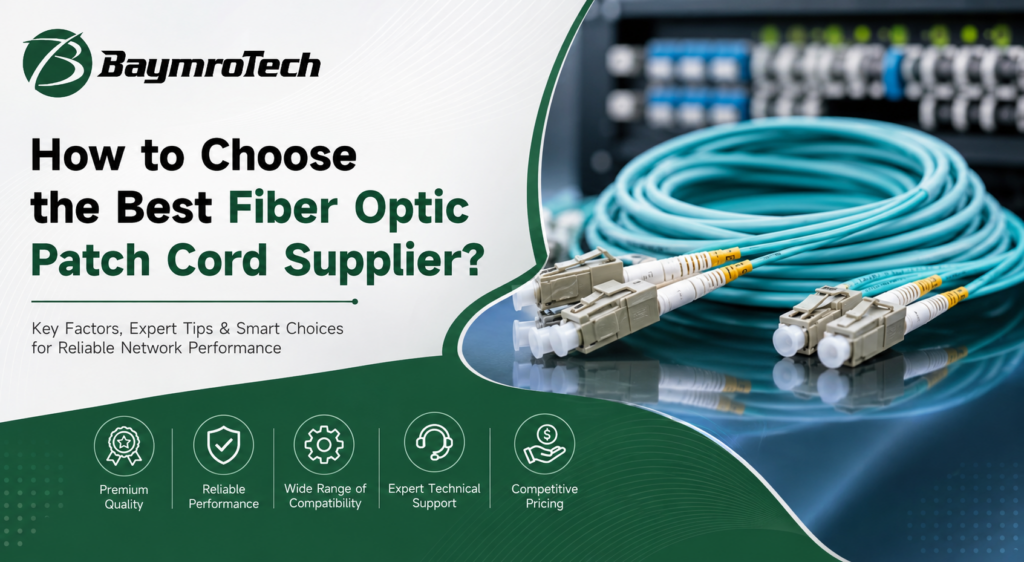
A fiber optic patch cord supplier manufactures and supplies pre terminated optical fiber cables that connect networking equipment such as optical distribution frames, switches, routers, patch panels, servers, and communication devices. These cables transmit high speed optical signals with minimal loss, making them essential components in modern communication networks.
A professional supplier does much more than provide finished products. They support customers with product selection, customization, quality testing, documentation, production planning, logistics coordination, and technical assistance throughout the procurement process.
Reliable suppliers typically offer products such as:
- Single mode patch cords
- Multi mode patch cords
- LC, SC, ST and FC connector types
- Simplex and duplex configurations
- Indoor and outdoor patch cords
- Armored fiber optic patch cords
- Customized cable lengths
- OEM and private label manufacturing
For procurement teams, selecting a supplier with engineering expertise ensures compatibility with project specifications while reducing installation challenges and future maintenance requirements.
Applications and Industry Use Cases
Fiber optic patch cords are used across a wide range of industries where reliable, high speed data transmission is critical.
Telecommunications Networks
Telecom operators use fiber optic patch cords to connect optical distribution frames, transmission equipment, GPON systems, and backbone infrastructure. Consistent optical performance is essential for maintaining stable communication services.
Data Centers
Modern data centers require thousands of fiber connections between servers, storage systems, switches, and patch panels. High quality patch cords help minimize signal loss and improve network reliability while supporting future scalability.
FTTH Deployments
Fiber to the Home projects depend on patch cords for connecting optical line terminals, distribution cabinets, splitters, and customer premises equipment. Large scale deployments require consistent quality across every cable.
Enterprise Networks
Businesses, campuses, hospitals, universities, and government facilities rely on fiber patch cords to support high bandwidth applications, cloud connectivity, and secure communication.
Industrial Communication
Manufacturing plants, transportation systems, energy facilities, and industrial automation projects often operate in demanding environments where ruggedized fiber optic patch cords provide dependable performance.
Broadcasting and Media
Broadcast studios and media production companies use optical patch cords for high speed video transmission with minimal latency and signal degradation.
Every project has unique technical requirements. A telecom backbone project may require low insertion loss single mode patch cords, while an industrial facility may need armored cables with enhanced environmental protection. Different applications also require specific certifications, customized cable lengths, connector types, packaging standards, and testing documentation. This is why evaluating a supplier’s manufacturing flexibility and engineering capability is just as important as comparing product prices.
Buyer Decision Factors When Selecting a Fiber Optic Patch Cord Supplier
Choosing the right supplier requires evaluating far more than product pricing. Procurement teams should assess the supplier’s ability to consistently support current and future projects while minimizing operational risks.
1. OEM Manufacturing Capability
OEM capability demonstrates that the supplier controls production rather than acting only as a trading company.
Manufacturers with in house production can better manage quality, production schedules, customization, and product consistency. They are also more capable of supporting long term supply agreements and engineering modifications.
Ask suppliers:
- Do you manufacture your own products?
- Which production processes are completed in house?
- Can you support OEM or private label projects?
- Can you modify products according to customer specifications?
BaymroTech supports OEM manufacturing services for customers requiring customized fiber optic connectivity solutions designed around specific project requirements.
2. Customization Options
Large infrastructure projects rarely use identical products across every installation.
A qualified supplier should be able to customize:
- Connector combinations
- Cable length
- Fiber type
- Jacket material
- Cable color
- Packaging
- Product labeling
- Private branding
Customization improves installation efficiency while reducing unnecessary inventory and field modifications.
3. Minimum Order Quantity Requirements
MOQ directly affects procurement planning and inventory management.
Some projects require only small quantities for pilot deployments, while nationwide network expansion projects involve high volume purchasing.
Understanding MOQ requirements helps buyers:
- Control inventory costs
- Improve procurement planning
- Reduce unnecessary stock
- Support phased deployment strategies
Flexible suppliers often provide better support for both small engineering projects and large scale telecom contracts.
4. Lead Time Stability
Stable lead times are critical for maintaining project schedules.
Delayed deliveries can postpone installation, increase labor costs, and create contractual penalties.
When evaluating suppliers, procurement managers should ask:
- What is the average production lead time?
- How is production capacity managed?
- Can urgent orders be prioritized?
- How are raw material shortages handled?
Suppliers with well established production planning and reliable supply chains help minimize unexpected delays.
5. Product Certifications
Certifications provide confidence that products meet recognized industry standards.
Depending on project requirements, buyers may request documentation related to:
- ISO quality management
- RoHS compliance
- CE compliance
- IEC standards
- Telcordia testing where applicable
Certification documentation is often required for government, telecom, and infrastructure projects.
6. Testing Reports
Every fiber optic patch cord should undergo thorough quality verification before shipment.
Important testing may include:
- Insertion loss testing
- Return loss testing
- End face inspection
- Connector geometry verification
- Optical performance validation
Reliable suppliers provide complete testing reports to support product acceptance and simplify project documentation.
7. Quality Control Procedures
Quality control is one of the most important factors separating reliable manufacturers from low cost suppliers.
Procurement teams should evaluate whether the supplier has documented quality procedures covering:
- Incoming raw material inspection
- Fiber inspection before termination
- Connector polishing verification
- Optical performance testing
- Final visual inspection
- Packaging inspection before shipment
Consistent quality control reduces field failures, warranty claims, and maintenance costs. For large scale deployments, even a small defect rate can create significant operational expenses.
8. Technical Support Capability
Complex network projects often require engineering assistance before and after purchase.
A strong supplier should be able to support:
- Product selection guidance
- Connector compatibility verification
- Loss budget calculations
- Application recommendations
- Installation best practices
- Documentation support
- Issue investigation if problems occur
Technical support becomes especially valuable when projects involve mixed connector standards, high density installations, or specialized environments.
9. Production Capacity
Procurement teams should confirm that the supplier can support both current and future demand.
Key questions include:
- What is the monthly production capacity?
- Can the supplier scale output during peak demand?
- How are large orders scheduled?
- Are backup production resources available?
Insufficient capacity can become a major risk during network expansion projects.
10. Supply Chain Reliability
A supplier’s own supply chain directly affects delivery performance.
Evaluate:
- Availability of fiber and connector materials
- Supplier diversification strategy
- Inventory management practices
- Logistics and export experience
- Contingency planning for disruptions
Suppliers with mature supply chain management are generally better positioned to maintain delivery commitments during market fluctuations.
11. Project References
Past project experience provides valuable insight into a supplier’s capabilities.
Ask for references related to:
- Telecom network deployments
- Data center projects
- FTTH rollouts
- Industrial communication systems
- Large volume procurement programs
Relevant project experience demonstrates that the supplier understands real world deployment requirements, documentation expectations, and procurement processes.
Procurement Risks and Common Supplier Selection Mistakes
Many procurement issues arise not from product specifications but from incomplete supplier evaluation.
Common procurement risks
No OEM capability
Trading companies may have limited control over manufacturing quality, customization, and production schedules.
No testing reports
Without documented optical testing, buyers cannot verify insertion loss, return loss, or product consistency.
No customization support
Standard products may not match project specifications, leading to field modifications and installation delays.
Unstable lead times
Inconsistent delivery schedules can disrupt project milestones and increase labor costs.
Limited technical support
When compatibility or performance issues arise, inadequate engineering support can delay resolution.
Inconsistent quality control
Variations between production batches can create unpredictable network performance and higher maintenance requirements.
These risks often become visible only after deployment, when replacement costs, downtime, and project delays are far more expensive than the original purchase price difference.
Procurement Checklist for Fiber Optic Patch Cord Suppliers
Use the following checklist during supplier evaluation and RFQ comparison.
Supplier Evaluation Checklist
Recommended
Evaluation Item
Verify
OEM manufacturing capability
MOQ flexibility
Stable lead times
ISO and compliance certifications
Insertion loss and return loss test reports
Customization options available
Technical engineering support
Documented quality control procedures
Relevant project references
Supply chain stability
Procurement teams can use this checklist to compare suppliers objectively and identify potential risks before issuing purchase orders.
Why B2B Buyers Work With BaymroTech
BaymroTech serves telecom operators, system integrators, engineering contractors, and infrastructure developers that require reliable fiber optic connectivity products for professional network deployments.
Rather than operating only as a trading company, BaymroTech supports customers as an OEM manufacturer and engineering focused B2B supplier. This approach helps procurement teams obtain products that match project specifications while maintaining quality consistency across large volume orders.
BaymroTech provides support for:
- OEM and private label manufacturing
- Custom cable lengths and connector configurations
- Single mode and multi mode solutions
- Telecom, FTTH, data center, and enterprise applications
- Quality testing and documentation support
- Project based production planning
- B2B export and logistics coordination
For organizations managing multi site deployments or long term network expansion programs, BaymroTech focuses on supply continuity, technical collaboration, and procurement efficiency rather than simply supplying catalog products.
Suggested Image Placement: Quality inspection and testing image showing optical testing equipment and connector inspection.
Frequently Asked Questions
What is a fiber optic patch cord?
A fiber optic patch cord is a pre terminated optical fiber cable used to connect networking equipment such as patch panels, switches, routers, and optical distribution frames.
Why is it used in telecom projects?
It provides low loss, high speed optical connections that support reliable data transmission across telecom and broadband networks.
Can fiber optic patch cords be customized?
Yes. Common customization options include connector type, cable length, fiber type, jacket material, color, labeling, and OEM branding.
What certifications should buyers request?
Buyers commonly request ISO quality management documentation, RoHS compliance, CE compliance where applicable, and relevant industry testing reports.
What is the typical lead time for bulk orders?
Lead time depends on order volume and customization requirements. Procurement teams should confirm production schedules and delivery commitments during the RFQ stage.
How can buyers verify supplier quality?
Request insertion loss and return loss test reports, review quality control procedures, evaluate certifications, and ask for relevant project references.
Does OEM capability matter?
Yes. OEM capability generally indicates greater control over manufacturing quality, customization, production planning, and long term supply consistency.
Discuss Your Project Requirements
Every network deployment has unique technical and procurement requirements. Before finalizing a supplier, discuss:
- OEM manufacturing requirements
- Connector and cable customization needs
- MOQ expectations
- Required certifications and test reports
- Production lead times
- Packaging and labeling standards
- Project specific performance requirements
- Long term supply planning
Early technical and procurement alignment can help reduce sourcing risks, improve delivery predictability, and support smoother project execution.
Suggested Image Placement: Project deployment image showing fiber optic patch cords installed in a large scale network environment.
Conclusion
Choosing the best fiber optic patch cord supplier is ultimately a strategic procurement decision that affects network reliability, project schedules, operational costs, and long term scalability. Price remains important, but it should be evaluated alongside manufacturing capability, quality assurance, technical support, customization flexibility, and supply chain stability.
By using a structured supplier evaluation process, procurement teams can reduce deployment risks, improve installation efficiency, and build stronger long term sourcing relationships.
Ready to evaluate your next fiber optic patch cord supplier? Contact BaymroTech today to discuss OEM requirements, customization options, MOQ planning, lead times, and project specific network solutions with our engineering and sourcing team.
Before issuing your next RFQ, compare BaymroTech’s OEM manufacturing capability, testing standards, and supply reliability to see how the right supplier can reduce project risk and improve network performance.
