Introduction
As telecom networks continue expanding to support higher bandwidth demands, fiber infrastructure projects are becoming larger, more complex, and increasingly time-sensitive. Telecom operators, system integrators, engineering contractors, and infrastructure developers are under constant pressure to complete deployments on schedule while maintaining network reliability and controlling costs.
One component that plays a critical role in fiber network performance is the Fiber Distribution Box (FDB). Although it may seem like a standard hardware item, selecting the wrong Fiber Distribution Box manufacturer can create serious challenges, including inconsistent product quality, installation issues, project delays, unstable lead times, increased maintenance requirements, and higher total cost of ownership.
For procurement managers and sourcing teams, supplier selection should not be treated as a simple price comparison exercise. Instead, it should be viewed as a strategic procurement decision that directly impacts project success, operational efficiency, and long-term network performance.
This article explores the key factors telecom companies should evaluate when selecting a Fiber Distribution Box manufacturer and how choosing the right supplier can support successful project execution.
What Is a Fiber Distribution Box?
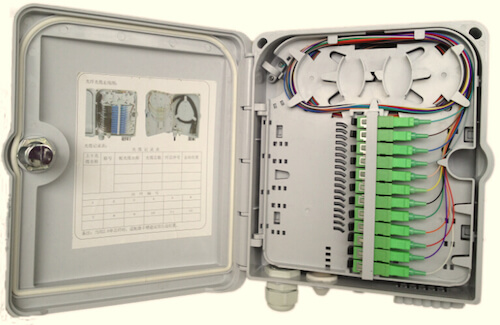
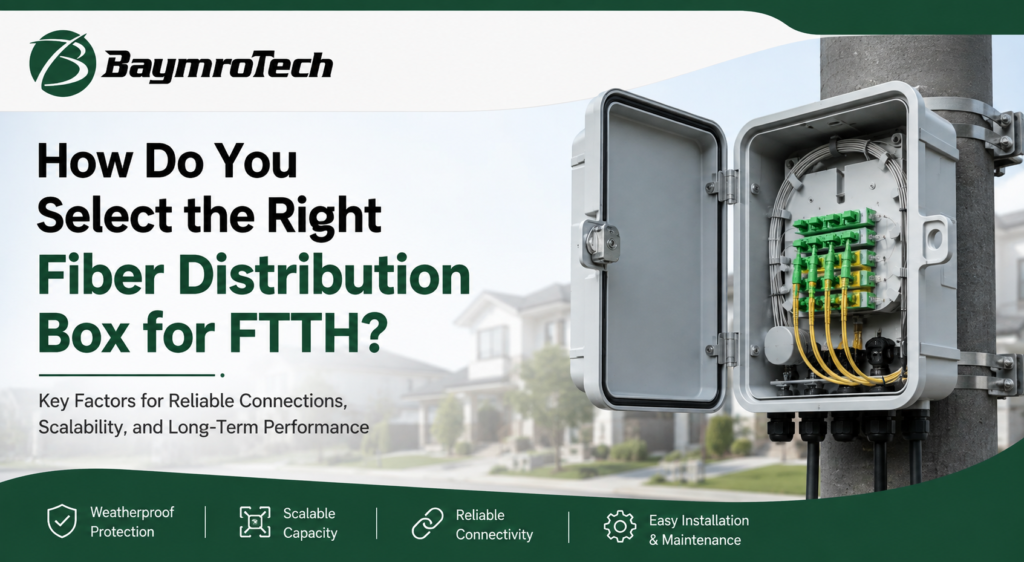
A Fiber Distribution Box is a protective enclosure designed to manage, distribute, terminate, and organize optical fiber connections within a telecommunications network.
It serves as a centralized point where fiber cables can be spliced, split, connected, and protected from environmental conditions. Fiber Distribution Boxes are commonly used in FTTH deployments, access networks, data communication infrastructure, broadband expansion projects, and outdoor telecom installations.
Their primary purpose is to improve cable management, protect fiber connections, and ensure reliable signal transmission throughout the network.
Applications and Industry Use Cases
Fiber Distribution Boxes are used across a wide range of telecommunications and networking projects.
FTTH Networks
Fiber Distribution Boxes serve as connection points between backbone fiber cables and end-user subscriber connections.
FTTB and FTTC Deployments
They support fiber routing and distribution in multi-dwelling units, commercial buildings, and urban broadband infrastructure.
Mobile Network Infrastructure
Telecom operators use Fiber Distribution Boxes to connect fiber backhaul networks supporting mobile base stations and communication towers.
Smart City Projects
Fiber distribution solutions help manage extensive fiber connectivity requirements in surveillance systems, intelligent transportation networks, and public communication infrastructure.
Industrial Communication Networks
Manufacturing facilities, energy projects, transportation systems, and utility providers use Fiber Distribution Boxes for secure fiber cable management.
Data Centers and Enterprise Networks
Fiber Distribution Boxes assist with structured fiber management, cable organization, and network scalability.
Different telecom projects often require different enclosure sizes, fiber capacities, ingress protection ratings, mounting options, cable entry configurations, certifications, and customization requirements. As a result, selecting the right manufacturer becomes a critical procurement decision rather than simply choosing a standard product supplier.
Buyer Decision Factors When Selecting a Fiber Distribution Box Manufacturer
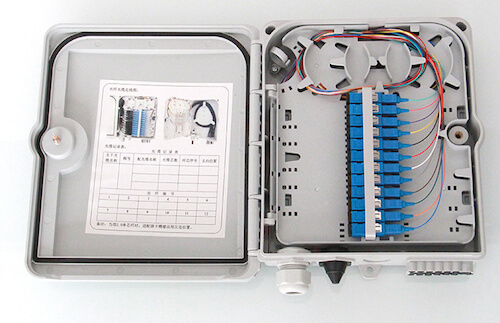
This is often the most important part of the supplier evaluation process. Procurement teams should assess manufacturers using a comprehensive set of criteria rather than focusing solely on pricing.
1. OEM Manufacturing Capability
Many telecom projects require customized products rather than off-the-shelf solutions.
A manufacturer with strong OEM capabilities can provide:
- Custom branding
- Specialized enclosure designs
- Modified cable entry configurations
- Project-specific fiber capacities
- Customized accessories and mounting options
OEM capability allows telecom companies to align products with unique deployment requirements while maintaining consistency across projects.
BaymroTech supports OEM manufacturing solutions for businesses requiring customized fiber distribution products for large-scale telecom deployments.
2. Customization Flexibility
Customization is increasingly important for infrastructure projects operating in different environmental and operational conditions.
Buyers should evaluate whether the supplier can offer:
- Various port configurations
- Different enclosure sizes
- Indoor and outdoor versions
- Custom materials
- Project-specific accessories
- Unique installation requirements
A flexible supplier can help reduce installation complexity and improve project efficiency.
3. Minimum Order Quantity (MOQ)
MOQ requirements can significantly impact procurement planning.
Some suppliers only focus on high-volume orders, while others can accommodate pilot projects, phased deployments, and ongoing procurement programs.
Before supplier selection, buyers should clearly understand:
- Standard MOQ
- OEM MOQ requirements
- Customization MOQ policies
- Volume pricing structures
This helps avoid procurement delays and budget challenges.
4. Lead Time Stability
Consistent lead times are essential for telecom project scheduling.
Unpredictable delivery schedules can create:
- Construction delays
- Installation disruptions
- Increased labor costs
- Contractual penalties
Reliable manufacturers maintain production planning systems and inventory strategies that support stable lead-time performance.
5. Product Certifications
Certifications provide confidence that products meet industry standards and regulatory requirements.
Buyers should request documentation related to:
- CE compliance
- RoHS compliance
- ISO quality management systems
- Environmental testing certifications
- Material compliance reports
Certification verification should be a standard part of supplier qualification procedures.
6. Testing Reports
Testing reports provide evidence that products perform as specified.
Important tests may include:
- Mechanical testing
- Environmental testing
- Waterproof performance testing
- UV resistance testing
- Impact resistance testing
- Temperature cycling tests
Procurement teams should request current testing documentation rather than relying solely on supplier claims.
7. Quality Control Procedures
Quality control consistency directly affects field performance.
A qualified Fiber Distribution Box manufacturer should implement:
- Incoming material inspection
- In-process quality control
- Finished product inspection
- Functional testing procedures
- Traceability systems
Strong quality control reduces defect rates and minimizes costly field failures.
8. Technical Support Capability
Technical support becomes particularly important during large telecom deployments.
Manufacturers should be able to provide:
- Product selection guidance
- Installation recommendations
- Technical drawings
- Product specifications
- Engineering consultation
Responsive technical support can reduce project risks and improve implementation efficiency.
9. Production Capacity
Production capacity determines whether a supplier can support project growth.
Questions buyers should ask include:
- Monthly production capacity
- Peak production capability
- Scalability during large projects
- Manufacturing facility resources
Suppliers with insufficient production capacity may struggle to support expanding telecom infrastructure programs.
10. Supply Chain Reliability
A strong supply chain helps manufacturers maintain consistent product availability and delivery performance.
Procurement teams should assess:
- Raw material sourcing stability
- Component availability
- Inventory management systems
- Supplier diversification
Supply chain resilience has become a critical factor in supplier evaluation.
11. Project References
Past project experience often provides valuable insight into supplier capabilities.
Request information regarding:
- Telecom deployment experience
- International project references
- Infrastructure projects served
- Long-term customer relationships
Proven project experience can reduce procurement risk and increase buyer confidence.
Procurement Risks and Common Supplier Selection Mistakes

Many telecom buyers encounter avoidable challenges when supplier evaluations focus primarily on pricing.
Choosing Suppliers Without OEM Capability
Limited customization options may create installation complications and force costly design adjustments.
Ignoring Testing Documentation
Without verified testing reports, buyers may receive products that fail to meet environmental or operational requirements.
Overlooking Technical Support
Insufficient technical support can delay deployment decisions and increase installation challenges.
Accepting Unstable Lead Times
Late deliveries can disrupt construction schedules and impact project completion targets.
Failing to Review Quality Control Processes
Weak quality systems often lead to inconsistent product quality and increased maintenance costs.
Selecting Suppliers Without Supply Chain Stability
Supply interruptions can delay procurement activities and create project bottlenecks.
Understanding these risks helps procurement teams make more informed supplier selection decisions.
Fiber Distribution Box Supplier Evaluation Checklist
| Evaluation Criteria | Verify Before RFQ Approval |
| OEM Manufacturing Capability | ✓ |
| Minimum Order Quantity | ✓ |
| Lead Time Stability | ✓ |
| Product Certifications | ✓ |
| Testing Reports | ✓ |
| Customization Options | ✓ |
| Technical Support Capability | ✓ |
| Quality Control Procedures | ✓ |
| Project References | ✓ |
| Supply Chain Stability | ✓ |
Using a structured checklist helps procurement teams compare suppliers objectively and reduce sourcing risks.
Why Telecom Buyers Choose BaymroTech
For telecom operators, engineering contractors, infrastructure developers, and procurement professionals, supplier reliability is often just as important as product performance.
BaymroTech operates as an OEM-focused B2B manufacturer serving customers that require dependable fiber connectivity solutions for telecommunications and network infrastructure projects.
Key advantages include:
- OEM manufacturing support
- Customization capabilities
- Engineering-focused solutions
- Quality-driven production processes
- Technical consultation support
- Consistent manufacturing capacity
- Flexible project support
- Responsive B2B service
Rather than simply supplying products, BaymroTech works with customers to help align Fiber Distribution Box solutions with project requirements, installation conditions, and long-term operational objectives.
Frequently Asked Questions
What is a Fiber Distribution Box?
A Fiber Distribution Box is an enclosure used to organize, protect, terminate, and distribute optical fiber connections within telecom networks.
Why is a Fiber Distribution Box used in telecom projects?
It helps protect fiber connections, improve cable management, simplify maintenance, and support reliable network performance.
Can Fiber Distribution Boxes be customized?
Yes. Many manufacturers offer OEM customization options including enclosure design, port configuration, branding, and mounting solutions.
What certifications should buyers request?
Buyers commonly request CE, RoHS, ISO-related documentation, and product-specific testing reports.
What is the typical lead time for Fiber Distribution Boxes?
Lead times vary based on order volume, customization requirements, production schedules, and supplier capacity.
How can buyers verify supplier quality?
Buyers should review testing reports, certifications, quality control procedures, factory capabilities, and project references.
Why is OEM capability important?
OEM capability allows products to be customized according to specific project requirements, helping improve deployment efficiency and operational performance.
What procurement risks should buyers avoid?
Common risks include poor quality control, unstable lead times, lack of testing documentation, limited customization support, and insufficient technical assistance.
Should I choose an indoor or outdoor fiber distribution box?
The choice depends on the installation environment. Outdoor fiber distribution boxes should provide weather resistance (such as IP65 or higher), UV protection, and long-term durability, while indoor models focus on compact design and easier cable management.
How do I choose the right capacity for a fiber distribution box?
The required capacity depends on the number of fiber connections, network architecture, and future expansion plans. Selecting a distribution box with sufficient spare capacity can help reduce upgrade costs and simplify future network expansion.
Request a Project Consultation and RFQ
If you are evaluating Fiber Distribution Box suppliers for an upcoming telecom project, now is the ideal time to discuss your specific requirements.
Whether you need OEM manufacturing support, customized product configurations, MOQ information, lead time planning, technical guidance, or project-specific solutions, BaymroTech’s team can help you assess the most suitable option for your deployment.
Contact BaymroTech today to discuss your project requirements and request a tailored RFQ based on your operational, technical, and procurement objectives.
Our engineering team can recommend the most suitable Fiber Distribution Box configuration based on your project environment, fiber capacity, protection level, and installation requirements.
Final Thought
Before committing to your next Fiber Distribution Box supplier, speak with BaymroTech and discover how the right OEM manufacturing partner can reduce procurement risks, improve deployment efficiency, and deliver a more reliable telecom infrastructure solution for your project.